Every directory says it verifies. Most mean someone filled out a form. Here is exactly what we check, what we don’t, how current the data is, and where our coverage is thin — with live counts, so you can judge for yourself rather than take our word.
What we actually verify
Every listing on this site is checked against an official state record before it carries a badge — and the badge names the record, because the records differ by state:
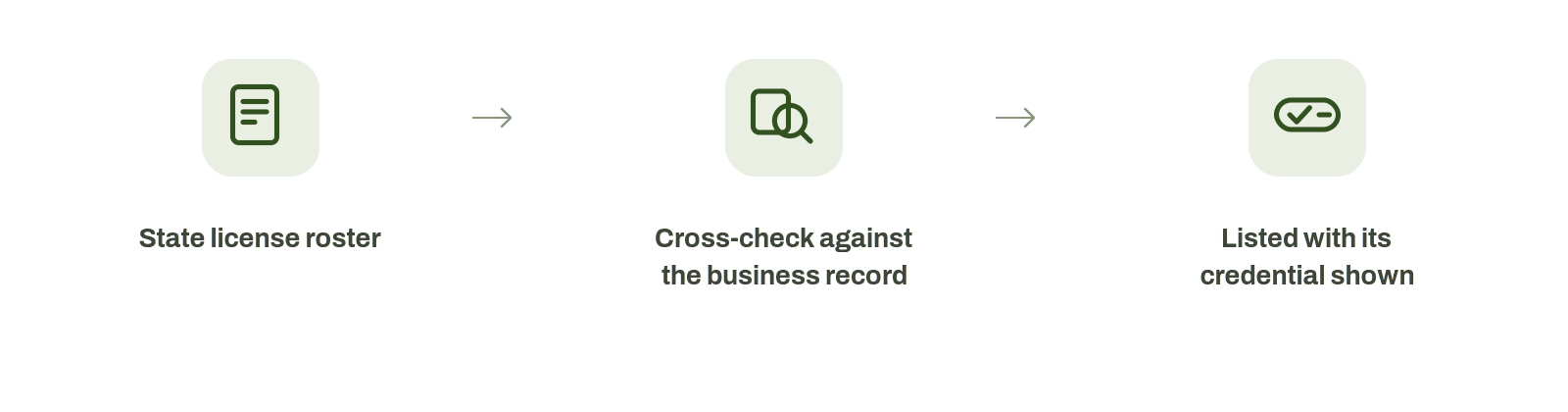
Texas: Every license-verified listing is matched to a current TCEQ license: type, number and status, with a link to the state registry on the provider’s profile. Pumping and hauling businesses hold a TCEQ sludge transporter registration (30 TAC Chapter 312) instead, and we match and label those as registered, never as licensed.
Ohio: Ohio issues no statewide installer license. Contractors register with each health district and carry a surety bond filed with ODH, so we verify against the published ODH bonding lists and say so plainly.
Pennsylvania: Pennsylvania issues no installer license. The strongest public credential is DEP septage hauler registration; home improvement contractor registration and PSMA certification are labeled as what they are.
Minnesota: Every listing is matched to a current MPCA SSTS business license: number, status and specialty areas, with a link to the state registry on the provider’s profile. Minnesota licenses require a surety bond, liability insurance and a state-certified individual.
Tennessee: Tennessee issues no septic license. TDEC permits installers and septic tank pumping contractors directly, statewide: an installer passes a written exam, pays for the conventional permit and for each alternative system type, and renews every December 31. We match each listing to a current permit — number, type and status — and call it a permit, because that is what it is.
Alabama: Alabama licenses the people who do septic work, not the companies: the Alabama Onsite Wastewater Board issues installer, pumper and portable toilet licenses to individuals, and a firm may only trade through a licensed person in responsible charge (Ala. Code § 34-21A-12(e), (h)). Working without one is a Class A misdemeanor (§ 34-21A-25(a)). Every license is bonded — at least $15,000, or $30,000 at advanced level (§ 34-21A-16) — and expires every December 31. We match each listing to the current AOWB license records behind it: number, type and status.
Missouri: Missouri registers the person who installs a septic system, not the company: DHSS issues basic and advanced OWTS installer registrations to individuals under 19 CSR 20-3.080, each gated on a department course scored seventy percent or better, running thirty-six months, renewed on continuing education, and revocable after an unannounced on-site audit. It is a registration and not a license — Missouri’s septic license goes to the inspector who evaluates an existing system at a house sale, under a separate rule — and it carries no bond and no insurance requirement. We match each listing to the DHSS roster: number, class and expiry date. Where a registration has run out we say so, and the listing loses its badge.
We pull each roster from the state, match listings to it, and publish what we matched — number, class or list, and status — with a link to the state’s own lookup. That last part is the point. We are not asking you to trust our badge. We are handing you the primary record:
- Texas — TCEQ public registry ↗
Listings carry the edition we read: Jul 30, 2026 – Sep 27, 2026. - Ohio — ODH contractor bonding lists ↗
Listings carry the edition we read: August 2, 2026. - Pennsylvania — PA DEP septage hauler registry ↗
Listings carry the edition we read: April 17, 2024. That is the newest edition DEP publishes — re-checked September 8, 2026. - Minnesota — MPCA SSTS licensed business search ↗
Listings carry the edition we read: August 29, 2026. - Tennessee — TDEC active installer and pumper permit records ↗
Listings carry the edition we read: August 30, 2026. - Alabama — AOWB public license search ↗
Listings carry the edition we read: September 1, 2026. - Missouri — DHSS registered OWTS installers list ↗
Listings carry the edition we read: September 1, 2026.
What we do not verify — plainly
We check official state records. We do not vet, screen, approve, endorse, or recommend. Specifically, we do not check:
- Criminal background, of owners or employees
- Insurance coverage beyond what a state filing itself proves
- Complaint history, lawsuits, or BBB records
- Workmanship quality, or whether past customers were happy
- Pricing fairness
- Whether the credentialed individual is the person who will show up at your property
A current state credential means someone met that state’s requirements and the record was current when we last checked. That is meaningful. It is not a recommendation, and any site telling you otherwise is selling you something.
Our verification tiers
| Tier | What it means | How many, right now |
|---|---|---|
| Tier 1 — License-matched | Matched to a current state license record; type, number and status published on the card, with a link to the registry on the provider’s profile. | 3,096 |
| Tier 2 — Roster-matched | Matched to an official state roster that is not a license register — ODH contractor bonding lists in Ohio, PA DEP septage hauler registry in Pennsylvania, TDEC active installer and pumper permit records in Tennessee and DHSS registered OWTS installers list in Missouri. The listing says which list, and what it does and does not prove. | 9,714 |
| Tier 3 — Directory-sourced | Compiled from public sources, not yet matched to any state record. Labeled “Unverified” on the page, every time. | 459 |
Counts are live — they change as listings pass or fail verification, and a launch day for a new state moves them by thousands. Refreshed at most every 15 minutes.
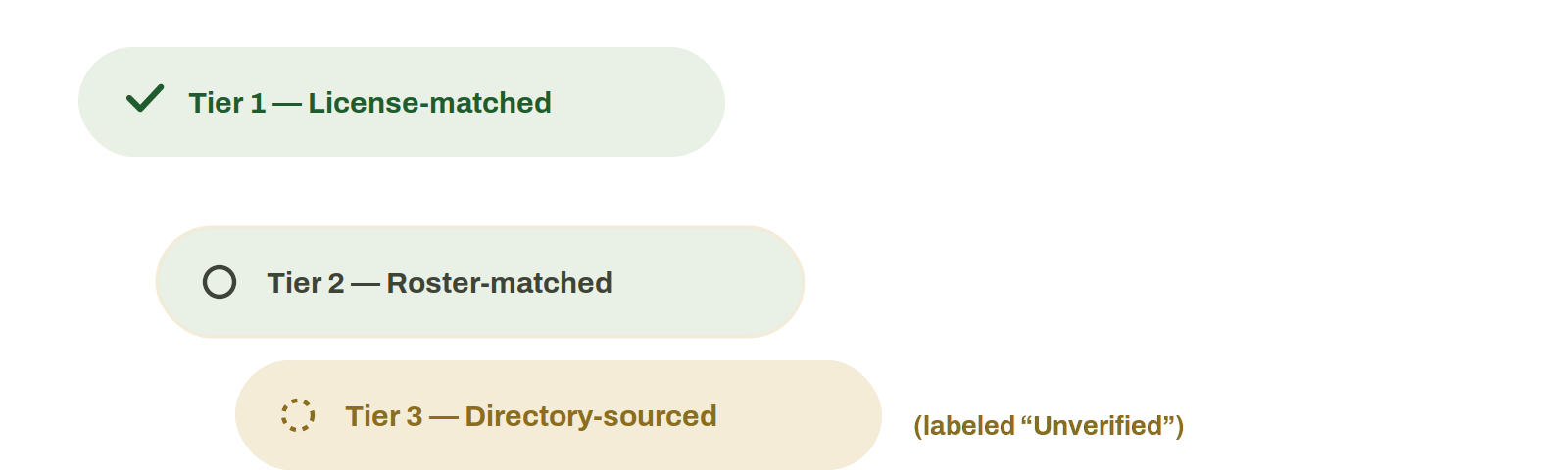
We launched Tier 1 first, because we would rather list fewer businesses than list unverified ones without saying so. Tier 2 exists because two of our states issue no septic license at all — there, the strongest official record is a bonding list or a registration, and we say exactly which rather than dressing it up as a license. Tier 3 listings carry the word “Unverified” in plain language — not a missing badge you have to notice.
Our data, by the numbers
- 18,335 credential holders tracked across Texas, Ohio, Pennsylvania, Minnesota, Tennessee, Alabama and Missouri, refreshed on a schedule from TCEQ public registry in Texas, ODH contractor bonding lists in Ohio, PA DEP septage hauler registry in Pennsylvania, MPCA SSTS licensed business search in Minnesota, TDEC active installer and pumper permit records in Tennessee, AOWB public license search in Alabama and DHSS registered OWTS installers list in Missouri
- 3,096 listings matched to a current state license, and 9,714 to an official state roster
- 773 county pages, each with its actual permitting authority, phone, and local rules
- 10 years of Texas county permit data (2015–2024), reconciled to TCEQ’s published statewide totals — 42,097 septic systems authorized statewide in 2024, the denominator behind our Texas county statistics
Live counts, refreshed within 15 minutes of any change; the same figures as the list above.
Where our data is thin — the part nobody publishes
A directory’s coverage map is the most useful thing it can tell you, and the least flattering. Ours:
- Verified listings cluster. Many counties currently have no verified provider on this site. If yours is one of them, the county page still gives you the permitting office, the local rules, and the ground conditions — and says plainly that we have no verified provider to hand you, instead of padding the page with names we haven’t checked.
- Rural Texas is served from elsewhere. 34 of 254 Texas counties have no OSSF license holder with a mailing address in the county at all. Whoever services those systems drives in. That is a fact about rural Texas, not a gap in our records, but it shapes what we can show you.
- 49 Texas counties have no local authorized agent — permitting runs through a TCEQ regional office instead. We label those rather than inventing a local contact.
- Contact details are the scarcest data we handle. State records prove a credential; they mostly do not come with a phone number we’re permitted to publish. Where a state restricts contact-data release, that restriction binds every directory equally, whatever their listing counts imply. We publish what we may, and we verify the rest by contacting businesses directly.
- A record check is a point-in-time check. Credentials lapse between our refreshes. Every profile shows the date we last checked it. If that date is stale, treat it as stale.
How we handle numbers in our writing
Three rules, applied to every article and county page:
- Every figure is attributed and dated where it appears — not just in a footer. If we say a pump-out runs $267 to $650, the sentence names the sources those endpoints came from and when they were published.
- We never blend sources into a tidy average. If two sources disagree, we publish the range and cite both.
- When no trustworthy figure exists, we say so instead of estimating. An honest gap is more useful than a confident guess.
We do not cite surveys we haven’t run. If you ever see “according to our data” on this site, the underlying dataset and method are named on the same page.
How we make money
Nearby Septic is free to read. We intend to earn revenue by connecting homeowners with providers — quote requests routed to septic companies — and, in time, from optional enhanced listings.
What money does not buy: verification status, tier assignment, or a favorable write-up. A tier is a factual state — either a listing matches a current state record or it doesn’t — and payment cannot move a listing into it. If we ever accept paid placement, it will be labeled as paid placement on the page where it appears. Our county editorial and cost research are written from public records, not from provider input.
Corrections and disputes
We will get things wrong. When we do, we want it in writing and we want to fix it.
- Homeowners: if a fee, phone number, rule, or figure on this site is wrong, email corrections@nearbyseptic.com. We publish corrections with the date and the specific error — not a silent edit.
- Providers: if your listing is inaccurate, or you want it removed, email corrections@nearbyseptic.com from a business address or call the number on your listing. We respond within five business days. Removal requests are honored; we do not hold listings hostage.
- County offices: if we have misstated your rules, fees, or jurisdiction, we will correct it and cite you. That is the whole point.
What we are still building
Publishing this page early means publishing it incomplete. Currently missing, and honestly labeled as such: phone verification as a distinct signal on listings, permit guides for most counties, a published sampling audit of our record-match accuracy, and per-county data-confidence grades. We would rather show you the roadmap than imply the work is done.
Questions about this methodology: hello@nearbyseptic.com. What we do with your information is a separate document — see our privacy policy.
Get free quotes from verified septic pros.
Pumping, an inspection, or help fixing a septic system: tell us once and we send it to up to 3 verified pros. Free, no spam, delete your request anytime.
Secure form. Sent over an encrypted connection to up to 3 verified pros. Never sold to data brokers, and you can have your request deleted anytime.