Aerobic Septic Systems & Maintenance
Texas law requires aerobic septic inspections and reports every four months. The 30 TAC 285 obligations, chlorine rules, and honest costs.
What an aerobic system is
An aerobic treatment unit (ATU) is a miniature sewage plant in your yard: it injects air so oxygen-breathing bacteria treat the wastewater, then usually disinfects it and sprays it on your lawn. The treatment train runs from a trash tank to an aeration chamber, then a clarifier, a chlorine or UV disinfection unit, and a pump tank feeding spray heads or drip lines (Texas A&M AgriLife Extension, B-6234). Most residential units are sized around 500 gallons per day.
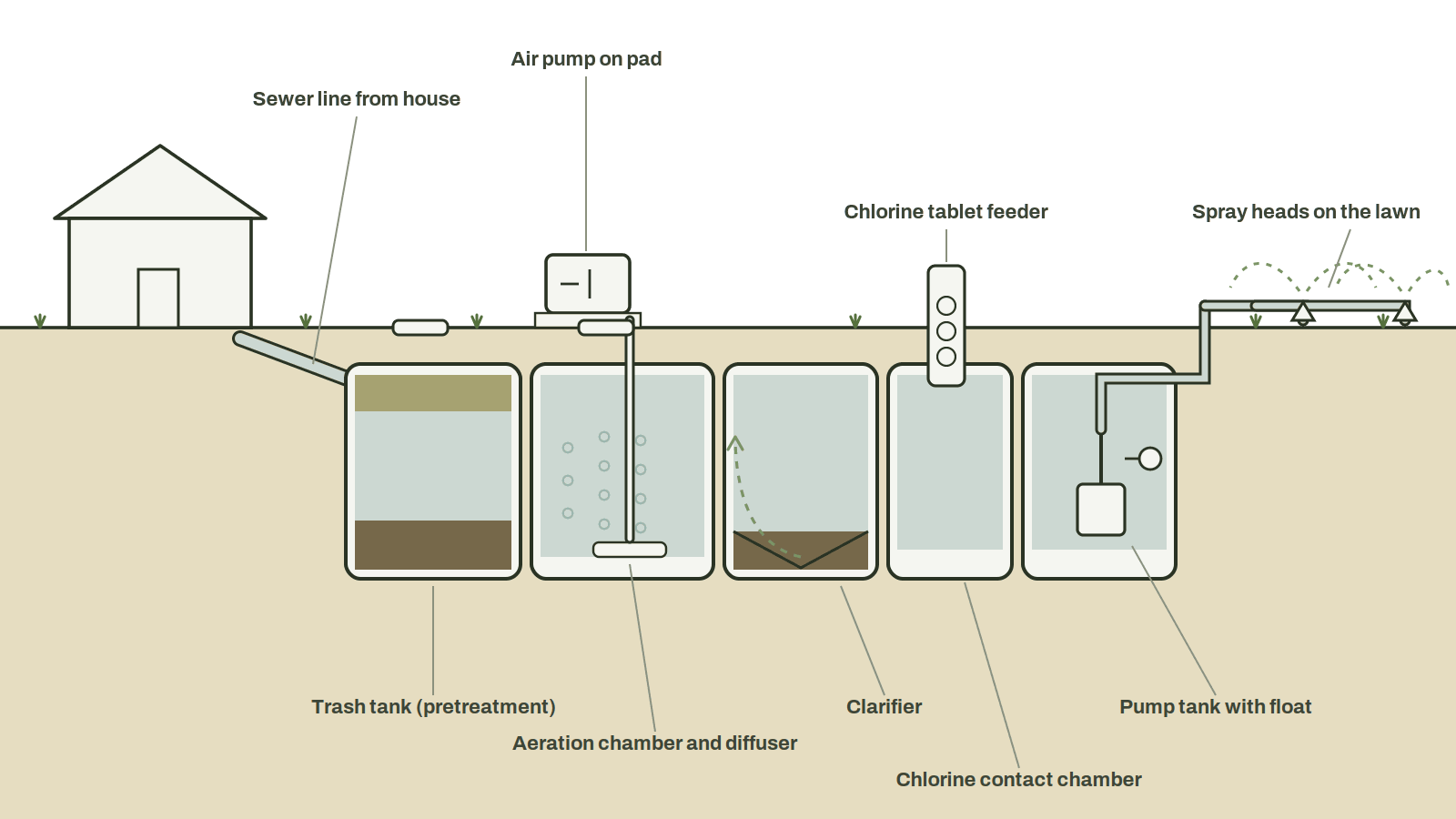
Texas counties push new construction toward ATUs because they work where conventional drainfields cannot: small lots, clay or other poor soils, high water tables, and land near sensitive water bodies (EPA). The trade-off is mechanical: compressors, pumps, and disinfection all need tending, which is why Texas attached a legal maintenance schedule to these systems.
Your maintenance obligation under Texas law
Texas requires every aerobic system to be inspected, tested, and reported on to the permitting authority at least once every four months — a legal duty that never expires, though after the first two years you may do the work yourself. Per TCEQ, for the first two years after installation the system is maintained under its initial service arrangement; after that, you either keep a contract with a TCEQ-licensed Maintenance Provider or take over the inspections, testing, and reporting personally. Some counties are stricter — a few require homeowner training or prohibit self-maintenance outright — so confirm local rules before dropping a contract.
A licensed provider must tag the system and mark the tag at every visit, inspect each component, run the tests required by 30 TAC 285.91(4), and file a report with the permitting authority and you at least every four months — stretched to six months only if the system has an electronic monitor that phones in failures. Reports are due within 14 days of testing. TCEQ also requires the contract itself to name who services your system, list what is covered, state a response time for complaints, and say who keeps the disinfection unit stocked. Note that TCEQ licenses individual providers, not companies, so verify the person’s license, not just the business name.
Self-maintainers face real enforcement. In counties of 40,000 or more people, a violation gives you 10 days to fix the problem or sign a maintenance contract; a second violation within three years forces a contract, with an administrative penalty of up to $100 (Texas Health & Safety Code §366.0515).
Inspections, chlorine, and the service calendar
Plan on three service visits a year, and keep the chlorinator stocked between them — with calcium hypochlorite tablets rated for wastewater, never pool tablets.
| Task | How often | Who |
|---|---|---|
| Inspection, testing, and report to permitting authority | At least every 4 months; every 6 months with an approved electronic monitor | Licensed Maintenance Provider, or you if self-maintaining |
| Chlorinator refill | No interval set in rule — tablets deplete with water use, so check between visits | Owner, unless the contract assigns it |
| Tank pump-out | No fixed schedule — based on sludge depth and manufacturer guidance (TCEQ) | TCEQ-registered sludge transporter |
Never put swimming-pool chlorine tablets in a septic chlorinator. TCEQ warns they dissolve too slowly to disinfect the effluent and can release an explosive gas when not fully submerged. Use only calcium hypochlorite tablets EPA-certified for wastewater — they kill 99 percent of bacteria within about 10 minutes.
Effluent needs roughly 30 to 60 minutes of chlorine contact time for typical strengths (Texas A&M AgriLife Extension). Treat the spray field as treated wastewater, not sprinkler water: keep people and pets off while it is wet, and never let it reach a vegetable garden — Texas rules prohibit that outright.
What aerobic maintenance costs
Honest answer: no Texas agency publishes maintenance-contract prices, and we have not verified a trustworthy statewide figure — so get two or three bids before signing anything. EPA’s often-quoted $250-to-$500 maintenance figure describes conventional-system upkeep over three to five years, not annual ATU contracts, so don’t let a salesperson borrow it. Your real annual cost stacks the contract fee, chlorine tablets, electricity for the compressor, occasional parts, and periodic pump-outs. We track what verified sources say in our cost guide, and you can request quotes from license-verified providers near you.
Texas rules
The controlling rules are 30 TAC Chapter 285 — §285.7 for maintenance duties and §285.91(4) for required testing — resting on Health and Safety Code §366.0515. The statute cuts both ways: a permitting authority may not condition a single-family aerobic permit on your signing a maintenance contract, but you must maintain the system either directly or by contract, and violations can force you into one. The full rule text is on the Texas Secretary of State’s TAC portal. On licensing: an Installer II puts these systems in the ground, a Maintenance Provider services them, and a Site Evaluator or professional engineer does the soil work first (TCEQ). Our Texas permit guide covers the county-level process, and our county pages list providers whose licenses we have checked.
Aerobic system questions, answered
The recurring obligations are where most Texas ATU owners get tripped up — here are the specifics.
Is a septic maintenance contract required in Texas?
Not statewide, after the first two years. TCEQ allows homeowners to take over aerobic maintenance two years after installation, and state law bars permitting authorities from conditioning a single-family aerobic permit on a contract. But some counties require training or prohibit self-maintenance, and documented violations can legally force you into a contract. Check your county’s order first.
How often does an aerobic septic system need to be inspected in Texas?
At least once every four months — three times a year — covering component checks, testing under 30 TAC 285.91(4), and a report to your permitting authority. The cycle stretches to every six months only if the system has an approved electronic monitor that automatically reports failures and tracks disinfection. This applies whether a licensed provider or the homeowner does the work.
Can I use pool chlorine tablets in my aerobic septic system?
No. TCEQ warns pool tablets (trichlor) dissolve too slowly to disinfect septic effluent and, because they sit partly out of water in a chlorinator, can release an explosive gas. They are not EPA-approved for wastewater. Buy calcium hypochlorite tablets labeled for wastewater disinfection, and store them outside the house and away from metal tools.
How often should an aerobic system be pumped out?
Texas sets no fixed interval. TCEQ says pump based on measured sludge depth and your manufacturer’s guidance — your four-month inspections are when sludge gets checked. Heavy organic loads accelerate the need: Texas A&M AgriLife notes a kitchen garbage disposal can shorten pump-out intervals by one to two years. Use a TCEQ-registered sludge transporter.
What does self-maintaining an aerobic system actually involve?
Inspecting the system about every four months, testing the effluent, keeping the chlorinator stocked, filing a report with your permitting authority after each inspection, and buying gear like a chlorine test kit and sludge sampler (Texas A&M AgriLife, B-6234). It saves the contract fee but carries health risks, legal deadlines, and penalties if reports lapse.
Do this work for a living?
- Credential-matched claim
- You control your profile
- Quote-request alerts
Get free quotes from verified septic pros.
Pumping, an inspection, or help fixing a septic system: tell us once and we send it to up to 3 verified pros. Free, no spam, delete your request anytime.
Secure form. Sent over an encrypted connection to up to 3 verified pros. Never sold to data brokers, and you can have your request deleted anytime.