New Septic System Cost in Ohio (2026)
No Ohio septic installer publishes a price list for new systems, so the only Ohio-specific numbers you can check yourself are the government ones. Across seven Ohio local health districts that publish their own fee schedules, the site review plus the installation permit for a new household sewage treatment system runs from $511 in Perry County to $1,472 in Wood County (schedules accessed August 21, 2026). For the construction itself, only national estimates carry dates: $3,589 to $12,463 with an $8,019 average (Angi, August 3, 2026), or $3,500 to $8,500 for a conventional system (HomeGuide, September 22, 2025).
The numbers behind this guide: Ohio permit plus site review for a new system: $511 (Perry County packet, dated 05/27/2026) to $1,472 (Wood County schedule, revised 02/22/2024). State’s share of every new installation permit: $74 (OAC 3701-29-05). Local health departments ODH surveyed in 2022-2023: 111. Systems counted by the 61 that answered: 499,358, of which 68,508 (14%) were failing (ODH report dated June 13, 2025). Conventional install, national estimates: $3,000 to $8,000 (Angi, Aug 2026) or $3,500 to $8,500 (HomeGuide, Sep 2025). Mound: $10,000 to $20,000 (Angi) or $25,000 to $50,000+ (HomeGuide).
What does a new septic system cost in Ohio?
Every Ohio installed-cost figure online traces back to a national dataset, so the number to start from is the permit. We searched for Ohio installers publishing new-system pricing on August 21, 2026 and found none. Septic pumping is different: two Ohio companies publish complete flat-rate lists (see our Ohio pumping cost guide). Installation gets quoted per site, because soil depth and bedroom count change the design. The dated national estimates, each on its own row rather than blended:
| Source (date) | Conventional | Mound | Aerobic / ATU | Whole project |
|---|---|---|---|---|
| Angi (Aug 3, 2026) | $3,000–$8,000 | $10,000–$20,000 | $10,000–$20,000 | $3,589–$12,463, avg $8,019 |
| HomeGuide (Sep 22, 2025) | $3,500–$8,500 | $25,000–$50,000+ | $20,000–$40,000+ | not stated |
| The Septic Guide (Apr 2026) | $5,000–$10,000 | $12,000–$25,000 (engineered) | $12,000–$25,000 (engineered) | not stated |
| SepticTankHub (Mar 2, 2026) | $7,000–$15,000 (3-bed) | $15,000–$25,000 (3-bed, hard soil) | +30–50% over conventional | $3,000–$25,000, avg $7,500 |
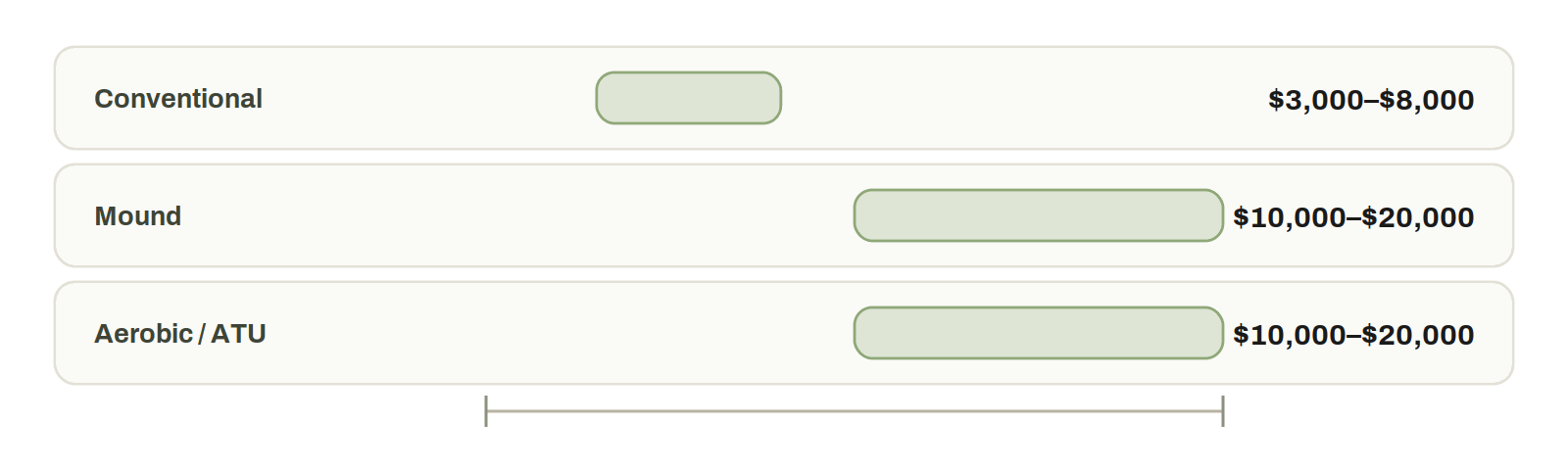
Look at the mound column: four sources, all updated within twelve months, and the ceiling moves from $20,000 to past $50,000. That is four methodologies, not a market signal. Use the table as a planning bracket, then get three quotes.
One metro estimate exists, with a caveat. Angi’s Columbus page puts septic tank replacement at $4,775 to $11,460, average $5,730 (updated August 4, 2026), and its Columbus land-utilities page puts installation at $3,240 to $10,980 (updated June 9, 2026). Both pages explain the method: a national average multiplied by a local price index from the Bureau of Economic Analysis Regional Price Parities. That is arithmetic, not Columbus quotes.
Cleveland, Cincinnati, Toledo, Dayton, Akron and Youngstown have no independent 2026 installed-price series at all. The absence is the finding.
Conventional, mound, or aerobic: what changes the price
The soil evaluation picks your system type, not your budget. Of 499,358 systems counted in ODH’s 2022-2023 survey, 214,369 (43%) were septic tank or pretreatment to leaching, 87,537 (17%) discharged off lot, and another 13% ran to sand filters (ODH report dated June 13, 2025).
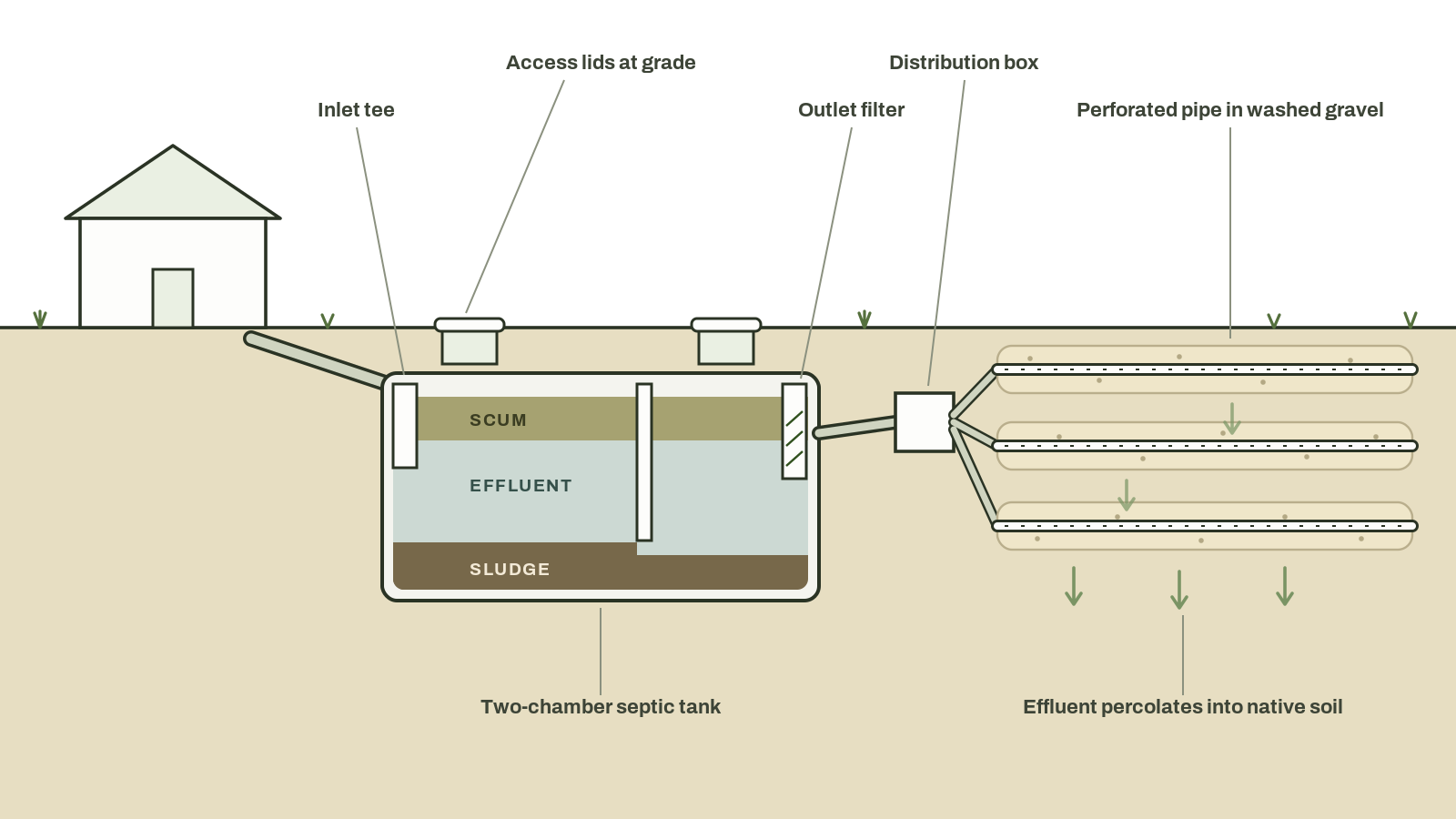
That inventory carries a buying signal most cost guides skip. In the same survey, mound systems had the lowest failure rate of any specified type, about 4%, against near 5% for leaching systems and roughly 26% for discharging ones. A mound is the expensive answer on paper and often the durable one in the ground.
Location matters just as much. ODH’s respondents reported 24% failure in both the northeast and northwest districts, against 3% in central, 4% in southwest and 6% in southeast Ohio. The report blames flat topography and a shallow seasonal water table, the conditions that push a design away from a simple leach field toward a mound or a pretreatment unit. Northeast Ohio buyers should budget for an engineered system before the soil report lands.
Ohio septic permit fees by health district (2026)
Ohio permit costs are set district by district, and the published spread is nearly three to one. Every figure below comes from that district’s own fee schedule or packet, checked August 21, 2026. The total column adds the site review to the installation permit, because Ohio requires both before anyone digs.
| Health district | Site review / evaluation | Installation permit | Total to permit (new) | Schedule date |
|---|---|---|---|---|
| Perry County Health Dept | $204 | $307 | $511 | packet dated 05/27/2026 |
| Mahoning County Public Health | $275 new / $225 replacement | $624 | $899 | 2026 schedule, sewage fees eff. 01/01/17 |
| Butler County General Health District | $425 | $569 (new or replacement) | $994 | effective Jan 1, 2026 |
| Marion Public Health | $300 site + $100 design review | $624 ($550 local + $74 state) | $1,024 | 2026 schedule |
| Summit County Public Health | $525 new / $200 replacement site review; $0 soil evaluation | $550 ($476 local + $74 state) | $1,075 | 2026 approved schedule |
| Delaware Public Health District | bundled into the permit | $1,264 new / $1,114 replacement | $1,264 | 2025 fee sheet; no 2026 sheet posted |
| Wood County Health Dept | $728 new / $478 replacement | $744 (install plus O&M) | $1,472 | revised 02/22/2024 |
Operation permits sit on top and vary as widely: $30 every two years for a Summit County leaching system, $40 to $125 by system level in Mahoning County, $500 in Marion County, and in Butler County $25 a year for a discharging unit or $40 for a ten-year non-discharging permit.
For contrast, SepticTankHub’s Ohio page tells readers to expect “$200-400 for new installations” in county permit fees. Not one of the seven schedules above lands inside that band. Angi’s national $450 to $2,300 is wide enough to contain the real Ohio numbers but cannot say which end fits your address.
Cost by county is really cost by district
Ohio has no single county rate, because one county can contain more than one health district, each setting its own fees. Statute puts the rules in ODH’s hands under ORC 3718 and OAC 3701-29, effective January 1, 2015, and leaves the money question to the districts, which may also set stricter standards. Its 2022-2023 survey went to 111 local health departments, city and county alike.
The mechanism is in the rule. OAC 3701-29-05 directs that “boards of health of city or general health districts shall establish fees in accordance with section 3709.09 of the Revised Code,” then adds a fixed state portion, which is why the Summit and Marion County schedules both show a $74 state fee line inside the permit price.
National cost guides never reach this part. Franklin County is served by Franklin County Public Health, while the City of Columbus runs its own program through Columbus Public Health at separate fees: $150 for a system evaluation, $150 for an abandonment, $150 per new lot for a lot split review, and a $110 contractor licensing fee. Columbus asks applicants to confirm jurisdiction by phone before it issues an application.
Cuyahoga County has the Cuyahoga County Board of Health alongside Cleveland’s health department; Montgomery County has Public Health – Dayton & Montgomery County alongside Oakwood. Two houses a mile apart can be permitted by two agencies at two prices. Find the district that permits the parcel before you price anything: our Ohio county pages name the district for each county, and the Franklin County page shows how a split county works.
What soil evaluation and site testing cost in Ohio
Ohio prices a soil evaluation, not a percolation test, which alone invalidates most of the testing figures on national cost pages. OAC 3701-29-07 requires a scaled site drawing with boring locations, soil profile descriptions written to NRCS standards for color, texture, structure and horizon depth, and identification of limiting conditions, from borings no deeper than 60 inches. Certified soil scientists may do the work, along with professionals under their supervision, registered sanitarians the board judges capable, and others the director of health approves. The owner keeps the right to hire an independent evaluator rather than the board.
The cost arrives in two layers:
- The soil scientist’s fee. OSU Extension fact sheet AEX-742 (Slater and Mancl, September 11, 2019) says the service “costs a few hundred dollars depending on the time needed to evaluate the site,” and points to the Association of Ohio Pedologists consultant list. It is the only Ohio-sourced figure we found, and at seven years old it is a floor, not a quote.
- The district’s review fee. That is the site-review column in the table above, $204 in Perry County to $728 in Wood County. Summit County splits that into two applications and prices them separately: Section 101.02(a), Application for Site Review, is $525 for a new system and $200 for a replacement, while Section 101.02(b), Application for Soil Evaluation, is $0. The district charges for reviewing the site, not for performing the soil work, which the private soil scientist bills.
National guides price a perc test at $250 to $700 (HomeGuide, September 2025), $300 to $1,500 (The Septic Guide, April 2026) or $700 to $2,000 (Angi, August 2026). Those numbers describe a different test than Ohio’s rule asks for.
SepTek Services in Miamisburg publishes 1 to 2 weeks for soil testing and site evaluation, 2 to 4 weeks for county permit review, 1 to 3 days of installation, and 4 to 8 weeks in total (published March 19, 2026). Wood County allows up to 30 days for site review alone. Perry County evaluations and Mahoning County site approvals stay valid five years, so one done before a lot purchase can still be current at build time.
Replacement versus new install: where the price really differs
Districts that price the two separately charge less to replace than to build new, and the gap sits in the site review rather than the permit. Summit County charges $525 for a new site review against $200 for a replacement, while the installation permit stays $550 either way. Wood County charges $728 for new construction against $478 for a replacement. Delaware Public Health District prices the whole package at $1,264 new against $1,114 replacement. Mahoning County charges $275 against $225. Butler County draws no distinction: $569 covers a new or replacement install permit.
The larger difference is regulatory: it decides what can be built. OAC 3701-29-08 is blunt: “no lot shall be created which requires a NPDES permit for a discharging STS.” A failing system on an existing home can still get one where the soil supports nothing else; a new lot has to work without one.
ODH’s 2025 report describes that permit as barring new discharging installations, which reads harsher than the permit does. Ohio EPA’s own page puts new and updated systems inside the general permit alongside replacements, and makes one category ineligible: “HSTS discharge proposals from newly created lots.” The bar falls on the lot, not on the system.
If a discharging system is the answer, price its ongoing obligations. Ohio EPA’s household general permit OHK000004 runs January 1, 2022 through December 31, 2026, carries a $200 application fee at the notice of intent, and requires annual diagnostic sampling plus a maintenance contract with a trained service provider.
Replacement also unlocks money new construction does not. Ohio EPA’s Water Pollution Control Loan Fund pays 100%, 85% or 50% of eligible costs for households at or below 100%, 200% and 300% of the federal poverty guidelines, and the final PY2026 program plan, dated January 22, 2026, allows a local health district “up to $150,000 to repair/replace failing HSTS,” with additional funding of “up to $100,000” allocated for connecting homes to sewer and for assisting more low-income homeowners. Districts may use 100% of that additional funding for sewer connections. Since 2016, Ohio EPA reports over $112 million awarded to local health districts and more than 5,800 systems repaired or replaced, unchanged when we checked on August 23, 2026. Date that page carefully: it carries a July 12, 2021 byline, but both of its data tables are stamped “as of July 31, 2025,” and the funding table’s last full row is 2025, at $10,150,000 across 79 health districts. The byline is the article’s, not the data’s. We are not dividing those figures into an average system cost, because the same money covers sewer laterals and administration.
What to ask before you sign an installation contract
Ohio issues no statewide septic contractor license, so verification means checking two records, not one. ODH’s contractor page requires installers, service providers and septage haulers to carry a statewide surety bond filed with ODH, and separately “requires the registration of sewage treatment system installers, service providers and septage haulers with each local health district where they perform work.” Service providers and septage haulers bond at $25,000. ODH publishes bond lists and posted 2026 bond form packages for each category. Each list is a dated file rather than a headline count: the current installer list is titled 2026 Multiple Systems Installer Bonding List 8-14-26, and ODH publishes no total.
Four questions worth asking before signing:
- Which district registers you for this address, and is your ODH bond current?
- Does the quote include the district’s site review and installation permit, or are those billed separately?
- Which system type does the soil evaluation call for, and what does the design cost?
- Is the 12-month follow-up covered? Butler County’s $569 permit includes two inspections and a 12-month follow-up, and Wood County schedules a maintenance inspection within 12 months of final approval.
Skipping the permit costs more: Mahoning County applies a 25% penalty when installation proceeds without one. Our cost calculator turns bedroom count into a planning range, and how we verify explains what gets checked before a company appears on a Nearby Septic page.
FAQs
How much does it cost to have a septic system installed for a 3-bedroom house?
No Ohio installer publishes that number, and the dated national estimates for 2026 disagree by a factor of two. SepticTankHub puts a conventional three-bedroom system at $7,000 to $15,000 (March 2, 2026), Angi’s national whole-system range is $3,589 to $12,463 with an $8,019 average (August 3, 2026), and HomeGuide’s conventional range is $3,500 to $8,500 (September 22, 2025). Verifiable in Ohio: $511 to $1,472 in site review and permit fees across the seven district schedules checked here.
Do you need a permit for a septic system in Ohio?
Yes, and two separate approvals are normal. Under OAC 3701-29, districts require a site review or site evaluation first, then an installation permit before construction begins. Wood County’s published procedure runs soil evaluation, design, site review application, site inspection, permits, installation, final inspection, then a maintenance inspection within 12 months.
Who can install a septic system in Ohio?
A contractor who holds an ODH surety bond and is registered with the district issuing the permit. Ohio never created a statewide installer license. The bond is filed with the Ohio Department of Health, which publishes bond lists, while registration happens separately in each district where the contractor works. Registration in one district does not carry to the next.
Why are Ohio septic permit fees so different from one county to the next?
Because each board of health sets its own fees under OAC 3701-29-05 and ORC 3709.09, with only the $74 state portion in common. That is how Perry County reaches $511 for site evaluation plus permit while Wood County reaches $1,472. One county can also hold several districts, so the answer follows the parcel, not the county line.
Sources & Methodology
Every dollar in the fee table is transcribed from the issuing district’s own document, dated in that table: Butler County General Health District, Summit County Public Health, Marion Public Health, Perry County Health Department, Wood County Health Department, Delaware Public Health District, Mahoning County Public Health and Columbus Public Health. Regulatory statements cite ORC 3718, OAC 3701-29-05, -07 and -08, ODH’s sewage treatment systems and contractor pages, and Ohio EPA’s general permit OHK000004.
Prevalence and failure figures come from ODH’s Household Sewage Treatment System Failures in Ohio, reporting the 2022-2023 survey, PDF dated June 13, 2025 and posted June 23, 2025. Sixty-one of 111 local health departments answered, so the survey samples Ohio rather than counting it, and ODH notes districts differ on what they call a failure. Installed-cost figures are national estimates from Angi, HomeGuide, The Septic Guide and SepticTankHub. Each keeps its own update date and its own row, and none is combined with another. Access date for every source: August 21, 2026.
Septic company? Claim your free listing.
- Credential-matched claim
- You control your profile
- Quote-request alerts
Get free quotes from verified septic companies.
Pumping, an inspection, or help fixing a septic system: tell us once and we send it to up to 3 verified septic companies. Free, no spam, delete your request anytime.
Secure form. Sent over an encrypted connection to up to 3 verified septic companies. Never sold to data brokers, and you can have your request deleted anytime.