Septic System Installation
How septic installation works in Texas: soil evaluation, permits, licensed installers, final inspection, and honest guidance on cost.
When you need a new septic system
About one in five new Texas homes is built with its own septic system (Texas Water Resources Institute, 2026), and you’ll need an installation any time you build beyond the sewer line, replace a worn-out system, or add capacity a remodel demands. Systems age out on a fairly predictable clock: EPA advises planning an upgrade once a system passes 25 to 30 years, and TWRI puts full replacement between 15 and 40 years depending on tank material and water use. Adding bedrooms matters too, because Texas sizes systems by bedroom count and square footage — a bigger house can outgrow its permit.
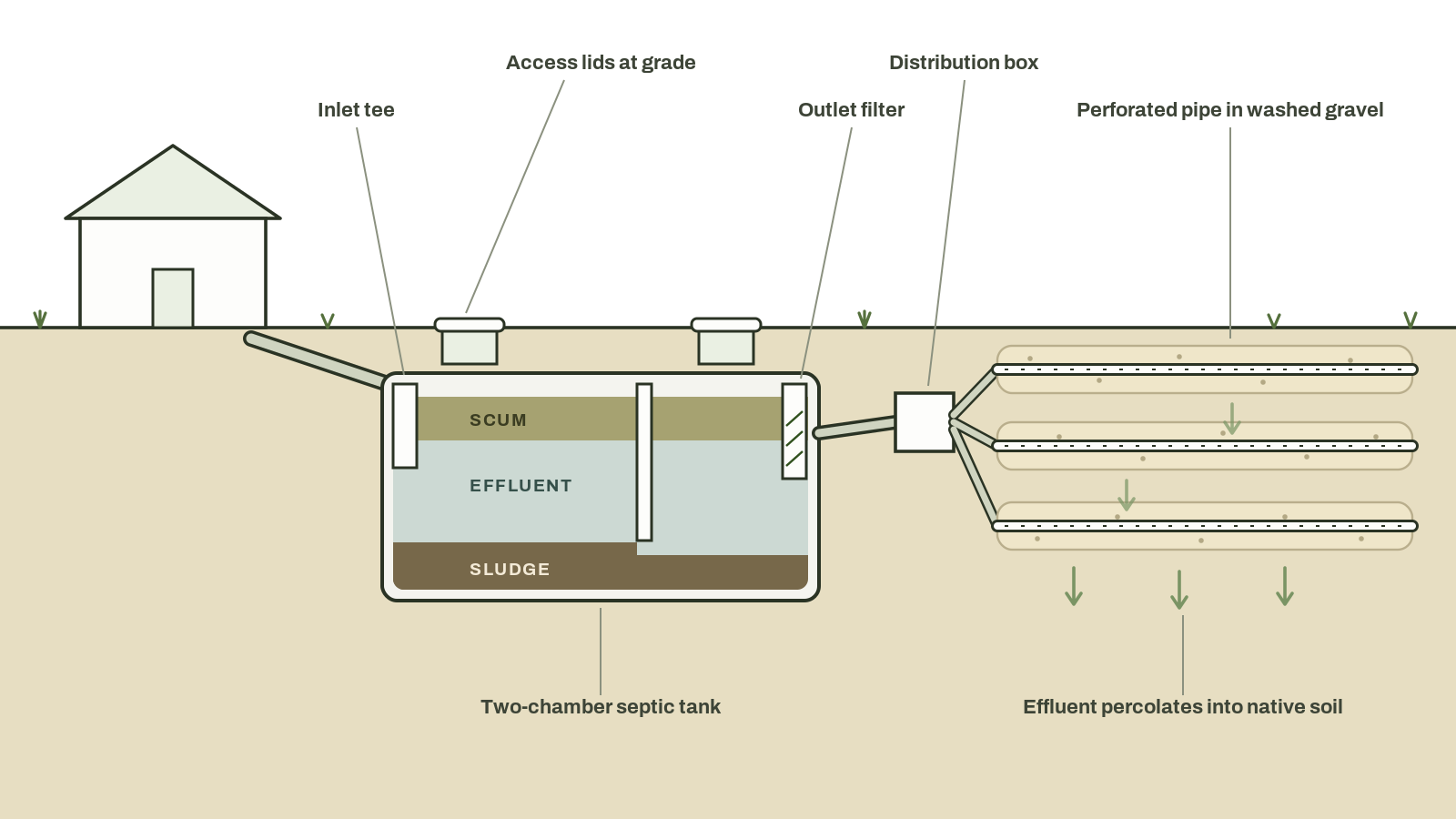
What gets installed depends on dirt, not preference. Sandy loam with room to spare may take a conventional tank and drainfield or a chamber system; tight clay, shallow rock, small lots, or high groundwater usually push you into an aerobic unit with spray or drip dispersal (EPA). The soil test decides — which is why Texas makes it the mandatory first step.
How installation happens, start to finish
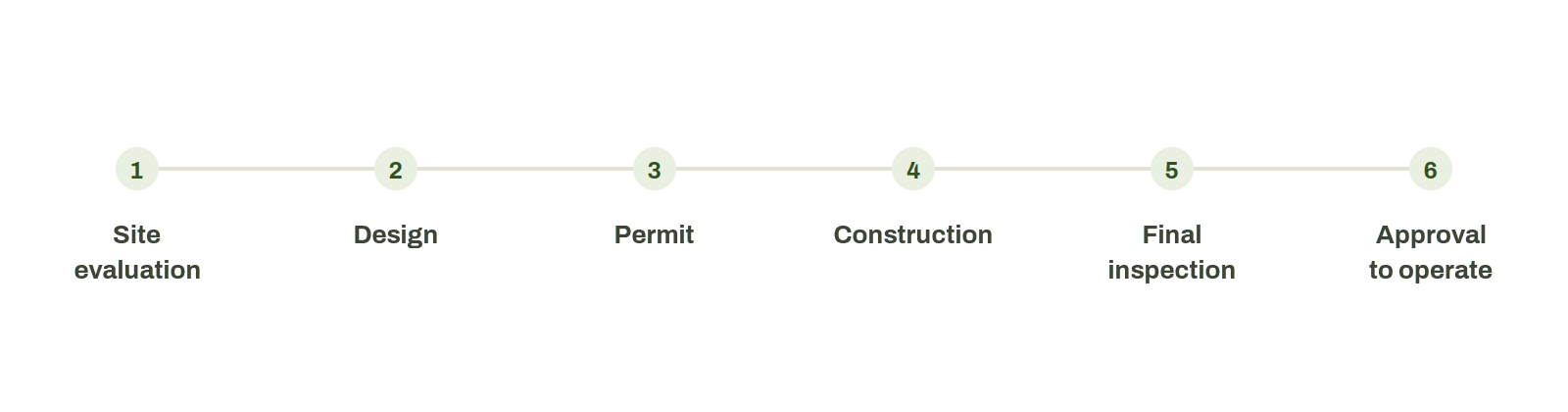
A legal Texas install follows a fixed sequence — site evaluation, design, permit, licensed construction, final inspection — and you may not use the system until the permitting authority approves it.
- Site evaluation. A TCEQ-licensed Site Evaluator or a professional engineer surveys the lot and analyzes soil in the proposed disposal area (TCEQ).
- Design and application. Planning materials go to your permitting authority — usually a county or other local “authorized agent,” or a TCEQ regional office where no local program exists. The authority must approve or deny within 30 days, and a denial must come with a written explanation you can appeal.
- Construction. The installer must notify the permitting authority before breaking ground (Health & Safety Code §366.054), then build to the approved plan.
- Inspection. The finished work is inspected before use — state law requires the inspection within two working days of the completion notice, and the system stays off-limits until approved (§§366.055–366.056).
- Paperwork. Keep the permit, the as-built drawing, and the soil report; every future buyer, repair crew, and pump truck will want them.
Who is allowed to do the work is licensed by class (TCEQ):
| Credential | Role on an installation |
|---|---|
| Site Evaluator (or Texas PE) | Preconstruction site evaluation: lot survey and soil analysis |
| Installer I | Standard systems: septic tanks, absorptive drainfields, unlined evapotranspiration drainfields, leaching chambers, gravel-less pipe, pumped-effluent drainfields |
| Installer II | Every system type, including aerobic and proprietary units |
| Designated Representative | Reviews applications and inspects the construction for the permitting authority |
What installation costs
No Texas agency publishes installation prices, and we haven’t verified a trustworthy statewide figure — so treat any “average septic cost” you read online as marketing until proven otherwise. The nearest verified anchor: EPA puts replacing a malfunctioning conventional system at $5,000 to $15,000, alternative systems higher (EPA, 2026). Your bid will move with system type (an aerobic unit with spray heads carries more equipment and lifetime maintenance than a gravity trench), soil quality, rock, lot access, and county permit and evaluation fees. We log verified figures in the cost guide as we confirm them, and the fastest way to a real number is quotes from license-verified installers on your actual site.
Texas rules
Health and Safety Code §366.051 makes it illegal to construct, alter, or operate a septic system without a permit and approved plan — with one narrow exception. The “10-acre rule” exempts a single-family home on a tract of 10 acres or more, but only if a licensed Site Evaluator or PE has evaluated the site, every part of the system sits at least 100 feet from the property lines, effluent stays on the property, and it’s the only dwelling on the tract (TCEQ). The system still has to meet 30 TAC 285 construction standards.
Texas also lets a homeowner install their own system — if the local permitting authority allows it, you own both home and property, nothing is being built for sale or lease, and all permit requirements are met. Anyone who helps must hold the right installer license, except a licensed electrician wiring components or a delivery driver setting tanks. Some proprietary units may only be installed by factory representatives. County programs can be stricter than the state minimums, so start with our Texas permit guide and find your county’s verified installers on our county pages.
Installation questions, answered
Permits and sizing generate the most confusion — here are the sourced answers.
Do I need a permit to install a septic system in Texas?
Almost always yes — state law requires a permit and approved plan before construction. The exception is a single-family home on 10+ acres with a completed site evaluation, all components 100 feet from property lines, effluent kept on-site, and no second dwelling. Even then, construction standards still apply, and your county can require more.
Can I install my own septic system in Texas?
Yes, if your local permitting authority allows it and you own the home and land, nothing is for sale or lease, and you meet every permit and construction requirement. Anyone assisting must be a licensed installer, apart from licensed electricians and tank-delivery drivers. Some aerobic and proprietary units can only be installed by factory representatives.
How long does septic permitting take in Texas?
The permitting authority must approve or deny your application within 30 days of receiving it, with a written explanation and an appeal path if denied. After construction, the final inspection must happen within two working days of your completion notice. The slow parts are usually scheduling the site evaluation and the installer, not the legal clocks.
What size septic system does my house need?
Texas sizes systems by bedroom count and square footage, whichever demands more — Texas A&M AgriLife notes most residential aerobic units are rated around 500 gallons per day. Conventional drainfield sizing rides on the soil analysis. Your site evaluator and designer set the final numbers, which is why the soil test comes before any equipment quote.
Who is licensed to install a septic system in Texas?
A TCEQ-licensed Installer I may build standard systems — septic tanks with absorptive drainfields, leaching chambers, gravel-less pipe, unlined evapotranspiration beds, and pumped-effluent drainfields. Aerobic and proprietary systems require an Installer II, who may install anything. Verify the individual’s license class before signing; every pro in our directory is listed with credentials checked.
Do this work for a living?
- Credential-matched claim
- You control your profile
- Quote-request alerts
Get free quotes from verified septic pros.
Pumping, an inspection, or help fixing a septic system: tell us once and we send it to up to 3 verified pros. Free, no spam, delete your request anytime.
Secure form. Sent over an encrypted connection to up to 3 verified pros. Never sold to data brokers, and you can have your request deleted anytime.