Septic Tank Risers
What tank risers do, PE vs PVC vs concrete, Texas's 2023 riser requirement, and why no one ever enters a septic tank.
What a septic tank riser is
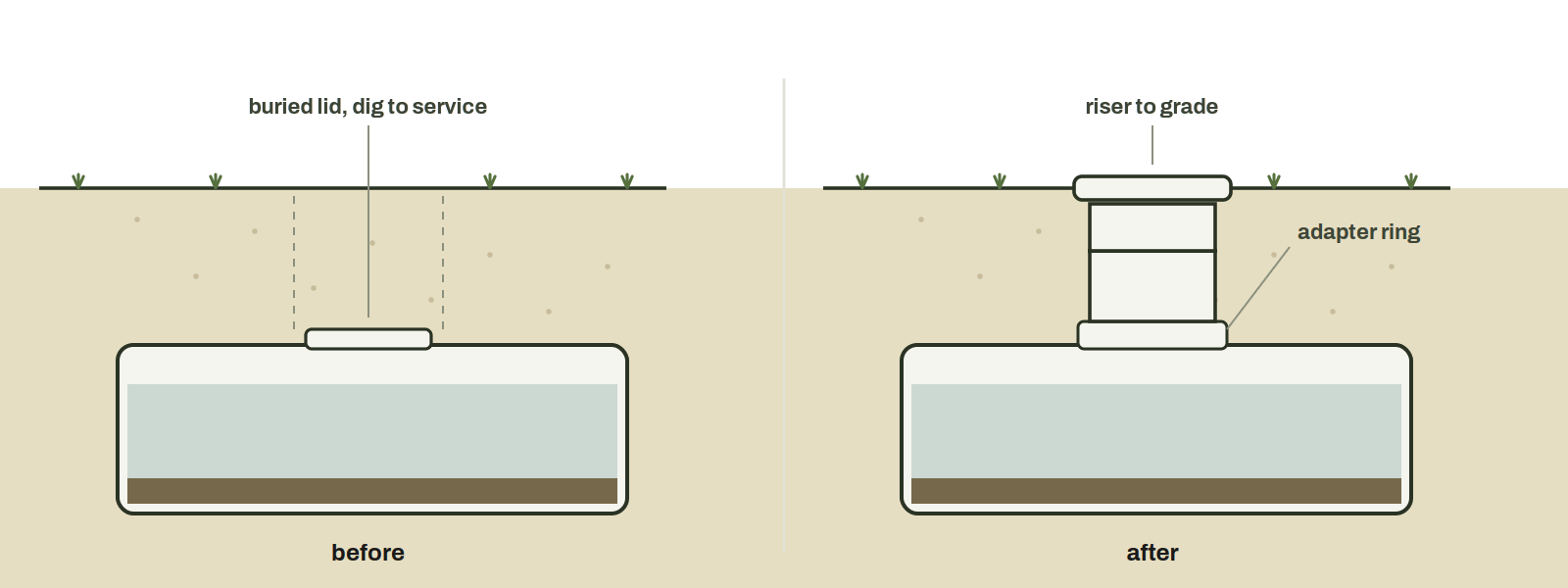
A riser is a watertight vertical collar that extends a septic tank’s buried access ports up to ground level, so servicing the tank means lifting a cap instead of digging a hole. Every Texas tank must have inspection or cleanout ports over its inlet and outlet devices, each at least 12 inches across at its smallest dimension — that’s 30 TAC 285.38(b). A riser sits on top of that port, sealed to the tank lid, with a removable secured cap at the surface. The rule requires the riser’s inside diameter to be at least as large as the port it covers.
Why retrofit a riser on an older tank
Because every inspection and every pump-out starts at the lids: the EPA recommends inspections every one to three years and pumping every three to five, and a riser takes the digging out of all of them. On older systems the lids may sit under a foot or more of soil, and locating them is half the service call. A riser fixes that permanently, makes it obvious where the tank is (useful when you sell), and brings an older tank up to the standard Texas now applies to new construction — every system permitted on or after September 1, 2023 must have risers. Aerobic systems have the strongest case of all, since TCEQ-required service happens as often as three times a year.
PE, PVC, or concrete
All three materials are acceptable in Texas provided the finished assembly is watertight, permanently fastened to the tank, secured against entry, UV-protected where exposed, and strong enough to resist soil pressure — 30 TAC 285.38(d) lists those requirements, not a material.
| Material | Character | Worth knowing |
|---|---|---|
| Polyethylene (PE) | Lightweight ribbed sections that stack to the depth you need | The common retrofit kit material; sections bolt or screw together with gasket seals |
| PVC | Rigid, smooth-walled pipe sections | Smooth interior sheds waste during pumping; typically the choice at smaller diameters |
| Concrete | Heavy cast rings matching older concrete tanks | Weight is a feature: a recessed cover of 65 pounds or more is one of the rule’s approved security measures on its own |
Whatever the material, sunlight-exposed risers and caps must have ultraviolet protection under the rule — worth checking on bargain kits.
How installation happens
A retrofit is a half-day excavation job with one step that matters more than the rest: the seal between riser and tank lid, which the rule says must be watertight.
- Locate and expose the tank’s ports, then clean the tank top around them
- Seal an adapter ring to the tank lid, sized to the port opening
- Stack and seal riser sections to reach grade
- Fit the secured cap — a padlock, a cover requiring tools, or a recessed 65-pound cover all satisfy 285.38
- On systems permitted since September 2023, add the required secondary plug or restraint beneath the cap
- Backfill and grade so surface water runs away from the riser
Who may do the work is spelled out in the rule: on a new system, riser installation is construction and belongs to a licensed installer. Retrofits on components installed on or after September 1, 2012 are treated as emergency repairs under 30 TAC 285.35 — a licensed installer, licensed Maintenance Provider, or registered Maintenance Technician may perform them, with written notice to the permitting authority within 72 hours. For tanks older than that, ask your county how it wants the work handled before anyone digs.
Safety: never enter a septic tank
No one goes into a septic tank, ever — not to retrieve a dropped tool, not to “take a quick look” — and the Texas riser rule is literally titled “Prevention of Unauthorized Access” because open and unsecured tanks kill. A tank is a confined space: low oxygen, toxic gases, and liquid you cannot climb out of. The rule’s secondary-restraint requirement exists precisely so that a damaged or removed cap doesn’t leave an open shaft. Two habits follow from it. Anyone who opens a secured lid must resecure it when done — that’s 285.38(g), and service reports must document it. And if a cap on your tank is cracked, loose, or missing, treat it as urgent: cap security is exactly the kind of fix the emergency-repair rule was written for.
What a riser costs
We haven’t verified a riser price from any government or university source, so we won’t print one — this is a market where quoted prices vary with tank depth, material, and how far the installer must travel. Depth is the honest variable: a tank two feet down needs more riser sections than one six inches down. Our cost guides note where sourced figures exist, and you can request quotes from license-verified installers in your county through our Texas directory to see real numbers side by side.
Texas rules
Since September 1, 2023, every newly permitted Texas system must have risers extending at least two inches above grade, with a secondary plug or restraint below the cap — 30 TAC 285.38(c). The rest of the section sets the standing requirements: risers permanently fastened or cast into the tank with a watertight connection, removable watertight caps protected against intrusion (padlock, tool-removable cover, 65-pound recessed cover, or another approved method), UV protection where exposed, and enough strength to withstand soil pressure. Retrofit work runs through the emergency-repair process in 285.35, including the 72-hour written notice. Your county’s permitting contacts are in our permit guides.
Septic riser questions
Start here: risers are mandatory on new Texas systems, optional but sensible on old ones.
Are septic tank risers required in Texas?
On systems permitted on or after September 1, 2023, yes — 30 TAC 285.38 requires risers extending at least two inches above grade. The rule doesn’t force retrofits on older systems, though some counties set their own conditions when a system is repaired or altered, so confirm with your permitting authority.
Can I install a septic tank riser myself?
Texas assigns riser work to licensed people: a licensed installer on new systems, and an installer, Maintenance Provider, or Maintenance Technician for retrofits on components installed since September 2012, with 72-hour notice to the county. For older tanks the rule is silent — ask your permitting office. Either way, an open tank is a life-safety hazard, not a casual weekend project.
Do septic tank risers smell?
A correctly installed riser shouldn’t. The rule requires watertight caps and a watertight seal to the tank, which also seals in odor. Persistent smell near a riser usually means a failed gasket or cracked cap — a cheap fix — or an odor source elsewhere, like a roof vent, which EPA notes is a common false alarm.
How tall should a septic riser be?
Tall enough to reach at least two inches above finished grade — that’s the standard Texas applies to newly permitted systems, and it’s the sensible retrofit target too. Above-grade termination keeps rain and mower debris out and makes the tank findable. Installers stack sections to match your tank depth exactly.
What keeps children out of a septic tank riser?
Three layers under Texas rules: a secured cap (padlock, tool-removable, or a 65-pound recessed cover), a secondary plug or restraint beneath the cap on newer systems in case the cap is damaged or removed, and the legal duty for anyone who opens a lid to resecure it. If any layer is missing on your tank, fix it now.
Do this work for a living?
- Credential-matched claim
- You control your profile
- Quote-request alerts
Get free quotes from verified septic pros.
Pumping, an inspection, or help fixing a septic system: tell us once and we send it to up to 3 verified pros. Free, no spam, delete your request anytime.
Secure form. Sent over an encrypted connection to up to 3 verified pros. Never sold to data brokers, and you can have your request deleted anytime.