Drain Field Repair Cost in Texas (2026)
Repairing a failing drain field in Texas costs $1,000 to $5,000 for the most common fixes, while replacing the field outright runs $5,000 to $20,000, per published 2026 pricing from Texas installers 1 Source Water Well & Septic (Montgomery County, updated April 2026) and Dillon Septic (Spring Branch, January 2026). The EPA’s 2026 guidance puts repair-or-replace costs for a malfunctioning conventional system at $5,000 to $15,000 and pegs a drain field’s service life at 25 to 30 years. The decision turns on one question: is the problem a part you can fix, or has the soil stopped accepting water?
| What | 2026 figure | Source (date) |
|---|---|---|
| Drain field repair, common fixes | $1,000–$5,000 | 1 Source, Magnolia TX (updated Apr 2026) |
| Full drain field replacement, Texas | $5,000–$20,000 | 1 Source (Apr 2026); Dillon Septic (Jan 2026) |
| EPA repair-or-replace, conventional system | $5,000–$15,000 | EPA septic maintenance page (updated Mar 2026) |
| Drain field service life | 25–30 years | EPA (2026) |
| Repair permit, verified county examples | $100 (Kerr) · $200 (Gillespie) | County fee schedules (2025) |
What Does Each Drain Field Fix Cost in Texas?
The price ladder runs from a few hundred dollars for line jetting to $20,000 or more for an aerobic conversion, and every rung below full replacement only pays off if the soil can still drain. Here is each fix with the best published figure and an honest note where no verified Texas price exists:
| Fix type | What it addresses | Published 2026 cost | Source (date) |
|---|---|---|---|
| Field line cleaning / jetting | Clogged or root-fouled laterals | $600–$1,100 national average; hydro-jetting $200–$1,400 | Angi (Jul 2026); HomeGuide (Dec 2025). No Texas-specific published figure; Texas providers quote per job |
| Soil fracturing / rejuvenation | Compacted soil, immature biomat sealing | $1,000–$5,000 national | HomeGuide (Dec 2025). No verified Texas price; Dillon Septic (Jan 2026) says these methods buy 1–3 years but publishes no rate |
| Pipe / solid line repair | Broken or crushed line between tank and field | $1,000–$4,000 | 1 Source, TX (Apr 2026) |
| Partial trench / section repair | One failed lateral or section | $1,000–$5,000 for section work; new leach lines $20–$45 per linear foot | 1 Source (Apr 2026); HomeGuide (Dec 2025) |
| Full replacement, conventional | Field-wide failure, mature biomat | $5,000–$20,000 in Texas; gravel trench $5,000–$10,000, chamber $8,000–$15,000 | 1 Source (Apr 2026); Dillon Septic (Jan 2026) |
| Aerobic conversion | Soil that fails modern criteria for any trench field | $12,000–$25,000 | Dillon Septic aerobic drain field (Jan 2026) |

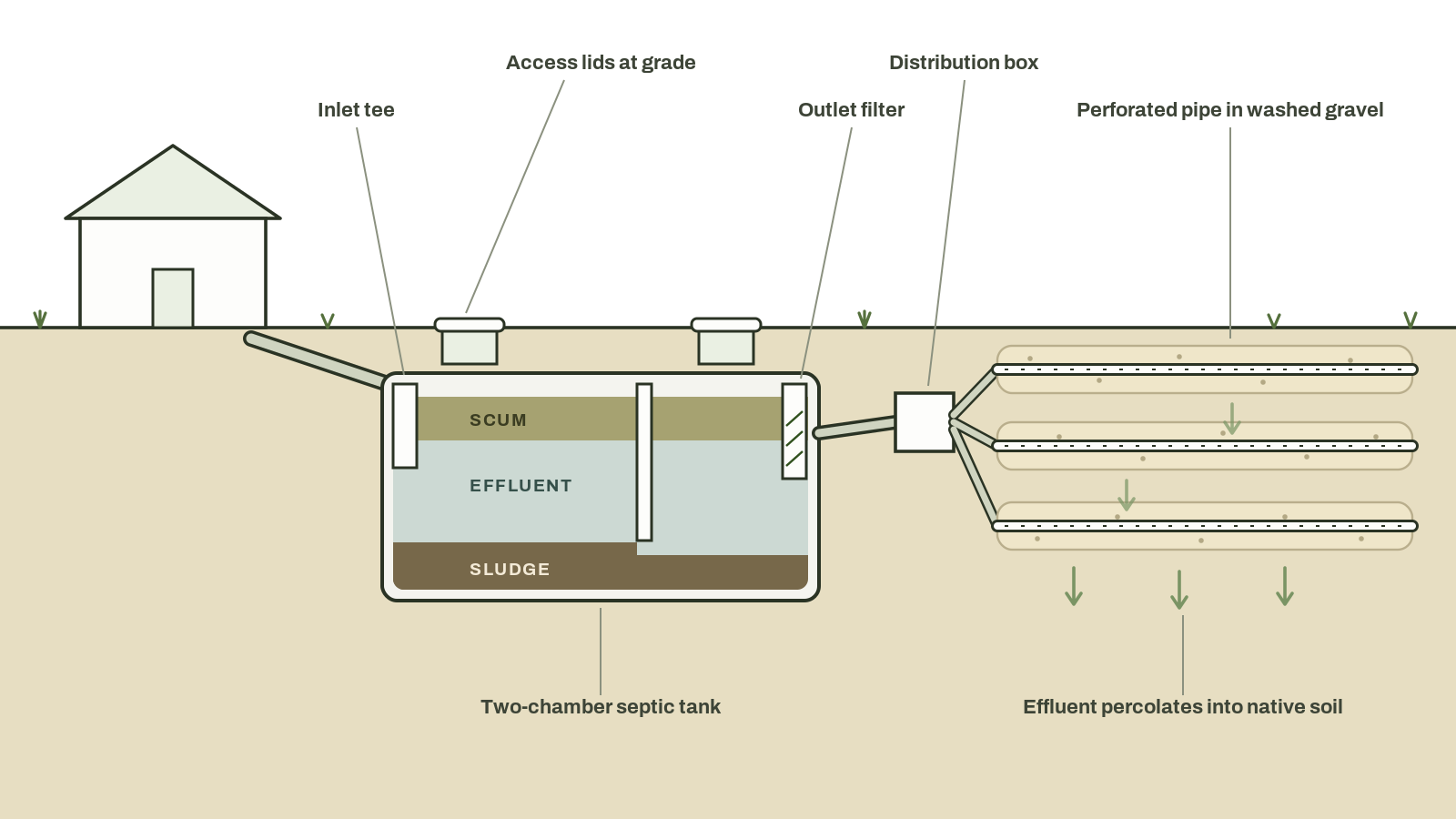
Before any of these, rule out the cheap mimics. A clogged effluent filter, a dead pump, or a broken baffle produces the same backups and soggy spots as a dying field. Baffle work runs $300 to $900 and an aerator pump $500 to $1,500 (1 Source, April 2026), a rounding error next to a new field. The EPA’s standard inspection covers exactly these items; insist on it before anyone quotes trenching. What fixing a septic system involves at each of those points, and which repairs may start before the permit arrives, is in our septic repair explainer. Our drain field repair directory lists Texas pros whose licenses we verify against the TCEQ registry.
Should You Repair or Replace the Drain Field?
Age matters more than the symptom: below about 15 years, a localized problem is usually repairable; past 25, the EPA itself recommends starting to plan for replacement, and in between the deciding factor is whether the biomat has sealed the soil. The biomat is the bacterial layer on trench bottoms; the EPA notes that past 25 to 30 years it thickens until effluent can no longer pass, which no jetting truck reverses for long.
| Field age | Localized symptom (one wet strip, slow drains after rain) | Field-wide symptom (surfacing sewage, backups in dry weather) |
|---|---|---|
| Under 15 years | Repair: jet the line, fix the pipe, patch the section | Check tank, filter, pump, and distribution box first; then partial repair |
| 15–25 years | Repair can work; get the biomat and soil assessed before paying | Get replacement bids; repeated repairs at this age often outspend them |
| 25–30+ years | Fix if trivial, but start replacement planning now (EPA guidance) | Replace; order the site evaluation and permit |


Four factors tip a borderline case toward replacement:
- Biomat maturity. Rejuvenation (fracturing, jetting, bacterial treatments) buys roughly 1 to 3 years on an aging field per Dillon Septic (January 2026); paying $5,000 for three years is a bad trade when replacement costs $10,000 and lasts 25.
- Compaction. Soil crushed by vehicles or construction traffic no longer accepts water, and the EPA warns the damage extends to the pipes. It is a soil problem; pipe-level fixes don’t touch it.
- Root intrusion. Cutting roots out of laterals is a legitimate repair, but if trees still stand over the field, the roots return. Factor removal into the math.
- What the failure did to the tank. A field that backed up for months often pushed solids downstream; price a pump-out and inspection before deciding.
Replacement is not always like-for-like, either. Texas clay and Hill Country rock fail to meet modern soil criteria so often that, in 2025, over half of systems authorized by county-level agents statewide used aerobic surface irrigation rather than trenches: 24,392 of 41,990 (TCEQ, “Types of Systems Installed by Time Period”, report dated 2026-04-27). If your soil evaluation comes back poor, your replacement may legally have to become an aerobic system.
What Drives Drain Field Costs in Texas?
Three local variables move a Texas drain field bid more than anything on the invoice: what your soil is, what your lot allows, and what your county charges.
Soil class. Sandy loam accepts a simple gravel trench at the bottom of the price range. Clay and shallow limestone need engineered dispersal: chambers, drip tubing, mounds, or a full aerobic conversion. Dillon Septic reports that poor percolation alone raises project costs by 30 to 50 percent, and its January 2026 price table ranges from $5,000 for gravel trenches to $30,000 for mound systems on exactly this variable. The soil evaluation, not the contractor, decides which column you are in.
Lot access and layout. Equipment that cannot reach the field adds labor hours, and a replacement field must respect setbacks from wells, property lines, and buildings; small or sloped lots can force costlier designs or relocation, priced at $5,500 to $21,500 nationally (HomeGuide, December 2025). Trees over the work area add removal costs.
County fees and process. Every repair or replacement flows through your county permitting office, and fees vary widely: Kerr County charges $100 for a repair permit (August 2025 schedule) while Gillespie County charges $200 (October 2025 schedule). That is far below the $450 to $2,000 permit-range cost guides for national average quotes, and one reason national averages mislead Texans. Replacement permits cost more because they require new planning materials and a site evaluation. Soil testing runs $600 to $2,000 per site, according to HomeGuide’s December 2025 data, and Dillon budgets $500 to $3,000 for permits plus engineering. County-by-county fees and forms live in our Texas permit guides.
What Are the Texas Rules for Drain Field Repairs?
Texas law requires a permit and an approved plan before you repair or alter a septic system, with one narrow emergency exception that does not cover drain field replacement. The rules that matter, all in 30 TAC Chapter 285:
- A permit is required to repair. Section 285.3(a) requires a permit and approved plan to “construct, alter, repair, extend, or operate” an on-site sewage facility, and TCEQ’s homeowner guidance repeats it: almost all OSSFs must have a permit before any repair. A contractor who says drain field work needs no paperwork is describing a violation, not a shortcut.
- The emergency-repair list is short. Section 285.35 allows immediate work only to abate “an immediate, serious and dangerous health hazard,” and only for listed tasks: replacing tank lids, inlet and outlet devices, risers and riser caps, disinfection devices, damaged drip tubing, and solid lines. Whoever performs the work must notify the permitting authority in writing within 72 hours of starting work, describing the methods and materials used. Trenching a new field is not on the list; it goes through the normal permitting process.
- Replacement means a site evaluation. Under 285.3(b), an authorization to construct requires planning materials and a site evaluation conducted in accordance with 285.30. A TCEQ-licensed Site Evaluator or professional engineer performs the evaluation, not the installer selling you the job. The permitting authority then has 30 days to approve or deny (285.3(c)).
- Installer I vs. Installer II. TCEQ licenses installers in two classes: Installer I covers conventional systems; Installer II covers all system types including aerobic units (Van Delden Wastewater Systems’ license guide; TCEQ). A conventional trench repair can be an Installer I job, but if your replacement becomes an aerobic conversion, verify Installer II before signing.
- The pre-1989 grandfather trap. Systems installed before September 1, 1989 are exempt from permitting only while the system “has not been altered, and does not need repair” (285.3(f)(1)). The moment your 1985 field fails, the exemption ends by its own terms: the repair must be permitted and built to current standards, and if the soil fails modern criteria, the county can require a different system type entirely. Owners of old unpermitted systems should budget for this cliff, not be surprised by it.
- Enforcement is real. After a complaint, TCEQ guidance typically allows an owner 30 days to make substantial progress before the authorized agent may file a criminal complaint with the local justice of the peace. A surfacing drain field is the classic trigger.
How Do You Vet a Drain Field Quote?
One rule filters out most bad bids: no diagnosis in writing, no deal. A trustworthy quote states what failed and how the contractor knows, before it prices anything. Work through this checklist:
- Demand the written diagnosis. It should state whether the tank was opened, the effluent filter was checked, the pump was verified, the distribution box was inspected, and the lines were probed or camera-inspected, mirroring the EPA’s inspection scope. “Your field is shot” from the driveway is a sales pitch, not a finding.
- Verify the license. Look up the company in TCEQ’s licensing search (www2.tceq.texas.gov/lic_dpa/index.cfm). Installer I is fine for conventional repairs; aerobic conversions need Installer II.
- Make the permit part of the quote. The bid should name the permitting authority, state who files, and pass the fee through transparently. Refusing to pull a repair permit violates 285.3(a) and leaves you with the legal risk.
- Get the emergency paper trail. If work starts under the 285.35 emergency provision, ask for a copy of the 72-hour written notice the contractor must file. No notice means the “emergency repair” was unpermitted.
- Collect three same-scope bids. Ranges this wide mostly reflect differences in scope; identical line items are the only fair comparison. Our cost guides provide the published baselines for negotiation.
- Treat miracle additives as a red flag. The EPA’s position: septic additives are unnecessary and can actually harm drain field performance. A contractor selling monthly enzyme treatments as a field cure is selling time, not treatment.
Drain Field Repair Cost FAQs
How much does drain field replacement cost in Texas?
Published Texas pricing puts full drain field replacement at $5,000 to $20,000, with conventional gravel trenches at the low end. Dillon Septic’s January 2026 table prices gravel trenches at $5,000 to $10,000, chamber systems at $8,000 to $15,000, drip distribution at $10,000 to $20,000, and mounds at $15,000 to $30,000; 1 Source’s April 2026 Texas range is $5,000 to $20,000 overall. If the whole system goes, see our new septic system cost guide.
Can a failing drain field be fixed without replacing it?
Sometimes: when the field is relatively young, and the cause is a clog, a broken pipe, or an upstream component, targeted fixes in the $600 to $5,000 range can restore function. When the cause is a mature biomat or compacted soil, rejuvenation buys roughly 1 to 3 years per Dillon Septic’s January 2026 assessment; on an old field, that money is usually better applied to replacement.
How long does a drain field last in Texas?
The EPA puts drain field service life at 25 to 30 years, and advises planning an upgrade once a system reaches that age. Published estimates vary; Dillon Septic’s 2026 table lists 20 to 30 years for conventional trenches, and national cost guides cluster around 20 to 25 years. Pumping the tank every 3 to 5 years is the single habit that pushes a field toward the long end.
Do I need a permit to repair a drain field in Texas?
Yes. 30 TAC 285.3(a) requires a permit and an approved plan to repair or alter a septic system, and repair permits in counties we’ve verified cost $100 to $200. The only exception is the 285.35 emergency list (lids, inlet/outlet devices, risers, disinfection devices, drip tubing, solid lines) to abate an immediate health hazard, and even then the permitting authority must receive written notice within 72 hours.
Can I repair my own drain field in Texas?
Only on your own single-family residence: TCEQ allows homeowners to do their own OSSF work, but the permit requirement still applies, and anyone you pay to help must hold a TCEQ license. Given the excavation, site-evaluation, and county-inspection requirements, most owners hire out anything beyond minor component swaps.
Why does my drain field pool water after heavy rain?
Rain saturates the soil the field depends on, so a marginal field shows standing water after storms before it fails outright. Texas clay holds that water longest. Divert gutters and surface runoff away from the field, and watch what happens in dry weather: per the EPA’s failure signs, ponding or spongy ground without rain means the field itself, not the weather, is the problem.
Sources & Methodology
Cost figures come from three kinds of sources, cited inline with dates: federal guidance (EPA’s septic maintenance and FAQ pages, updated March 11, 2026), published price lists from named Texas septic companies (1 Source Water Well & Septic of Magnolia, updated April 16, 2026; Dillon Septic of Spring Branch, published January 25, 2026), and national aggregator surveys (Angi, updated July 8–9, 2026; HomeGuide, December 22, 2025), which reflect their reported project data rather than Texas quotes. Where no verified Texas price exists (jetting and soil fracturing in particular), the table says so instead of inventing one. Regulatory statements cite 30 TAC 285.3 and 285.35 directly (via Cornell’s Legal Information Institute) as well as TCEQ’s homeowner guidance. County fees come from the Kerr (August 2025) and Gillespie (October 2025) schedules verified for our cost series. All sources accessed August 2, 2026. When Nearby Septic’s own Texas repair-price survey launches, these ranges will gain named local data.
Do this work for a living?
- Credential-matched claim
- You control your profile
- Quote-request alerts
Get free quotes from verified septic pros.
Pumping, an inspection, or help fixing a septic system: tell us once and we send it to up to 3 verified pros. Free, no spam, delete your request anytime.
Secure form. Sent over an encrypted connection to up to 3 verified pros. Never sold to data brokers, and you can have your request deleted anytime.