New Septic System Cost in Texas (2026)
A complete new septic system in Texas typically costs $8,500 to $14,000 installed, per 2026 published pricing from Central Texas installer Dillon Septic. Basic conventional systems start near $6,000, and aerobic systems run $9,000 to $20,000 across published 2026 price series. Metro averages from Angi’s 2026 customer cost data land inside that band: $6,720 in Dallas, $7,889 in Houston, $8,599 in Austin. What you’ll actually pay is decided less by the contractor than by your soil, which dictates the system type the county will approve.
| What | 2026 figure | Source (date) |
|---|---|---|
| Conventional gravity system, installed | $6,000–$10,000 | Dillon Septic, Central TX (Feb 2026) |
| Aerobic system, installed | $9,000–$20,000 | Span: Dillon Septic $9,000–$15,000 (Feb 2026); Angi $10,000–$20,000 (2026) |
| Metro install averages | Dallas $6,720 · Houston $7,889 · Austin $8,599 | Angi city cost pages (Feb 2026) |
| National average, all types | $8,023 (typical $3,591–$12,463) | Angi (2026) |
| New Texas systems permitted in 2025 | 43,165 statewide | TCEQ Historical OSSF Permitting Data index (page stamped 2026-05-14) |
What Does Each Type of Septic System Cost Installed?
Conventional gravity systems are the budget floor at $6,000–$10,000, aerobic units roughly double that, and engineered solutions for difficult ground (mounds, drip fields, low-pressure dosing) can reach $18,000–$25,000. These are complete-project ranges from a Central Texas installer’s published 2026 pricing, cross-checked against Angi’s national data where available.
| System type | Installed cost (2026) | Where it fits |
|---|---|---|
| Conventional gravity | $6,000–$10,000 (Dillon Septic) | Deep, well-draining sandy or loamy soil |
| Aerobic treatment unit (ATU) | $9,000–$15,000 (Dillon Septic); $10,000–$20,000 (Angi) | Clay soil, shallow rock, small lots (much of Texas) |
| Low-pressure dosing | $10,000–$18,000 (Dillon Septic) | Sloped or uneven sites, shallow soil over rock |
| Mound system | $15,000–$25,000 (Dillon Septic) | Insufficient soil depth or high water table |
| Replacement of a failed system | $9,000–$18,000 (Dillon Septic) | Includes removing old tank and lines |

Two real 2026 jobs show the spread better than any table. Dillon Septic reports an aerobic system with spray distribution near Canyon Lake, on rocky Hill Country ground, finishing at $13,400 including permits and inspections. In contrast, a gravity system on sandy soil near Johnson City came in at $7,200 and took three days. Same corner of Texas, $6,200 apart, and the difference was entirely underground before anyone showed up.
One caution when comparing quotes to internet averages: some published ranges include design, permits, and site work, while others don’t. Dillon’s figures above are for complete projects; Angi’s anaerobic “system cost” of $3,000–$8,000, for instance, covers the tank-and-leach-field package before accounting for some site costs. Always ask a bidder what’s inside the number.
Which System Will Your Land Require?
You don’t choose your septic system in Texas. A licensed site evaluator’s soil analysis does, and in 2025 the most common outcome statewide was an aerobic system with surface (spray) irrigation. TCEQ’s permitting data for 2025 shows 24,392 of the 41,990 systems authorized by county-level agents used surface irrigation (58.1 percent, our arithmetic on TCEQ’s counts), with leaching chambers (5,894), drip irrigation (3,767), and standard trenches (3,105) trailing well behind.
The pattern is regional, and it follows the dirt:
- Blackland Prairie and clay belts (DFW to San Antonio corridor): slow-draining clays routinely fail the soil criteria for conventional drain fields, pushing installs to aerobic-with-spray. Montgomery County alone authorized 1,837 systems in 2024, 1,435 of them surface irrigation (TCEQ).
- Hill Country limestone: shallow soil over rock rules out trenches on many sites; aerobic spray and drip dominate. In Comal County, 744 of 785 systems permitted in 2024 were surface irrigation or drip (TCEQ).
- Sandy East and Central Texas pockets: conventional still wins where soil is deep. Gillespie County split its 266 permits in 2024 almost evenly between chamber/trench systems (149) and spray/drip (111), because Pedernales River valley loams perc where the county’s limestone hills don’t (TCEQ).
The document that settles it is the site evaluation (soil borings, texture classification, restrictive horizons, groundwater), performed by a TCEQ-licensed Site Evaluator or professional engineer before your permit application. Budget for it as the first check you write (costs in the next section), and treat any installer who quotes a firm system price before the evaluation as a red flag. More on the test itself in our perc test guide.
Where Does the Money Actually Go?
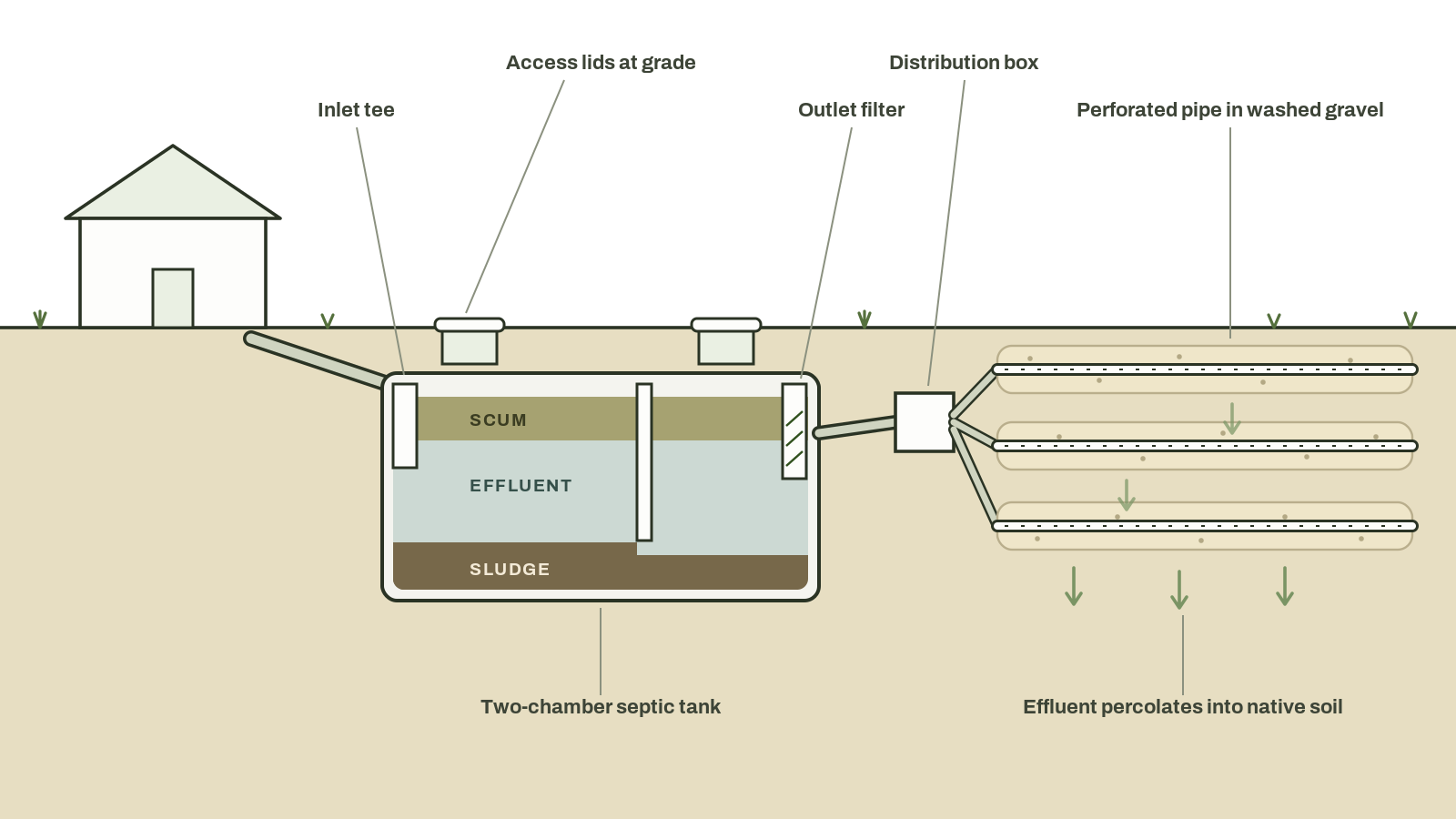
The tank is the cheap part. Dispersal, labor, and site work carry the project, and pre-construction costs (evaluation, design, permit) add $1,000–$4,000 before a shovel turns. Line items from 2026 published pricing:
| Line item | 2026 range | Source |
|---|---|---|
| Site evaluation & soil testing | $300–$1,200 (Dillon); $700–$2,000 (Angi soil testing) | Dillon Septic; Angi |
| Permit & inspections | $250–$800 typical; $250–$710 at counties we’ve verified | Dillon Septic; county fee schedules below |
| Septic tank | $1,200–$3,500 | Dillon Septic |
| Drain field / treatment area | $3,000–$9,000 | Dillon Septic |
| Labor & equipment | $2,000–$6,000 (50–70% of total per Angi) | Dillon Septic; Angi |
| Final installation & setup | $500–$1,500 | Dillon Septic |
| Land survey (if required) | $330–$900 | Angi |
| Electrical hookup (aerobic only) | included in ATU pricing or quoted separately | — |
Tank capacity is sized to your house, not your preference: Texas planning rules key wastewater flow to bedroom count and square footage. Gillespie County’s own permit application asks for bedrooms, bathrooms, and living-area tier before anything else. For the tank alone, Angi’s 2026 Austin data prices a 1,000-gallon tank (the three-to-four-bedroom standard) at $1,000–$1,700, with each size step adding a few hundred dollars.
How Much Do Costs Vary Across Texas?
Angi’s 2026 city data puts the same project $1,900 apart between Dallas and Austin, and rural, thin-provider counties can cost more than either metro once travel and engineered designs enter the picture.
| Market | Installed cost (Angi, 2026) | Average |
|---|---|---|
| Dallas | $5,312–$8,675 | $6,720 |
| Houston | $6,120–$9,855 | $7,889 |
| Austin | $4,519–$12,680 | $8,599 |
| National baseline | $3,591–$12,463 | $8,023 |
Austin’s wide range is the Hill Country effect: the western half of the metro sits on limestone, where engineered aerobic and drip systems are the norm, while eastern blackland lots can still sometimes trench. Angi notes Austin installs run about 7% above the national average.
Outside the metros, two costs replace the big-city premium: distance (equipment mobilization to a ranch outside Harper or Doss isn’t free) and design (thin-soil sites need pumps, sprayers, or imported material rather than gravity and gravel). That’s why the cheapest jobs in the state are sandy-soil gravity installs near a contractor’s yard, like that $7,200 Johnson City example, and the priciest are remote rocky hillsides that need a mound or drip field.
What Does the Permit Cost, County by County?
Permit fees are set county by county in Texas, and the spread is real: $250 all-in for most homes in Kerr County versus $710 for an aerobic permit in Williamson County. Always check your county’s own fee schedule, not a statewide average. Figures below come directly from each county’s published schedule:
| County | Standard residential permit | Aerobic / maintenance-contract permit | Repair | Schedule date |
|---|---|---|---|---|
| Kerr | $250 (incl. $10 state fee) | $300 | $100 | Aug 2025 |
| Gillespie | $325 | $425 | $200 | Oct 14, 2025 |
| Williamson | $510 | $710 | — ($100 extra site visit) | Sept 12, 2025 |
National cost guides quote permit ranges of $450–$2,300 (Angi, 2026). Texas counties generally run below that, but the gap between neighboring counties can still swing an aerobic project by hundreds of dollars. Note the recurring costs too: Williamson charges $60 to renew or transfer an aerobic license; every county collects a $10 state fee per permit that funds Texas’s on-site wastewater research program.
Statewide rules worth knowing at budget time (all TCEQ): the permitting authority must approve or deny your application within 30 days of receipt; a permit is required to construct, alter, extend, or repair a system (with narrow emergency-repair exceptions); and a limited exemption exists for single-family homes on 10+ acres meeting strict conditions, but counties can and do override it locally, so read the 10-acre rule’s fine print before counting on it. County-by-county fees, forms, and office contacts live in our Texas permit guides.
How Long Does Installation Take?
Plan on four to eight weeks door-to-door. Most of it is paperwork and scheduling, not digging. From Dillon Septic’s published 2026 timeline: site evaluation, design, and permitting take one to three weeks (state law caps the county’s review at 30 days), physical installation runs two to five days depending on system type, and final inspection typically follows within about 48 hours. Gillespie County’s application is valid for one year from the purchase date, so a permit bought in spring doesn’t expire before a summer build.
The step that burns calendars is sequencing, not construction. A complete application requires the site evaluation done, the design stamped, and (for aerobic systems) a maintenance contract signed before county review starts. Some counties have added their own pre-steps: since August 2025, Gillespie requires a floodplain determination from the County Engineer’s office before the septic application can even be filed. An installer who has worked your county recently will know these wrinkles; one who hasn’t will learn them on your schedule.
How Do You Keep a Quote Honest?
Three quotes, license numbers verified, and an itemized bid: those three habits protect a five-figure purchase better than any negotiation tactic.
- Verify the license before the handshake. Installation requires a TCEQ-licensed Installer (Installer II for aerobic and proprietary systems). Check for any available license number in TCEQ’s licensing search (www2.tceq.texas.gov/lic_dpa/index.cfm). Some counties, including Gillespie, also publish lists of installers active locally.
- Get the site evaluation first, then bid the job. A firm price quoted before soil work is a guess, and guesses get change orders. The evaluation is a few hundred dollars that disciplines every number after it.
- Demand line items. Tank, dispersal, labor, electrical, permit, restoration. The component table above is your benchmark; a lump-sum bid hides exactly the items that vary most.
- Ask what’s excluded. Tree removal, extra-long pipe runs, imported fill, re-inspection fees ($150 in Gillespie if the first inspection fails). The classic surprises live outside the quote.
- Know the DIY boundary. Texas allows a homeowner to install their own system only on a single-family home they own and occupy, only where the county permits it, and with all permitting and inspection requirements intact (TCEQ). Site evaluation and aerobic maintenance still require licensed professionals, and one buried mistake costs more than the labor you saved.
If the number still doesn’t fit the budget, you have options beyond the credit card: USDA rural programs and county assistance exist for exactly this purchase; see our septic financing guide.
What Does the System Cost to Own?
Ownership runs a few hundred dollars a year for conventional systems and roughly $400–$1,050 a year for aerobic systems once maintenance contract, electricity, and pumping reserve are accounted for (arithmetic on the published lines that follow). From Dillon Septic’s 2026 figures: pumping every three to five years at $350–$650 (full pumping cost breakdown here), aerobic maintenance contracts at $200–$600 per year (the span across Dillon’s own published pages), and $10–$20 a month of electricity for aerobic blowers and pumps. Texas requires that aerobic contract, and it’s not an upsell: here’s what it must include. Skipping maintenance is how a $10,000 system becomes a $5,000–$20,000 drain field repair a decade early. EPA’s guidance is blunt about the economics: routine maintenance is what extends system life beyond 25 years.
Texas Septic Cost FAQs
Is $15,000 too much for an aerobic septic system in Texas?
Not necessarily: $15,000 sits at the top of Dillon Septic’s published 2026 aerobic range ($9,000–$15,000) and inside Angi’s ($10,000–$20,000), so it’s a fair price for a difficult site and high for an easy one. Rocky ground, spray-area constraints, long electrical runs, and larger tanks all push toward the top. Get a second bid with line items before deciding; the spread between bidders on identical specs is routinely thousands of dollars.
How much is a septic system for a 3-bedroom house in Texas?
A three-bedroom home typically needs a 1,000-gallon tank, putting the project at $6,000–$10,000 for conventional systems or $9,000–$20,000 for aerobic septic systems in 2026, depending entirely on soil. The tank itself is $1,000–$1,700 of that (Angi Austin, 2026). Bedroom count sets system sizing under Texas planning rules, so a four- or five-bedroom build steps up tank and dispersal capacity (and cost) from there.
Can I install my own septic system in Texas?
Only on a single-family home you own and live in, only if your county allows it, and only with the full permit, inspection, and licensed site-evaluation process intact. TCEQ’s rules also specify which helpers you can use: anyone else doing installation work generally must be a licensed installer, with exceptions for licensed electricians and tank delivery. For aerobic systems, ongoing maintenance requires a licensed provider regardless of who installed.
Do I need a permit to replace a septic system on 10 acres?
Usually yes. The 10-acre exemption is narrower than the acreage: single-family dwelling, only dwelling on the tract, all components 100+ feet from property lines, effluent kept on-property, and a site evaluation still performed (TCEQ). Counties can require permits regardless; several Hill Country counties have moved that direction in their local orders. Confirm with your county office before building around the exemption: the full criteria are here.
Why do so many Texas lots require aerobic systems?
Because the soil fails first. Slow-percolating clay and shallow rock, the two most common Texas soil problems, both disqualify conventional trenches under 30 TAC 285 siting criteria, and aerobic treatment with surface or drip dispersal is the standard engineered answer. That’s why over half of all systems permitted statewide in 2025 used surface irrigation — 24,392 of 41,990 (TCEQ data). Full aerobic pricing is in our aerobic cost guide.
How long does a new septic system last?
Angi’s 2026 guidance puts tanks at 25–40 years and drain fields at 15–25 years, with aerobic mechanical parts (blowers, pumps) needing replacement on a 5- or 10-year cycle. Maintenance is the variable you control: pumped on schedule and kept off the drain field, systems reach the long end; neglected, the drain field goes first and takes the budget with it.
When you’re ready for bids, start with licensed installers who actually work your county. Our county pages list TCEQ-verified providers, like the Gillespie County directory, alongside each county’s permit process.
Sources & Methodology
Every figure above traces to a named, dated source; where sources disagree, we print the span rather than blend it. We do not yet run our own Texas installer price survey. When we do, it will be published with methodology.
- Angi: How Much Does a Septic System Cost? [2026 Data]; city cost pages for Austin, Houston (both updated Feb 25, 2026), and Dallas
- Dillon Septic (Spring Branch, TX): How Much Does a Septic System Cost in Texas in 2026 (published Feb 5, 2026)
- TCEQ: Getting a Permit for an OSSF (permit requirements, 30-day review, 10-acre exemption, homeowner installation rules)
- TCEQ: 2025 Systems Authorized by Authorized Agents (“Types of Systems Installed by Time Period”, report dated Apr 27, 2026) for the statewide figures, and the 2024 report (dated Mar 25, 2025) for the county-level 2024 figures, each of which names its year on the page
- County fee schedules: Williamson County OSSF Program Fees (updated Sept 12, 2025); Gillespie County OSSF Fees (effective Oct 14, 2025); Kerr County EHD OSSF Fee Schedule (Aug 2025 revision)
- US EPA: Septic Systems (maintenance and system-life guidance)
Prices verified July 30, 2026. Cost guides on this site are re-verified annually and dated in the title.
Do this work for a living?
- Credential-matched claim
- You control your profile
- Quote-request alerts
Get free quotes from verified septic pros.
Pumping, an inspection, or help fixing a septic system: tell us once and we send it to up to 3 verified pros. Free, no spam, delete your request anytime.
Secure form. Sent over an encrypted connection to up to 3 verified pros. Never sold to data brokers, and you can have your request deleted anytime.