Kerr County Septic Permits (2026): Fees, Process & Forms
Verified against county records · sources last read August 23, 2026 · rules change — confirm with the agent before applying
A standard residential septic permit in Kerr County costs $250 all-in, or $300 if your system requires a maintenance contract, which, in practice, means every aerobic unit. Repairs and alterations to an existing permitted system run $100. You’ll file with the county’s Environmental Health Department in Kerrville, and construction can’t be covered up until a county representative has inspected it.
Who Issues Septic Permits in Kerr County?
The Kerr County Environmental Health Department is the county’s TCEQ Authorized Agent: every OSSF permit in the county goes through this office.
Kerr County Environmental Health Department (OSSF Division) 550 Earl Garrett St., Suite 100, Kerrville, TX 78028 Phone: (830) 896-9020 · Fax: (830) 792-4903 Email: envhealth@env.kerrcountytx.gov Hours: Monday–Friday, 8 a.m.–noon and 1–5 p.m. (closed for lunch 12–1) Designated Representatives: Ashli S. Badders (Director) and Gumaro Ramirez
There’s no online application portal. Applications are filed on the county’s PDF forms (linked below), by mail or in person. Records requests, including the schematic drawing of an existing system on your property, go through the same office; the county holds OSSF records dating back to the program’s start, including files inherited from the Upper Guadalupe River Authority era.
What Does a Kerr County Septic Permit Cost?
For a typical home (under 500 gallons per day of disposal), the permit application is $250 total ($240 county fee plus a $10 state-required TCEQ Water Resource Management fee), and aerobic or other maintenance-contract systems pay $300.
From the county’s current fee schedule (revised August 2025):
| Application type | Total fee |
|---|---|
| New or upgrade, under 500 GPD | $250 (incl. $10 state fee) |
| New or upgrade, under 500 GPD, requiring maintenance contract (e.g., aerobic) | $300 (incl. $10 state fee) |
| Repair or alteration, under 500 GPD | $100 |
| New or upgrade, over 500 GPD | $500 (incl. $10 state fee) |
| New or upgrade, over 500 GPD, w/ maintenance contract | $600 (incl. $10 state fee) |
| Repair or alteration, over 500 GPD | $200 |
| Affidavit recording & records archival | $25 |
| Additional inspection (each) | $50 |
| Document revision | $25 |
The $10 state fee is collected by the county and passed to TCEQ under Chapter 367 of the Texas Health and Safety Code. It applies statewide, not just here. Note the $50 additional-inspection line: if your installer isn’t ready when the inspector arrives, that’s the cost of the second trip.
How the Permit Process Works, Step by Step
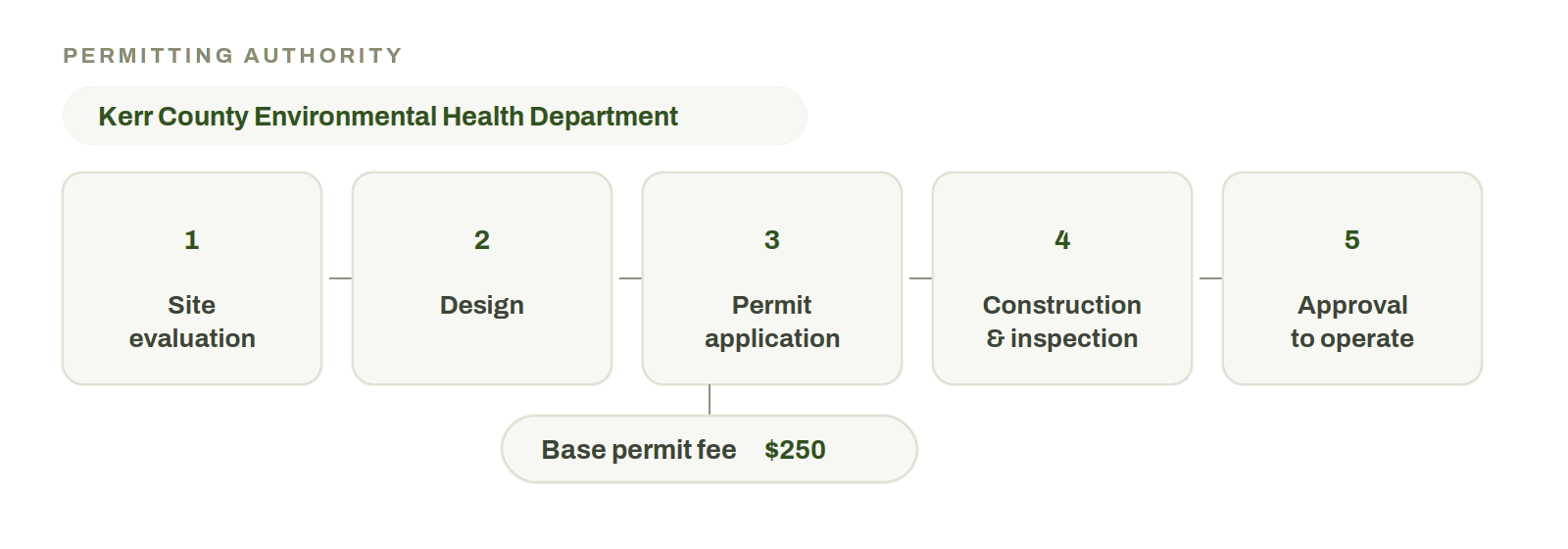
Plan on five stages, with licensed professionals required at nearly every one: site evaluation, system design, application, construction with a pre-cover inspection, and final authorization.
- Site evaluation. A TCEQ-licensed Site Evaluator or professional engineer digs test holes and profiles your soil: depth and type. On the Edwards Plateau’s thin soils, this step effectively chooses your system: shallow rock usually rules out a conventional drain field and points to an aerobic unit with surface application. The county’s own site evaluation form is required.
- Design and application. Your installer or designer prepares planning materials in accordance with 30 TAC 285 standards. Submit them with the county’s OSSF Development Permit application, your plat or survey, and the fee. Aerobic applications must include the required maintenance contract.
- Review. County Designated Representatives review the plans against state rules and Kerr County’s local order. The county doesn’t publish an average turnaround. Ask when you file, and don’t let a contractor start digging on the promise that “the permit’s coming.”
- Construction and inspection. Build only after the authorization to construct is issued. The county inspects the completed system before it’s backfilled. Covering work without inspection is the most expensive mistake in this process, because the fix is excavation.
- License to operate. After a passing inspection, the county issues the operating authorization, and the system records it.
Worth knowing: state law requires utilities to report new electric hookups, and the county checks those reports monthly against its permit files. Unpermitted construction tends to get noticed.
Which Professionals You’re Required to Use
Almost nothing in this process can legally be done by an unlicensed hand: evaluation requires a licensed Site Evaluator, installation requires a licensed Installer, and aerobic service requires a licensed Maintenance Provider. Installer I covers standard systems; aerobic and proprietary systems require Installer II. Verify any license in TCEQ’s records search (www2.tceq.texas.gov/lic_dpa/index.cfm) before signing, and cross-check the county’s published list of OSSF professionals working in Kerr. Homeowner self-installation questions come up often enough that the honest answer deserves its own line: talk to the EHD first. What’s allowed depends on your system type and the current county order, and aerobic maintenance in particular has license requirements attached.
The 10-Acre Exemption Is Closed in Kerr County
Every new or upgraded septic system in Kerr County needs a permit, regardless of tract size, and has since August 7, 2026. The Commissioners’ Court adopted a new OSSF order on July 13, 2026, TCEQ’s executive director approved it on August 7, 2026, and the order’s own Section 16 makes it effective “upon the approval of the TCEQ,” so the approval date is the date it took hold. Section 9, headed More Stringent Requirements, is the operative language: “Tracts Greater Than Ten (10) Acres [30 TAC 285.3(f)(2)]: A permit shall be required for all On-Site Sewage Facilities within Kerr County area of jurisdiction regardless of acreage.” The state’s 10-acre exemption, which let a single-family home on 10+ acres skip the permit when all sewage stayed on-site and 100 feet off the property lines, no longer runs here. The change is not retroactive: existing systems that meet the original exemption criteria remain grandfathered as long as they continue to meet them. Neighboring counties set their own rules, and several have adopted the same requirement, so check the county your tract actually sits in rather than assuming the exemption survives across a county line.
Official Forms & Documents
All hosted by Kerr County. Download current versions rather than relying on contractor copies:
- OSSF Development Permit Application (county PDF, Oct 2025 revision)
- OSSF Fee Schedule (Aug 2025 revision)
- Kerr County Site Evaluation Form
- Application for Transfer of Registration (existing systems changing hands)
- Affidavit to the Public (recorded for maintenance-contract systems; $25 recording fee)
- List of OSSF Professionals working in Kerr County
- Adopted Kerr County OSSF Order (adopted July 13, 2026; TCEQ-approved and effective August 7, 2026)
Find them on the county EHD’s OSSF page at kerrcountytx.gov, or pick them up at the Earl Garrett office.
Kerr County Permit FAQs
How much is a septic permit in Kerr County?
$250 total for most homes; $300 if the system requires a maintenance contract, as aerobic units do. Repairs to permitted systems are $100. Large systems over 500 GPD double the rate per tier.
Do I need a permit on 10+ acres?
Yes. Kerr County’s adopted OSSF order requires a permit for every on-site sewage facility regardless of acreage, effective August 7, 2026. The state’s 10-acre exemption no longer applies in this county. Existing systems stay grandfathered only while they keep meeting the original exemption conditions, so building a second dwelling or a barndominium with plumbing ends that protection. Anything new, altered, upgraded or repaired needs a permit.
Does buying a home with a septic system involve the county?
Yes, when the system has a maintenance contract or transferable registration: file the county’s transfer form so records and responsibility move with the deed. Also request the system schematic from the EHD during your option period; it shows tank size, location, and drain field layout, and tells your inspector where to dig. Budget for a pump-out and inspection as part of closing.
What happens if there’s an unpermitted system on my property?
Contact the EHD before anything else. The office directs owners to licensed professionals. It handles bringing systems into compliance, and unresolved violations can carry fines under the Health and Safety Code. The county investigates dozens of complaints a year (83 in 2024), so waiting for it to come up on its own is not a strategy.
Back to the Kerr County septic hub for local providers and ground conditions.
Who issues the permit.
Kerr County Authorized Agent
Before you start
Ready to build or repair?
Get free quotes from verified Kerr County pros.
Pumping, an inspection, or help fixing a septic system: tell us once and we send it to up to 3 verified pros. Free, no spam, delete your request anytime.
Secure form. Sent over an encrypted connection to up to 3 verified pros. Never sold to data brokers, and you can have your request deleted anytime.