New Septic System Cost in Pennsylvania (2026)
A new septic system in Pennsylvania costs roughly $4,000 to $45,000 installed, and the system type your soil forces on you moves that number more than anything else. Robinson Landscape, covering Bucks, Chester, Delaware and Montgomery counties plus Philadelphia, publishes $4,000 to $12,000 conventional and $10,000 to $20,000 or more for a sand mound or aerobic unit (updated March 3, 2026); Chester County Septic quotes $12,000 to $45,000 for a complete new system (updated March 6, 2025). On top sits a permit fee from whichever of Pennsylvania’s 1,806 permitting authorities covers your parcel, which for most addresses is your township or borough, not your county.
The numbers behind this guide: Conventional system $4,000 to $12,000 (Robinson Landscape, southeastern PA, Mar 2026) or $3,000 to $7,000 as a replacement (Septic Safe Solutions, Dec 2025). Sand mound or aerobic $10,000 to $20,000 and up (Robinson Landscape, Mar 2026). Complete new system $12,000 to $45,000 (Chester County Septic, Mar 2025). New-system permit fee $250 in Delaware Township, Pike County, to $850 per equivalent dwelling unit (EDU) in Bucks County. Private testing from $1,650 (Chester County Septic, Mar 2025). PENNVEST loan cap $25,000 at 1.75% (guidelines version 5/19/2025).
New septic system cost in PA: what three installers publish
Three Pennsylvania companies publish cost figures for their own markets, and their ranges overlap enough to give you a defensible budget. Each row stays with the company and date that published it. Blending them would hide what matters most: a conventional system and a sand mound are different purchases.
| Source | Coverage | Conventional | Sand mound / alternative | Aerobic unit | Published |
|---|---|---|---|---|---|
| Robinson Landscape LLC | Bucks, Chester, Delaware, Montgomery, Philadelphia | $4,000-$12,000 | $10,000-$20,000+ | $10,000-$20,000+ | Updated Mar 3, 2026 |
| Chester County Septic LLC | Chester County and neighbors | $12,000-$45,000, all types | Above grade tops that range | Not itemized | Updated Mar 6, 2025 |
| Septic Safe Solutions | PA, area not stated | $3,000-$7,000 replacement | $10,000-$15,000 | $10,000-$20,000 | Published Dec 1, 2025 |
| Angi (estimate) | Philadelphia metro | $3,000-$8,000 anaerobic | Not itemized | $10,000-$20,000 | Updated Aug 4, 2026 |
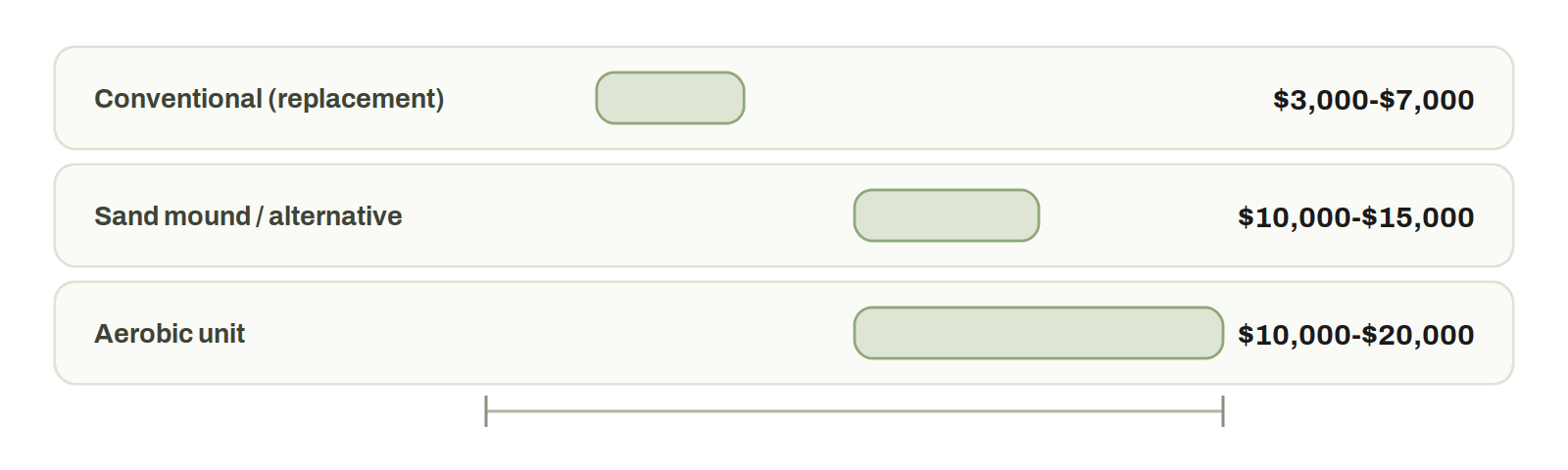
Angi’s Philadelphia page puts the metro average at $15,635, typical range $9,492 to $22,502 (updated August 4, 2026): an estimate modeled for a city almost entirely on public sewer. The honest reading: a conventional in-ground system starts in the low four figures, and anything your soil pushes above grade starts around $10,000. Our cost calculator turns tank sizing into a budget number.
Why Pennsylvania soil decides which system you buy
Pennsylvania’s soils, not its prices, are why so many homeowners here buy the expensive system. A conventional system needs enough suitable soil above the limiting zone to treat effluent. Where that depth is missing, and across much of the state it is, the absorption area gets built upward instead.
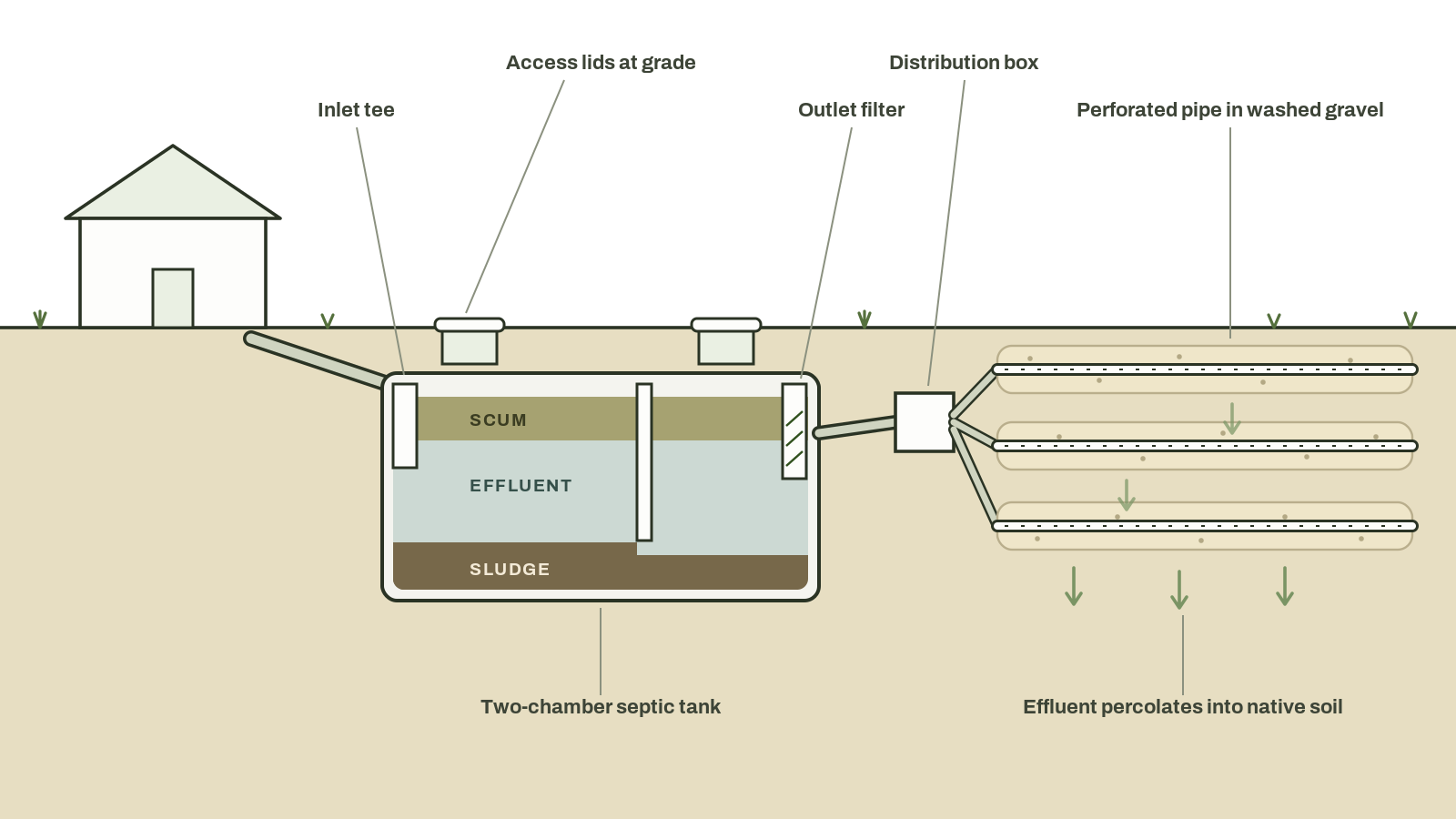
That is an elevated sand mound, governed by 25 Pa. Code Section 73.55: (a) design, (b) construction, (c) the sand itself, and (d) mound beds on slopes above 8%. Subsection (c) reaches your invoice: the sand must meet a specified quality standard and arrive with supplier certification, so no installer can substitute the cheapest fill that week. Trucked certified sand, a pump, an electrical run and a berm account for most of the gap.
Aerobic units cost like mounds for a different reason: mechanical treatment, meaning a blower, a control panel and a service relationship for the life of the system. Both Septic Safe Solutions (December 2025) and Angi’s Philadelphia page (August 2026) put aerobic installs at $10,000 to $20,000.
The two largest national aggregators mislead a Pennsylvania buyer in opposite directions: HomeGuide puts a mound at $25,000 to $50,000 and up (September 22, 2025), Angi’s national page at $10,000 to $20,000 (August 3, 2026). Neither publishes a single Pennsylvania figure. A $30,000 disagreement about this state’s most common system is why the Pennsylvania sources above are worth more than either.
Why “septic cost by county” is the wrong question in PA
In most of Pennsylvania your septic permit does not come from your county, so a county-by-county cost table would be fiction for most addresses.
Pennsylvania runs on the Sewage Facilities Act, Act 537 of the 1965 session, approved January 24, 1966, implemented through 25 Pa. Code Chapters 71 to 73. DEP’s program page puts it plainly: the onlot portion “is largely administered on the local government level by individual municipalities or groups of municipalities working together (including County Health Departments), which are known as local agencies and joint local agencies, respectively.” DEP supplies “technical oversight and financial assistance” and issues no permits. Section 72.22(a) is operative: nobody may install or contract for construction of an onlot system “without first obtaining a permit from the local agency.”
Our extract of DEP’s Municipal On-Lot Sewage Service Areas tabulations counts 1,806 bodies with permitting power across the 2,559 municipalities the Local Government Commission counts in its 2025 Legislator’s Municipal Deskbook, with townships and boroughs running their own program accounting for 1,782. Read 1,806 as an upper bound, not a census. The underlying DEP tabulation is dated 2015; we re-checked it against a live source for Delaware County on August 21, 2026 and nowhere else, so any municipality that has joined a joint agency since 2015 is still counted separately here. County-level permitting is the exception: six county health departments, plus 14 county sewage agencies and 4 joint local agencies. Philadelphia answers to the City of Philadelphia.
DEP’s own tabulation names only five of them: Allegheny (including Pittsburgh), Bucks, Chester, Erie and Montgomery, each covering an entire county. The sixth is Delaware County, which that tabulation misses because it is dated 2015 and the county health department did not take over on-lot permitting until June 1, 2023. Its program page is unambiguous: DCHD “is responsible for inspections, investigations, permit issuance, and enforcement in accordance with Pennsylvania Act 537,” and its Health Code Chapter 500 adopts Chapters 71, 72 and 73 by reference.
Delaware County is also the one place where the answer splits inside the county line. Thirteen municipalities stayed outside the health department’s environmental health services after litigation the county lost and chose not to appeal: Aston, Darby, Lower Chichester, Marple, Middletown, Ridley, Springfield, Thornbury, Tinicum and Upper Chichester townships, plus Clifton Heights, Eddystone and Ridley Park boroughs (county statement, July 24, 2025). The other 36 permit through the county.
Two more details keep that summary honest. Allegheny is not uniform: Edgeworth and Sewickley Heights boroughs ran their own programs in DEP’s 2015 table. And seven cross-county arrangements exist, a Clarion County township served by the Jefferson County Sewage Association among them.
A national page telling you to call your county health department is wrong for most of Pennsylvania; one telling you never to is wrong for six counties, and wrong for only part of the sixth. Start at our Pennsylvania hub.
Septic permit fees across PA, by permitting authority
Published permit fees for a new residential system run from $250 to $850 per EDU across the seven schedules below, and the testing fees attached to them swing wider still.
| Permitting authority | Type | New system permit | Site testing fee | Repair / replacement | Schedule date |
|---|---|---|---|---|---|
| Bucks County Health Dept | County | $850 per EDU | $1,300 lot; $1,900 primary/replacement | $650 repair; $225 component | ADM-71 Rev 08/2025, eff. 2026 |
| Chester County Health Dept | County | $800 major permit | $800 site evaluation | $250 component; $450 minor tank | Eff. Jan 1, 2025 |
| Erie County Dept of Health | County | $575 standard; $810 sand mound | $400 application per lot | $290 repair or alteration | Eff. Jan 1, 2025 |
| Montgomery County Office of Public Health | County | $425 conventional | $485 per lot, soil probes or perc | $225 major; $140 minor | Eff. Jan 1, 2026 |
| Washington County Sewage Council | Sewage council | $1,000 permit or perc test | Included; backhoe and design excluded | $1,000 repair permit | Undated |
| Rockefeller Twp, Northumberland | Municipality | $325 single-family | $350 perc test; $250 application | $200-$325 repair | Undated |
| Delaware Twp, Pike | Municipality | $250 septic permit | $250 perc application | Not published | Undated |
The Erie County row is the clearest proof that system type is priced into the permit: $575 standard, $810 elevated sand mound, $290 repair (effective January 1, 2025).
In Delaware Township, Pike County, testing plus permit is $500. In Bucks County, a lot evaluation plus a new permit is $2,150 before an installer touches the ground: a four-fold difference in government cost between two Pennsylvania addresses.
One fee to question. A local agency asked DEP about charging for an SEO, a Sewage Enforcement Officer, to investigate a complaint; DEP’s regulatory counsel replied that “the imposition of such a fee is not sanctioned by the Sewage Facilities Act and is not one of the powers and duties granted to municipalities by the legislature.” DEP still publishes it under the heading Inspection Fees for Complaint Investigations, undated and with no guidance number, so raise it as a question, not a quotation at a clerk.
Perc tests and soil probes: the two PA bills people forget
Testing is two separate purchases in Pennsylvania, and homeowners routinely budget for only one. 25 Pa. Code Section 73.14 covers the site investigation, the deep soil probe that finds your limiting zone; Section 73.15 covers the percolation test, the perc test on your invoice. Your authority charges for its SEO to witness that work; the excavation and the design are separate bills. Washington County Sewage Council says so outright: its fee covers the permit or perc test, while “costs of the backhoe and sewage design are the responsibility of the applicant, and not included in the application fee.”
Privately, Chester County Septic publishes testing from $1,650 for two test pits, six perc holes and one standard design, above $2,500 where soil is complex (updated March 6, 2025). Aggregator estimates sit in similar territory with no Pennsylvania anchor: Angi’s Philadelphia page lists $1,000 to $2,500 for a percolation test (August 2026), its national page $700 to $2,000, and HomeGuide $250 to $700 for a soil test (September 2025).
One conflict is worth naming. Chester County Septic states that Chester County Health Department (CCHD) permits and applications cost $2,000 for new construction and $1,200 for a replacement. CCHD’s own schedule, effective January 1, 2025, lists an $800 site evaluation plus an $800 major permit, totaling $1,600.
Both appear here because we cannot see inside the installer’s bundle. Ask your contractor to itemize the $400 gap.
Is replacing a PA septic system cheaper than installing new?
A replacement is cheaper on both sides of the bill, and the permit schedules prove it more clearly than installer quotes do. Erie County charges $290 for a repair or alteration against $575 or $810 for a new system. Bucks County charges $650 to repair against $850 per EDU to install, and a repair evaluation with no flow increase at $600 against $1,300 for a full individual lot evaluation.
A replacement still needs a permit. Section 72.22(b) requires one for alterations involving tank repair or replacement, or any change to the soil absorption area. Swapping a tank without one is not a shortcut, it is an unpermitted alteration.
The financing gap is what most homeowners miss. Pennsylvania’s homeowner septic loan, run by PENNVEST with the Pennsylvania Housing Finance Agency, caps at $25,000 with a $2,500 floor, a fixed 1.75% rate, terms to 20 years and no household income test since January 20, 2016 (guidelines version 5/19/2025). The eligible-use list is short: repairing or replacing an existing on-lot system, replacing a lateral, or hooking an existing home to public sewer.
Building where none stood is absent. Replace a failed system and the Commonwealth has cheap money waiting; build new and budget as though it does not exist.
Vetting a PA installer: three registrations that are real
No Pennsylvania agency licenses septic installers, so “state licensed” on a septic truck describes something that does not exist. Competence is enforced at the permit, where your municipality’s certified SEO inspects the installation against Chapter 73 before backfill. SEOs are certified through the State Board for Certification of Sewage Enforcement Officers, which requires a DEP-approved soils course, the precertification academy, and a passing exam.
Three verifications are real:
- PA DEP registered septage hauler. Anyone pumping or hauling residential septage registers under the Solid Waste Management Act and gets a five-digit transporter number. DEP’s Active Residential Septage Haulers workbook, current edition April 2024, lists them. Ask for the number.
- PA Home Improvement Contractor registration. Any contractor performing $5,000 or more of home improvement work a year must register with the Office of Attorney General under HICPA, which issues a PA number searchable at hicsearch.attorneygeneral.gov. It costs $100 every two years and involves no competency exam: a registration, never a license.
- PSMA certification. The Pennsylvania Septage Management Association issues inspection certifications through its 101, 102 and 103 courses, valid two years. An industry credential, not a government license, and PSMA does not claim otherwise.
Every company on our Chester County page has been run against that registry.
What nobody publishes about PA septic costs
Pennsylvania publishes no annual count of on-lot permits issued and no statewide malfunction data, so any page showing you a trend line for this state built it. No Pennsylvania authority publishes installed-cost data by county either, which is why the table above is permit fees only.
What exists is better than an average: on the order of 1,800 permitting authorities, most publishing a fee schedule, and installers publishing their own. Once your system is in, the recurring cost is pumping, covered on our septic pumping service page.
FAQs
How much does a new septic system cost in PA?
Between $4,000 and $45,000 installed, with system type deciding where you land. Robinson Landscape publishes $4,000 to $12,000 for a conventional system in southeastern Pennsylvania and $10,000 to $20,000 or more for a sand mound or aerobic unit (March 3, 2026). Chester County Septic quotes $12,000 to $45,000 for a complete new system (March 6, 2025). Permit and testing fees add roughly $500 to $2,150.
Who issues septic permits in Pennsylvania?
The local agency, which for most addresses is the township or borough, not the county. 25 Pa. Code Section 72.22(a) requires a permit “from the local agency” before installation. Six county health departments run their own program, and only five of them cover an entire county: Allegheny, Bucks, Chester, Erie and Montgomery. Delaware County is the sixth, permitting 36 of its 49 municipalities since June 1, 2023. DEP provides oversight but issues no on-lot permits.
Why are sand mounds so expensive in PA?
Because the regulation specifies the materials, not just the outcome. 25 Pa. Code Section 73.55(c) requires certified sand meeting a defined quality standard, and a mound also needs a pump, an electrical run and a berm. Erie County prices the difference into the permit itself: $810 for an elevated sand mound against $575 for a standard system (effective January 1, 2025).
Do septic installers need a license in Pennsylvania?
No statewide septic installer license exists. What is verifiable is a DEP septage hauler registration with a five-digit transporter number, a Home Improvement Contractor registration with the Attorney General at $5,000 or more of annual work, and voluntary PSMA industry certification. The enforcement that matters happens when your municipality’s certified SEO inspects the installation against Chapter 73.
How much is a perc test in PA?
Between $250 and $1,900 in agency fees, plus private testing from about $1,650. Delaware Township in Pike County charges $250, Rockefeller Township in Northumberland County $350, Bucks County $1,300 for an individual lot evaluation and $1,900 for a primary or replacement site evaluation. Chester County Septic publishes private testing from $1,650 for two test pits, six perc holes and a standard design (updated March 6, 2025).
Sources & Methodology
Cost figures come from Pennsylvania companies publishing their own numbers (Robinson Landscape LLC; Chester County Septic LLC; Septic Safe Solutions) and from dated aggregator estimates labeled as such (Angi Philadelphia, August 4, 2026; Angi national, August 3, 2026; HomeGuide, September 22, 2025). Fees come from each authority’s own schedule: Bucks County Health Department ADM-71 (Rev 08/2025), Chester County Health Department and Erie County Department of Health (both effective January 1, 2025), Washington County Sewage Council, Rockefeller Township and Delaware Township. Regulatory statements cite Act 537, 25 Pa. Code Chapters 71 to 73, DEP’s Act 537, SEO and hauler pages, and PENNVEST guidelines version 5/19/2025.
Each figure carries its own source and date; no two are blended into an average. Three municipal fee pages carry no effective date, noted in the table. Allegheny County Health Department publishes no sewage fee schedule online and Philadelphia publishes none, so nothing is estimated in for either. Montgomery County does publish one, effective January 1, 2026, and it is in the table. We check providers on our Pennsylvania county pages against DEP’s hauler registry and the Attorney General’s contractor search; how we verify sets out the method.
Do this work for a living?
- Credential-matched claim
- You control your profile
- Quote-request alerts
Get free quotes from verified septic pros.
Pumping, an inspection, or help fixing a septic system: tell us once and we send it to up to 3 verified pros. Free, no spam, delete your request anytime.
Secure form. Sent over an encrypted connection to up to 3 verified pros. Never sold to data brokers, and you can have your request deleted anytime.