Septic Inspection Cost in Ohio (2026)
Ohio homeowners pay $50 to $550 for a septic inspection, and the biggest variable is not the tank. It is whether the local health district does the inspection itself, lets a registered private company do it, or requires none at all. Where the district does the work, the fee is published: $375 in Summit County, $350 in Carroll, $300 in Trumbull.
The numbers behind this guide: Summit County Public Health: $375 for a point-of-sale sewage evaluation by its own staff, $45 to review one a registered evaluator performed (2026 fee schedule). Carroll County: $350 septic only, $400 with a coliform water test (adopted 3/15/23). Trumbull County: $300 (effective 6-1-17). Geauga Public Health: $350 including two visits (EH Fees 2026). Published private prices run $50 to $185 (Be Ohio; Kucharski, both accessed Aug 21, 2026). Angi’s Columbus estimate: $191 to $860 (updated July 7, 2026).
Ohio septic inspection fees by district and by company
Ohio has two price ladders, one set by health districts and one set by companies, and they do not line up. District fees are public documents you can read before you call; company prices are quotes.
| District | What it covers | Fee | Fee source |
|---|---|---|---|
| Summit | Point-of-sale evaluation, sewage only | $375 | 2026 fee schedule |
| Summit | Point-of-sale, sewage and water system | $550 | 2026 fee schedule |
| Summit | Review of a private evaluator’s report | $45 | 2026 fee schedule |
| Summit | Inspection to verify operation (O&M) | $125 | 2026 fee schedule |
| Geauga | Sale-of-property evaluation, two visits | $350 | EH Fees 2026 |
| Geauga | Revisit or re-evaluation | $75 | EH Fees 2026 |
| Carroll | Septic inspection only | $350 | Adopted 3/15/23 |
| Carroll | Septic plus coliform water test | $400 | Adopted 3/15/23 |
| Carroll | Re-inspection after repairs | $100 | Adopted 3/15/23 |
| Trumbull | Septic inspection at transfer | $300 | Effective 6-1-17 |
Private prices are thinner because most Ohio companies quote by phone. Kucharski lists a Summit County inspection at $185, or $75 when it is already pumping the tanks; Be Ohio advertises a $50 real-estate inspection across Franklin, Delaware and Morrow counties (both accessed August 21, 2026). Treat the $50 as an outlier, since no other source confirms it.
National estimates sit above nearly all of this. Angi’s national inspection page is the only aggregator source carrying an Ohio line, $520 (updated Jul 9, 2026); The Septic Guide estimates $300 to $650 for a real-estate inspection with no state breakout at all (updated March 2026).
Real-estate transfer inspection vs. routine inspection
These are different products, and in Ohio only one is ever mandatory. A routine inspection is one you schedule for yourself. A transfer evaluation is a regulated document the district accepts or rejects, and it exists to clear a sale.
Summit County’s fee schedule shows the gap: $125 for an inspection to verify operation, $375 for a point-of-sale evaluation. Same system, three times the price, because the second produces a Certificate of Transfer the district issues within three business days.
No statewide transfer requirement exists. Portage County Health District has no mandatory transfer inspection but “offers voluntary real estate transfer septic inspection as fee for service program.” Geauga repealed its mandate, voting on May 25, 2022 to end its For Sale of Property evaluation effective June 30, 2022, and still performs it on request for $350.
Which Ohio district you are in decides everything
Ohio sets septic standards in Columbus and enforces them from 111 separate offices, which is why one statewide number is always wrong. The Ohio Department of Health writes the rules under ORC 3718 and Ohio Administrative Code 3701-29, effective January 1, 2015, but permitting, inspection and enforcement belong to local health districts, and Huron County Public Health notes those districts can set rules stricter than the state’s.
ODH sent its most recent household sewage survey to 111 local health departments, 88 of them county-specific. The other 23 are city and combined districts sitting inside county lines, so your county and your health district are not always the same thing.
- Summit County: required before any residential transfer of a property with a sewage or private water system (EH Code 1680, effective September 1, 2008), unless the system was evaluated or replaced in the previous 24 months.
- Carroll County: required before a residential sale, performed only by an Environmental Health Specialist of the district.
- Portage and Geauga counties: voluntary, offered as a paid service.
- Cuyahoga County: no transfer mandate, but every household sewage system needs an annual Operation and Management permit renewed before January 1.
That survey found 68,508 of 499,358 systems failing, about 14%, with a wide regional spread: 24% in the northeast and northwest, 3% in central Ohio. Just 61 of the 111 districts answered, so read it as a large sample, not a headcount. Your district is on our Ohio county pages, including Summit County.
Who is allowed to inspect a septic system in Ohio?
Ohio licenses no septic inspectors, so the credential to check is a district registration backed by a surety bond ODH holds. National cost guides get this wrong routinely, telling readers that inspectors carry a state license.
Contractors post a bond with the Ohio Department of Health, currently $25,000 for service providers and septage haulers, and ODH publishes 2026 bond lists for all three categories. Registration is separate and local. ODH requires a “separate registration for each category of work performed prior to conducting work in a health district,” and Huron County spells out that anyone who “services, or evaluates” a system must register in every district where they work.
Districts narrow it further. Summit County requires a point-of-sale sewage evaluator to register with the district as an STS Service Provider and train with it, and its April 2026 public list carries 18 companies with an STS registration number.
Is pumping included in a septic inspection?
Almost never, and in at least one Ohio county a recent pump-out will cancel the inspection. Geauga Public Health’s sale-of-property checklist is blunt: “Homes where the tanks have been pumped within 60 days cannot be evaluated.” Vacant homes are out too, and the house must have been continuously occupied for the previous 30 days. The evaluator needs the system carrying a normal load, and an empty tank hides what they came to measure.
That reverses the usual advice: SepticTankHub prices a “full inspection with pumping” at $250 to $450 (updated 2026-03-02). Check your district’s rule before booking the truck, and see our Ohio pumping cost guide for published pump-out prices.
What the inspection report covers
An Ohio transfer evaluation is a findings document that can generate enforcement orders, not a checklist you file away. Geauga publishes the clearest description: the inspector compiles findings into a report, and “if corrections are needed, orders will be issued.”
Access is your job before anyone arrives. Geauga requires tank inlets and outlets, distribution boxes and curtain drain exits exposed, with lift station, chlorinator and discharge point accessible. Buried components can trigger a re-inspection fee, $75 in Geauga and $100 in Carroll County.
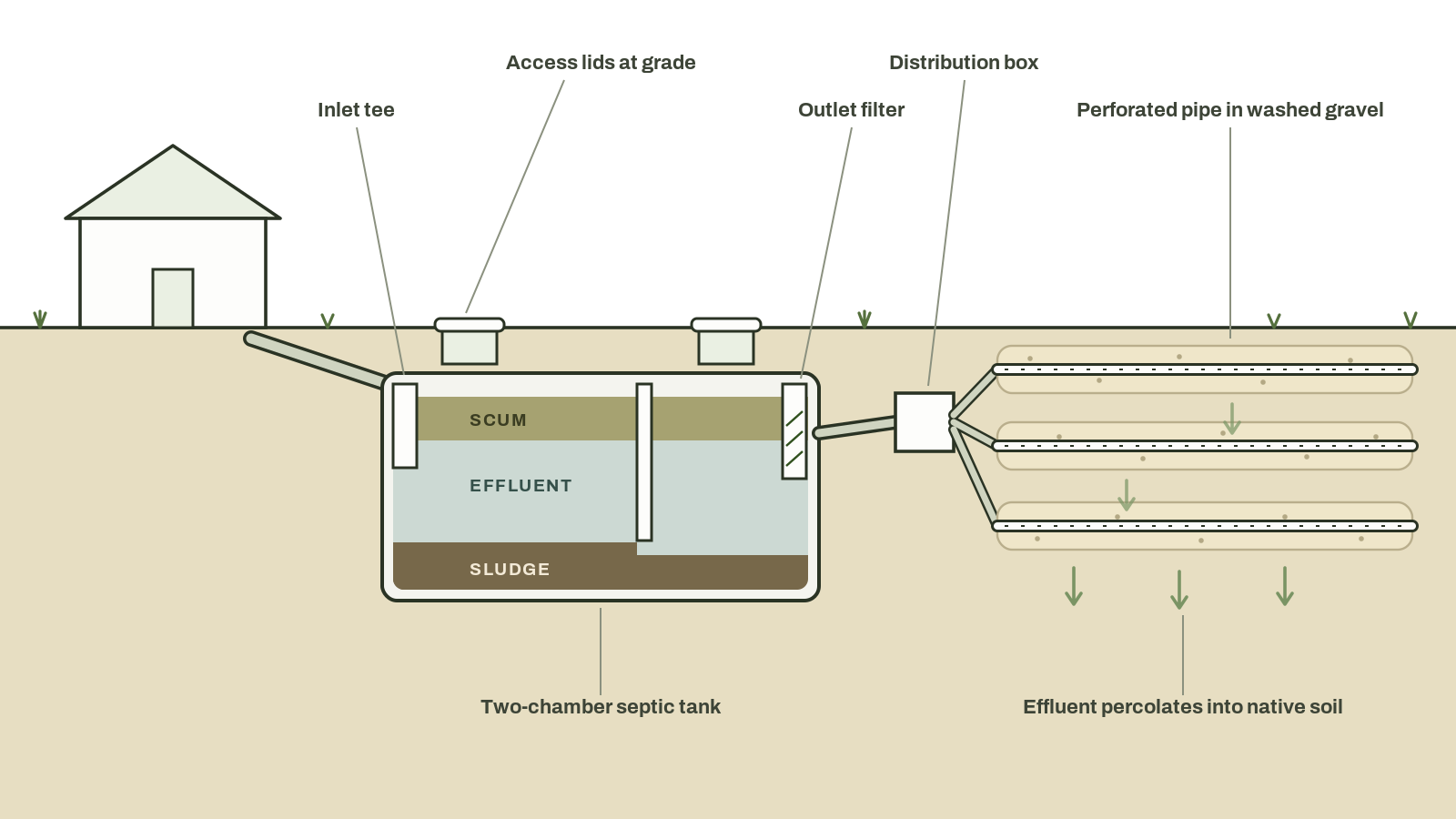
The field work is more than a look in the lid. Certified HPI, a registered service provider across seven Northeast Ohio counties, lists records retrieval, hydraulic load testing, dye testing and a site drawing; Be Ohio’s report adds a sludge and scum core sample and photo documentation.
Four questions to ask an Ohio septic inspector
Start with the registration number; the other three tell you whether you are buying a district-accepted document or a walk around the yard.
- What is your STS registration number in this district?
- Is this a district-accepted transfer evaluation or a routine inspection?
- Does the district charge a separate review fee on top of yours? Summit charges $45.
- Do you dye test and load test, or is this visual only?
Ask all four before the visit, not after. Our septic inspection service page walks through what happens on the day, and how we verify explains the bond-list check behind every listing on our Ohio county pages.
FAQs
How much does a septic inspection cost in Ohio?
Between $50 and $550, with district-run inspections clustering at $300 to $375. Summit County charges $375, Carroll $350, Trumbull $300, and Geauga $350 for two visits. Two Ohio companies published $50 and $185 (August 21, 2026). Angi’s Columbus estimate runs $191 to $860 (updated July 7, 2026), topping out above every district fee we found.
Is a septic inspection required to sell a house in Ohio?
Not statewide, only in the districts that adopted a rule. Summit and Carroll counties require an evaluation before a residential transfer. Portage says it has no mandatory requirement, and Geauga repealed its mandate effective June 30, 2022. The rule lives at district level, so ask the district covering that address.
Who can perform a septic inspection in Ohio?
A contractor registered with that specific health district and bonded with the Ohio Department of Health. No state license exists for this work. ODH requires a separate registration for each category of work in each district and holds the bond, currently $25,000 for service providers. Summit County’s April 2026 public list carries 18 companies with an STS number.
Does a septic inspection include pumping the tank?
No, and pumping first can disqualify the inspection. Geauga Public Health will not evaluate a system whose tanks were pumped within the previous 60 days. Where the two can be combined, ask about the discount: Kucharski charges $185 for a Summit County inspection alone and $75 when it is already pumping the tanks (price list accessed August 21, 2026).
What happens if the septic system fails the inspection?
The district issues orders, and the clock starts. Geauga’s published process is that a failing system draws orders to correct it or install a new one, with a follow-up inspection that may carry a re-inspection fee of its own.
Sources & Methodology
No Ohio price on this page is averaged, blended, or carried over from a national dataset. District fees are quoted from the source documents themselves: Summit County Public Health’s 2026 Environmental Health Fee Schedule and EH Code 1680, Geauga Public Health’s EH Fees 2026 and sale-of-property documents, Carroll County’s point-of-sale fees, and Trumbull County’s evaluation application. Regulatory framing comes from ORC 3718, OAC 3701-29, ODH’s contractor and bond-list pages, and ODH’s Household Sewage Treatment System Failures in Ohio survey. Aggregator figures stay aggregator figures: dated, attributed, and kept out of the Ohio totals. One gap is worth naming. Columbus aside, no Ohio metro has a dated 2026 inspection price series, so Cleveland, Cincinnati, Toledo and Dayton get that sentence instead of a number we invented.
Septic company? Claim your free listing.
- Credential-matched claim
- You control your profile
- Quote-request alerts
Get free quotes from verified septic companies.
Pumping, an inspection, or help fixing a septic system: tell us once and we send it to up to 3 verified septic companies. Free, no spam, delete your request anytime.
Secure form. Sent over an encrypted connection to up to 3 verified septic companies. Never sold to data brokers, and you can have your request deleted anytime.