Septic Tank Riser Installation Cost in Texas (2026)
A complete septic tank riser kit costs $145 to $395 in 2026, depending on diameter and height, and the sizes most Texas tanks need land between $170 and $275 (Tuf-Tite kits at Wholesale Septic Supply; Polylok packages at Septic Solutions, both priced in August 2026). Professional installation adds roughly $200 to $400 in labor (Angi, July 2026). A riser buys you out of the dig-out labor pumpers bill every visit: $175 an hour, one-hour minimum, on one published Austin price page (Mac Septic, 2026). Texas has already decided risers are worth it: every system permitted since September 1, 2023 must have them, extending at least 2 inches above grade (30 TAC 285.38).
| Quick stat | Figure | Source (date) |
|---|---|---|
| Complete riser kit, all sizes | $145–$395 | Wholesale Septic Supply Tuf-Tite kits (Aug 2026) |
| Most common sizes (24″ dia., 8″–14″ tall) | $170–$275 | Wholesale Septic Supply; Septic Solutions Polylok (Aug 2026) |
| Professional installation labor | $200–$400 per riser | Angi (Jul 2026) |
| Dig-out labor a riser eliminates | $175/hr, 1-hr minimum | Mac Septic, Austin price page (2026) |
| Texas rule | Risers required, 2″+ above grade, on systems permitted since Sept 1, 2023 | 30 TAC 285.38(c) |
What Does a Septic Riser Kit Cost by Size?
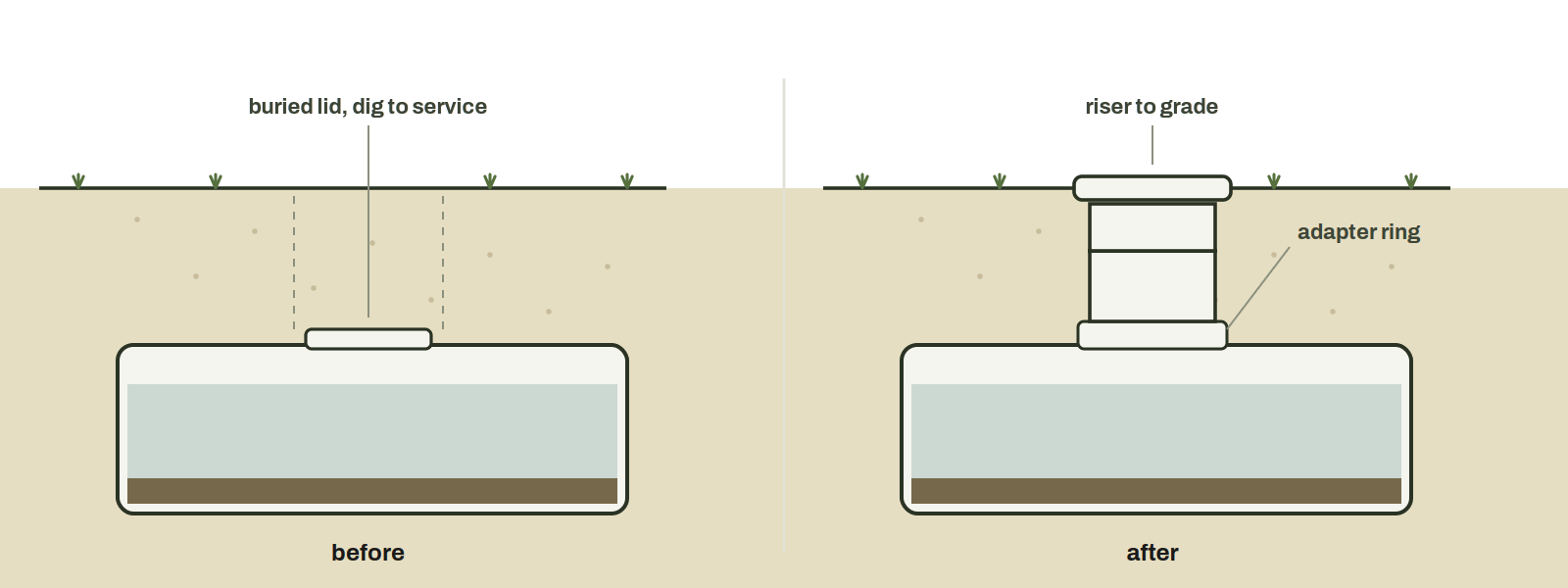
A complete kit (tank adapter ring, riser sections, and lid) runs $145 to $205 for tanks buried up to about a foot, and $270 to $395 when the lid sits 16 to 30 inches down. Height drives price, and burial depth sets the height: tank top to at least 2 inches above the grass.
Live prices for the two brands most Texas installers stock, checked August 2, 2026:
| Riser size (diameter x height) | Fits a lid buried about | Tuf-Tite complete kit (Wholesale Septic Supply) | Polylok complete package (Septic Solutions) |
|---|---|---|---|
| 24″ x 5″–8″ | 2–6 in. | $155–$180 | $210–$219 (4″–8″ tall) |
| 24″ x 11″–14″ | 8–12 in. | $190–$205 | $265–$275 (10″–14″ tall) |
| 24″ x 17″–20″ | 14–18 in. | $270–$290 | $325–$335 (16″–20″ tall) |
| 24″ x 26″–32″ | 22–30 in. | $325–$395 | $359–$385 (22″–26″ tall) |

Three money-savers:
- 20-inch versions run $15 to $40 less at the same heights ($145–$255 Tuf-Tite; $189–$315 Polylok). Either diameter satisfies Texas code, which requires the riser’s inside diameter to match or exceed the port opening (30 TAC 285.38(d)).
- 16-inch Tuf-Tite kits are $165 at every height. Fine over a small inspection port; pumpers want 20 to 24 inches over the main cleanout ports.
- Piecing it together at a big-box store rarely beats the kit. Home Depot’s bare Tuf-Tite 24″ x 12″ riser section is $81.52 (August 2026), and you still need the adapter ring and lid.
Generic cost pages quote “$100–$300 for a riser kit” with no brand, diameter, or retailer listed; the table above shows what the two dominant brands sell for this month.
What Does Professional Installation Cost in Texas?
Verified 2026 labor for a single riser installation is $200 to $400, roughly doubling for a second riser (Angi, July 2026); no independent Texas-specific installed-price survey exists as of August 2026. Some Texas sites claim “$300–$600 installed based on 2026 Texas contractor pricing” without naming a contractor; we won’t print a Texas-only installed figure until someone publishes one worth citing. What can be verified: Angi’s labor range, and Mac Septic’s published Austin rate of $175 per hour for dig-and-access labor ($150 for contract customers, $263 after hours, one-hour minimum).
The cheapest install happens during a scheduled pump-out: the tank is already located and open, so the extra work is sealing and stacking, roughly an hour at published rates. Kit plus one labor hour puts a realistic add-during-pumping total near $300 to $450 for the common sizes; that’s arithmetic from cited figures, not a published package price, so get it quoted before the truck rolls. The pump-out itself is a separate line: see our Texas septic pumping cost guide.
The Payback Math: What a Buried Lid Costs You Every Visit
One buried-lid dig can cost as much as the riser kit: published Texas dig labor runs $175 an hour with a one-hour minimum, and one Central Texas pump-out with a hard-to-reach tank billed $850 against a $480 routine job.
| Cost you avoid with a riser | Cited figure | Source (date) |
|---|---|---|
| Dig-out labor at pump-out | $175/hr, 1-hr minimum ($263/hr after hours) | Mac Septic, Austin (2026) |
| Routine pump-out turned excavation | $850 vs. $480 norm (stone patio over tank) | Dillon Septic, Central TX (Feb 2026) |
| Locate visit when lids are lost | $100–$450, or $100–$300/hr | Angi (Mar 2026) |
Now the arithmetic. The EPA’s pumping cadence is every three to five years, so 15 years of ownership means three to five pump-outs. At the minimum dig charge of $175 per visit, that’s $525 to $875 in avoidable labor; a lid needing two hours of digging, or buried under landscaping like Dillon’s $370-premium example, pushes the 15-year cost past $1,000. Against that, a 24″ x 14″ Tuf-Tite kit is $190 to $205. Installed at Angi’s labor figure, the riser breaks even by the second pump-out; added during one you were already paying for, it can pay for itself the first time the truck doesn’t dig.
Mac Septic names buried lids one of its two most common surprise charges and asks customers to pre-dig. A riser ends that, gets a seller through a buyer’s inspection without an excavation line item, and replaces the aging concrete lid a child or mower can find before you do.
Texas Riser Rules: What 30 TAC 285.38 Actually Requires
Since TCEQ’s 2023 rewrite of the access rule, every septic system permitted on or after September 1, 2023 must have risers over its inspection and cleanout ports extending at least 2 inches above grade, with a secondary plug, cap, or restraint below the riser cap (30 TAC 285.38(c), amended effective July 6, 2023). Guides stating that a riser only needs to reach “within 6 inches of the surface” or is only required “when the tank is buried more than 12 inches” are quoting superseded pre-2023 text; several Texas riser cost pages still do.
The rule’s requirements for the riser itself (30 TAC 285.38(d)):
- Inside diameter equal to or larger than the port opening
- Permanently fastened to the tank lid or cast into the tank, watertight
- Removable watertight cap, secured by a padlock, a cover that needs tools to remove, a 65-pound cover set into a recess, or another approved method
- UV protection if exposed to sunlight, and strength to withstand soil pressure
Retrofits have a legal fast lane. Adding risers to components installed on or after September 1, 2012 counts as an emergency repair under 30 TAC 285.35 (per 285.38(f)): no full permit application, but the installer must send the permitting authority written notice within 72 hours of starting work, describing methods and materials, and the authority may inspect. For pre-2012 tanks, the rule spells out no shortcut; ask your county first, via our Texas permits hub.
Who may do the work: on a new system, riser installation is construction reserved for a licensed installer (285.38(e)). On post-2012 components, the emergency-repair path opens it to a licensed installer, a licensed maintenance provider, or a registered maintenance technician (285.38(f)). And whoever opens a secured lid must re-secure it before leaving (285.38(g)).
How to Vet a Riser Quote
A good riser quote names the brand, diameter, height, and the license number of the person doing the work; a bad one says “riser install” next to a round number. Five checks before you sign:
- Verify the license at TCEQ’s licensing search (www2.tceq.texas.gov/lic_dpa/index.cfm). For a retrofit, look for a registration as an Installer I or II, Maintenance Provider, or Maintenance Technician.
- Get the hardware in writing. Brand, diameter, height, lid type. With the kit table above, you’ll know whether $700 for a $205 kit plus an hour of sealing deserves a follow-up question.
- Ask how it seals. The adapter ring should be fastened and sealed to the tank to ensure watertightness (with butyl rope or an approved sealant), not set on soil. Watertight is a code requirement.
- Confirm the secondary restraint. Required on new permits, cheap insurance on any system: a plug or barrier under the cap so a damaged lid never means an open tank.
- Time it with your pump-out, and ask for the 72-hour notice. Bundling kills the second dig charge; the written emergency-repair notice is your proof the retrofit was done inside the rules.
Providers on our septic riser service pages are checked against TCEQ’s registry county by county, Travis County included; every other price of septic ownership lives in the cost guide index.
FAQs: Septic Riser Costs in Texas
How much does it cost to add a riser to an existing septic tank?
Plan on $145 to $395 for the kit by size, with common 24-inch sizes at $170 to $275 (retailer pricing, Aug 2026), plus about $200 to $400 in labor for professional installation (Angi, Jul 2026). The cheapest route: add it during a scheduled pump-out, when the tank is already open.
Are septic tank risers required in Texas?
Yes on any system permitted on or after September 1, 2023: risers must extend at least 2 inches above grade with a secondary restraint below the cap (30 TAC 285.38(c)). Older systems aren’t required to be retrofitted, but any riser you add must meet the same standards: watertight, permanently fastened, and secured against entry.
Can I install a septic tank riser myself in Texas?
On a new system, no; that’s construction reserved for a licensed installer (285.38(e)), and on components installed since September 1, 2012, the rule assigns the work to a licensed installer, maintenance provider, or registered maintenance technician (285.38(f)). For pre-2012 tanks, call your county first. And never lean into or enter an open tank: the gases can incapacitate a person in seconds, which is why the rule requires secured caps.
Can you drive over a septic tank riser?
Standard residential kits are built for foot traffic, not vehicles. If cars will cross the riser, say so up front: Septic Solutions lists a heavy-duty 24-inch Polylok lid at $80 (Aug 2026), and a driveway location may need a traffic-rated design or different access plan.
Should the riser lid stick up above the ground or sit below it?
On systems permitted since September 1, 2023, it must finish at least 2 inches above grade; on older systems you can legally set it lower, but burying the lid under soil or a stepping stone recreates the problem you paid to solve. Green and black lids disappear into a lawn well enough; above grade, findable, and secured is what the payback math assumes.
Getting quotes? Start with licensed riser installers by county, verified against TCEQ’s license registry before listing.
Sources & Methodology
Every price here has a named, dated source: kit prices are live retailer listings pulled August 2, 2026, and regulatory statements quote current rule text. Where no citable figure exists (a Texas-specific installed-price survey), we say so rather than guess; the page updates when a citable source appears.
- Wholesale Septic Supply, Tuf-Tite riser kit collection, live prices accessed August 2, 2026 (kits by diameter and height, components)
- Septic Solutions, Polylok complete riser packages (20″ and 24″), live prices accessed August 2, 2026
- The Home Depot, Tuf-Tite 24″ x 12″ riser section (model 89-24RIS12), $81.52, accessed August 2, 2026
- Angi, “What Is a Septic Tank Riser?”, updated July 9, 2026 (installation labor $200–$400)
- Angi, “How Much Does It Cost to Locate a Septic Tank? [2026 Data]”, updated March 18, 2026 (locate visit and hourly ranges)
- Mac Septic, Septic Pumping in Austin, TX price page, published May 2026, updated July 31, 2026 (dig labor rates, buried-lid policy)
- Dillon Septic (Spring Branch, TX), pumping cost guide, updated February 5, 2026 ($850 buried-tank example vs. $480 routine)
- 30 Tex. Admin. Code § 285.38 (amended eff. July 6, 2023) and § 285.35, via Cornell Law School Legal Information Institute, accessed August 2, 2026
- US EPA, “How to Care for Your Septic System” (three-to-five-year pumping cadence)
- TCEQ licensing records search (license verification)
Do this work for a living?
- Credential-matched claim
- You control your profile
- Quote-request alerts
Get free quotes from verified septic pros.
Pumping, an inspection, or help fixing a septic system: tell us once and we send it to up to 3 verified pros. Free, no spam, delete your request anytime.
Secure form. Sent over an encrypted connection to up to 3 verified pros. Never sold to data brokers, and you can have your request deleted anytime.