Best Water Softeners for Well Water in Texas (2026)
For most Texas well households, the best water softener is the SpringWell SS (32,000–80,000 grains, from $1,620), a lifetime-warranty system built for the very hard water Texas limestone aquifers produce: 15–20 grains per gallon in San Antonio’s utility measurements of those same formations. If your well also runs iron (and many do), the SpringWell softener + iron filter combo (from $3,150) or the DIY-friendly AFWFilters Iron Pro 2 with the Fleck 5600SXT valve handles both problems for less than a dealer install.
Heads up: this guide contains affiliate links, including Amazon links. If you buy through one, we earn a commission at no extra cost to you. As an Amazon Associate we earn from qualifying purchases. Commissions never decide our picks. Our affiliate disclosure explains how we work.
Our picks at a glance
The right softener depends on three numbers: your hardness (gpg), your iron (ppm), and your household size. Test first: every recommendation below assumes you know those numbers. Our well water guide is the hub for getting those numbers and for everything else a private well needs.
| Pick | Best for | Why |
|---|---|---|
| SpringWell SS | Most Texas well homes | Sized by bathrooms (32k/48k/80k grain), 11–20 GPM flow, lifetime warranty, 6-month money-back |
| SpringWell WSSS combo | Wells with real iron (1+ ppm) | Air-injection iron filter (to 7 ppm iron, 8 ppm sulfur) ahead of the softener: the correct order |
| AFWFilters Iron Pro 2 48k | DIY installers on a budget | Fleck 5600SXT metered valve, fine-mesh resin for moderate iron, install-it-yourself pricing |
| Big-box units (Whirlpool, GE) | Light hardness, city-like water | Cheapest upfront; shorter warranties and proprietary parts (see below) |
How we chose
We haven’t put these systems on a test bench. This comparison is built from manufacturer specifications, installer consensus, published water research, and Texas water data, and every source is listed at the bottom. That’s worth saying plainly, because most “we tested 6 softeners” articles ranking for this search didn’t test them either. The highest-ranking review site concedes, in its own fine print, that it ran the softener behind an iron filter “so we had no way to test the softener’s iron removal abilities alone.” We’d rather show you our sources than borrow a lab coat.
What we weighted: valve track record (the control valve is what fails), resin quality for well conditions, warranty terms, honest capacity ratings, and (because this is Nearby Septic) what the discharge does to your septic system. None of the guides ranking for this search covers that last one. It has a Texas rule attached.
Texas well water is a different problem
Groundwater across most of Central and West Texas is “very hard”: above 180 mg/L of calcium carbonate on the USGS scale. The limestone that makes the Hill Country pretty is the same rock your well pulls water through. San Antonio’s utility, drawing on the Edwards and Trinity aquifers, reports 15–20 grains per gallon from the same formations that feed private wells across Kerr, Gillespie, Kendall, and Blanco counties. TWDB sampling of the Hill Country Trinity Aquifer shows calcium-bicarbonate water with median dissolved solids of 537 mg/L. Hardness is the dominant mineral load. No published figure isolates an average gpg for Trinity wells specifically, so we won’t invent one; plan on “very hard” and test your own.
One myth worth killing: softener sellers love to claim Austin has “15.7 grains per gallon” water. Austin Water’s own 2025 quality report says the city’s lime-softened supply averages 5.4 gpg. The hard-water problem in Central Texas isn’t city taps. It’s wells. If you’re on one, you’re the reason this guide exists.
A softener protects the equipment your well already makes work hard: the water heater, the pressure tank, fixtures, and appliances. On septic properties, it also changes what goes down the drain. More on that below, because Texas regulates it.
The picks
SpringWell SS: best for most Texas well homes
The SS is the system we’d point most well owners to first: correctly sized, warrantied for life, and sold with a 6-month money-back guarantee that’s rare in this category. SpringWell sells it by household size: 32,000 grains (1–3 bathrooms, 11 GPM), 48,000 grains (4–6 bathrooms, 13 GPM), and 80,000 grains (7+ bathrooms, 20 GPM), with pricing from $1,620 direct (springwellwater.com, July 2026). It regenerates on demand rather than on a timer, which matters for both salt use and, as you’ll see, Texas septic compliance. Expect a 40-lb bag of salt every month or two.
Who should skip it: wells with more than about 1 ppm of iron. A softener is not an iron filter, no matter what the box says. Which brings us to the combo.
SpringWell WSSS: best when iron is the real problem
If your water stains fixtures orange or smells like eggs, buy iron treatment first and softening second. The WSSS does both, in the correct order. It pairs SpringWell’s air-injection oxidizing filter (rated for up to 7 ppm iron, 8 ppm hydrogen sulfide, 1 ppm manganese) ahead of the SS softener, from $3,150 direct (springwellwater.com, July 2026). Running raw iron water through a bare softener fouls the resin bed and shortens its life; an oxidizing filter upstream is how installers actually plumb iron wells.
AFWFilters Iron Pro 2: best DIY value
The Iron Pro 2 is the budget answer for handy owners: a Fleck 5600SXT metered valve (widely called the most popular residential softener valve in the industry) on a 48,000-grain tank of fine-mesh resin that tolerates moderate iron (up to roughly 6 ppm by the maker’s rating; treat anything over 2–3 ppm as a job for a dedicated iron filter anyway). Installers and forum veterans have recommended Fleck-valve systems for decades because parts are cheap, non-proprietary, and documented; the valve carries a 5-year warranty and the tank 10 years. For price context without the combo: AFWFilters’ own store sells its plain Fleck 5600SXT 48k softener for $765 (store.afwfilters.com, July 2026), while an equivalent 48k Fleck system lists at $1,895 at dealer retail (Mid Atlantic Water, July 2026). The DIY discount is real if you can sweat a pipe or use SharkBite fittings. Check the Iron Pro 2 on Amazon.
Trade-offs: it arrives partially unassembled (you pour the resin), instructions lean on YouTube, and there’s no white-glove support line.
The big-box option: fine for light duty, wrong for hard wells
A $500–600 Whirlpool or GE from the home center will soften water, but it’s built for city hardness, not a 20-gpg limestone well. Warranties run one year against the Fleck ecosystem’s five-to-ten, parts are proprietary, and the compact resin beds work harder per gallon. Supply of specific cabinet models also comes and goes, which is not ideal for a machine your household runs every hour and will someday need parts for. If the budget is genuinely capped, buy the biggest cabinet unit your numbers justify and expect a shorter life.
What about salt-free “softeners”?
Salt-free units don’t soften water: they’re scale conditioners, and on untreated well water they’re usually the wrong tool. Template-assisted crystallization (TAC), the technology in most salt-free units, reduced scale formation by over 88% in the WateReuse/Arizona State study (genuinely useful on city water). But it removes nothing: hardness minerals stay in the water, a hardness test reads the same after treatment, and TAC media fouls on the iron and sediment common in wells. Even SpringWell labels its salt-free unit a “conditioner (softener alternative).” If you want soft water from a hard well, you want ion exchange and a salt bag.
How to size a softener for a Texas well
The math: people × 75 gallons per day × hardness in gpg = grains per day; add 3–5 gpg to your hardness number for every 1 ppm of ferrous iron; then size the unit so it regenerates about weekly. Worked example for a Hill Country household: 4 people × 75 gallons × 20 gpg = 6,000 grains a day, about 42,000 a week, which points to a “48k” unit regenerating weekly, with headroom. Add 1 ppm of iron and you’re effectively at 25 gpg: 7,500 grains a day, which argues for a 64k tank or more frequent regeneration.
Three spec-sheet rules for wells: choose 10% crosslink resin (it resists iron fouling and lasts years longer than standard 8%, worth it on almost any well), put a sediment filter ahead of the softener, and consider a twin-tank system only if you can’t tolerate hard water during regeneration. A dual tank isn’t inherently better just because you’re on a well. And know your limits on iron: past 2–3 ppm ferrous, any ferric (“red”) iron, or iron bacteria, no softener is the answer. That’s iron-filter territory.
The septic question nobody else answers
If your softener drains to a septic system, Texas law has an opinion: 30 TAC §285.37 requires any softener installed since September 1, 2003 that discharges to an OSSF to use demand-initiated regeneration (DIR). A timer-based unit doesn’t comply. The rule also requires a label on the unit identifying it as DIR-equipped. Every pick in this guide is metered/on-demand, which is one reason we didn’t list timer valves at all.
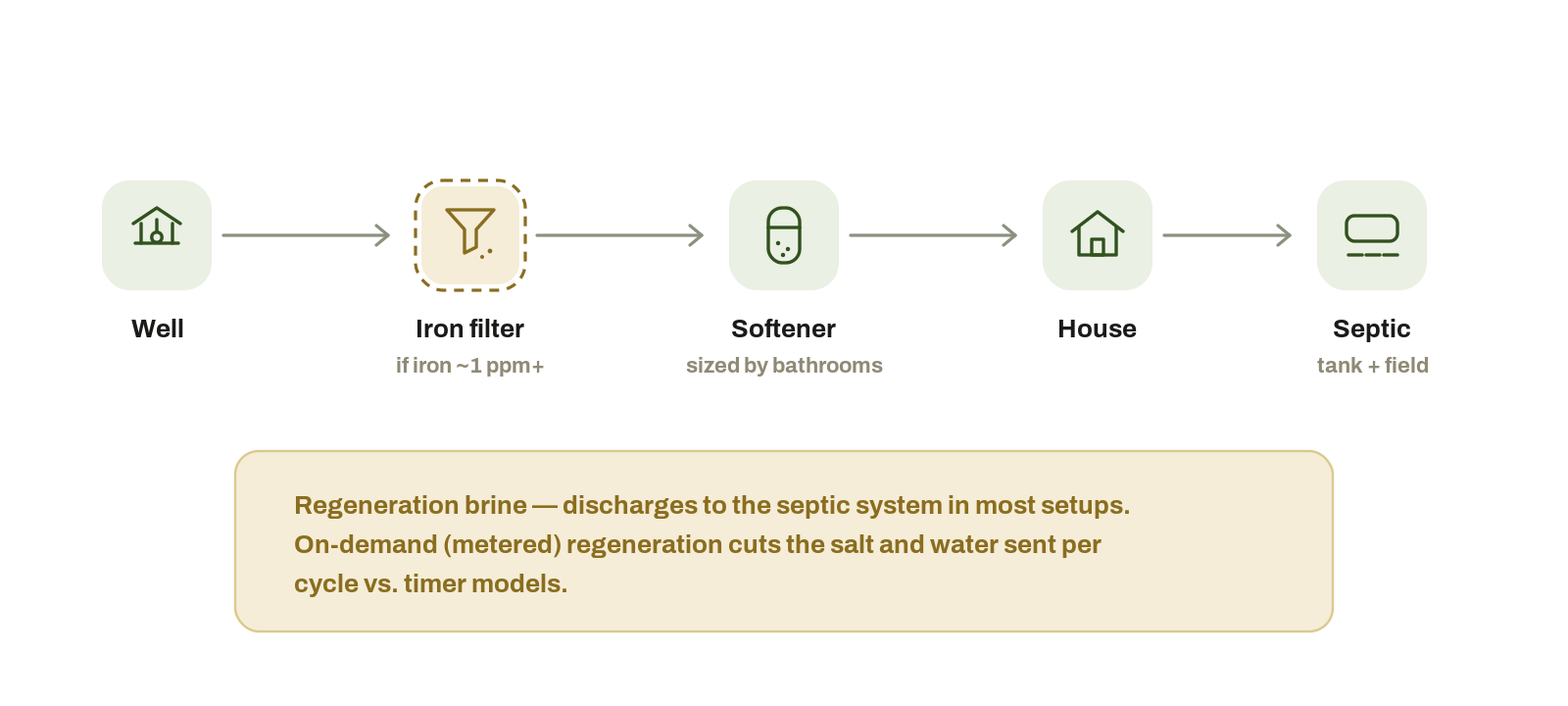
Aerobic system owners have a second requirement: the softener’s drain line may not run through the treatment unit itself. Under §285.37 it must bypass the aerobic plant and tie in downstream: directly to the pump tank or the line between treatment and disposal. If you’re on one of the aerobic systems common across the Hill Country, that’s a detail to settle at install time, not after your maintenance provider finds brine in the aeration chamber. (Contract rules and costs are covered in our aerobic system cost guide.)
Two more clauses in the same rule catch people out. An older softener can be grandfathered right up until you touch the septic system. Units installed before September 1, 2003 may keep discharging as-is, but §285.37 requires replacement with a compliant DIR unit as soon as either the softener is replaced or someone installs, alters, constructs, or repairs the OSSF serving that property. Budget for a new softener alongside any significant septic repair. And whatever the equipment, the rule requires discharge from all water treatment equipment to enter the system through an airgap or airgap device, per the Uniform Plumbing Code as adopted (a detail that fails inspections when a drain line is run straight into a tank fitting).
The science is more reassuring than the folklore. The Water Quality Research Foundation-funded Virginia Tech study (Novak & Hogan, 2013) found that brine mimicking an efficient demand-initiated softener (about 4,000 grains removed per pound of salt) improved septic tank effluent compared with diverting the brine. At about 2,000 grains per pound, the negative effect on effluent “was greatly lessened”; at about 1,000, an inefficient unit, effluent solids, COD and BOD5 rose. The Water Quality Association’s 2019 position paper summarizes the same study as finding that softeners removing 3,000 to 4,000 grains per pound “improved septic tank performance.” Texas A&M AgriLife still recommends keeping back-flush water out of the pretreatment tank where practical: routing it to the pump tank, the drainfield side, or a separate disposal point your permitting authority approves. Efficient DIR softener, correctly plumbed: fine. Ancient timer unit dumping brine into a small tank three times a week: that’s how the folklore started.
FAQ
Are water softeners good for well water?
Yes. Wells are where softeners earn their keep, since private wells get no municipal treatment and Texas groundwater is among the country’s hardest. The caveats: test first, treat iron before or alongside softening, and size the unit to your actual numbers rather than the sticker.
Can a water softener remove iron from well water?
Only a little. Figure up to about 2 ppm of dissolved (ferrous) iron with fine-mesh resin and disciplined maintenance. Above 2–3 ppm, with any red/ferric iron, or with iron bacteria, you need an oxidizing iron filter ahead of the softener. “Removes up to 10 ppm iron” claims on cabinet softeners are marketing, not a plumbing plan.
Do I need a sediment filter before the softener?
On a well, almost always yes. Sand and silt shorten resin life and jam valve pistons. An inexpensive spin-down or cartridge housing ahead of the softener is the cheapest insurance in the whole stack.
Is softened water safe for my septic system?
With a modern demand-initiated softener, yes. The WQA’s research found efficient softeners don’t harm septic performance, and Texas rule 30 TAC §285.37 requires DIR on any post-2003 install that drains to an OSSF. On aerobic systems, the drain must bypass the treatment unit, a plumbing detail your installer needs to know before the first regeneration.
Is $1,600–$3,200 too much for a well softener?
That’s the honest range for warrantied, well-rated equipment: $1,620–$2,700 for the SpringWell SS line and $3,150+ for the iron-handling combo, against $765–$901 for a DIY Fleck system and $1,895 at dealer retail (all prices from the sellers’ own sites, July 2026). The spread buys warranty length, support, and install labor, not softer water. Match the spend to your appetite for wrenches.
Sources & methodology
Prices and specifications were pulled from each seller’s own site on July 31, 2026, and are cited inline; we do not quote Amazon prices because they change hourly. Texas water data comes from USGS, SAWS, Austin Water, and TWDB publications. Septic-discharge guidance comes from 30 TAC §285.37, Texas A&M AgriLife Extension (ESC-015), and the Water Quality Association’s 2019 position paper incorporating the WQRF/Virginia Tech and NSF studies. We have not bench-tested these systems; recommendations synthesize manufacturer specs, installer consensus, and the published research above. Full citation list in the page footer sources block.
Get free quotes from verified septic companies.
Pumping, an inspection, or help fixing a septic system: tell us once and we send it to up to 3 verified septic companies. Free, no spam, delete your request anytime.
Secure form. Sent over an encrypted connection to up to 3 verified septic companies. Never sold to data brokers, and you can have your request deleted anytime.