Septic Inspection Cost in Pennsylvania (2026)
A septic inspection in Pennsylvania costs $350 to $700 with the tank unpumped, and $625 to $1,200 when pumping is part of the job, according to Penn State Extension’s on-lot inspection guidance updated March 11, 2026. Integra Home Inspections publishes a flat $375 inside that range; Chester County Septic starts at $450.
The numbers behind this guide: Inspection without pumping: $350–$700 (Penn State Extension, Mar 2026); $375, or $350 bundled with a home inspection (Integra, accessed Aug 21, 2026). Inspection plus pumping: $625–$1,200 (Penn State). Hydraulic load test: +$500–$1,000 (Penn State) or $750 alone (Integra). Dye test only: $225 (Hill Property Inspections, Johnstown, accessed Aug 21, 2026).
PA septic inspection cost, by type of inspection
The word “inspection” covers at least four different jobs in Pennsylvania, from roughly $200 for a look to $1,200 for a full workup with the tank emptied. Each column below is one source’s own published numbers, on its own date.
| Line item | Penn State Ext. (Mar 2026) | Integra, Lehigh Valley (Aug 2026) | Mountain to Valley, NEPA (May 2026) | Hill, Johnstown (Aug 2026) |
|---|---|---|---|---|
| Visual or transfer-level look | – | – | $200–$350 | – |
| Dye test only | – | – | – | $225 ($175 bundled) |
| Full inspection, tank not pumped | $350–$700 | $375 ($350 bundled) | $400–$700 | – |
| Inspection plus pumping | $625–$1,200 | – | – | – |
| Hydraulic load test | +$500–$1,000 | $350 bundled, $750 alone | – | – |
| Camera or scope add-on | – | – | $150–$300 | – |
| Digging out a buried lid | – | – | $50–$150 | – |
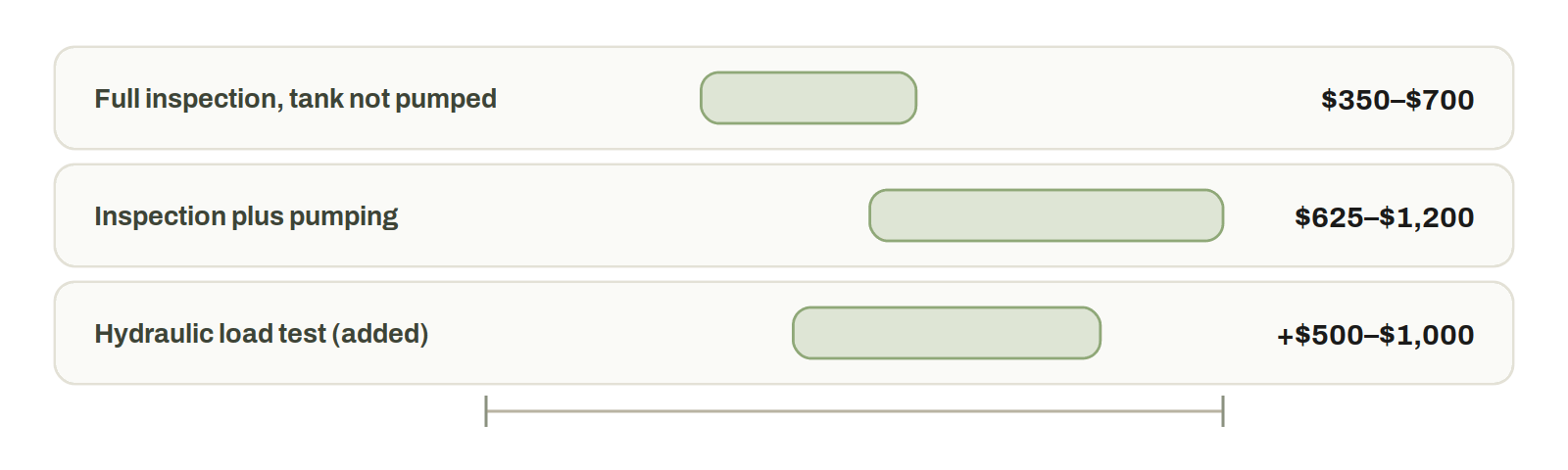
Chester County Septic prices a standard or PSMA inspection from $450, Integra adds $175 for cesspools needing extra loading, and Mountain to Valley tops out at $700 to $900 for large systems. Angi’s Philadelphia page (updated August 4, 2026) models most jobs at $205 to $923, average $564, with routine annual checks at $205 to $260, built from federal price parities. No aggregator publishes a dated city series for Pittsburgh, Erie, Harrisburg or Scranton, and that gap stays a gap here.
Where the $400 spread between two PA quotes comes from
Usually not in the headline price, and that one line is why two PA quotes for “an inspection” can differ by $400. Penn State Extension prices pumping as a separate $275 to $500 item (March 2026); Mountain to Valley in Northeast Pennsylvania calls it a $250 to $500 add-on (May 2026).
A thorough inspection still needs the tank empty at some stage; First Class Home Inspections in Pittsburgh describes a PSMA inspection as pumping plus a functional evaluation of the components (May 26, 2026). Mountain to Valley warns against pumping just before the inspector arrives, because “the inspector needs to see the wastewater at its normal operating level to check for proper flow, blockages, and backflow from the drain field.”
Observe loaded, pump, then examine the empty tank, and ask which steps your quote pays for. Our Pennsylvania pumping cost guide has standalone pumping numbers.
What a sale adds to a routine PA septic check
A routine check answers “is anything wrong yet”; a transfer inspection has to produce a document a lender, a buyer’s agent and possibly a township will accept.
Penn State Extension treats it as a contingency the buyer arranges: “The prospective buyer requests a contingency clause in the purchase agreement that states that a final contract is dependent upon inspection” (updated March 11, 2026). The extra work usually arrives as a hydraulic load test, measuring whether the absorption area can take the household’s flow. Penn State calls for it when “normal wastewater flow cannot be confirmed,” the vacant-house case; Brandywine Septic Services adds a large occupancy change. Penn State’s full stack of inspection, pumping and load test runs $1,125 to $2,200; Integra prices the load test at $350 bundled for homes up to five bedrooms, $750 alone.
Which PA credential actually qualifies a septic inspector?
Pennsylvania issues no septic inspector license and no septic installer license, so there is no state credential to look up. Four things get called a license here; none is one.
| Credential | Issued by | What it covers | A license to inspect? |
|---|---|---|---|
| Sewage Enforcement Officer (SEO) | State Board for Certification of SEOs, via DEP | Permit review, planning modules, permits, inspections for the local agency | No. Authority-side official, not a contractor you hire |
| PSMA certification | Pennsylvania Septage Management Association | Inspector courses 101, 102, 103 and refresher, tied to the PSMA/NOF (National Onsite Wastewater Education and Research Foundation) standards | No. Industry credential, not a government license |
| Home Improvement Contractor registration | PA Attorney General, under HICPA | Contractors doing $5,000+ of home improvement a year; $100 every two years | No. A registration only |
| Septage hauler registration | PA DEP, Solid Waste Management Act | Whoever pumps and hauls the septage; 5-digit number on the truck | No. Covers hauling, not inspecting |
The SEO is the one homeowners try to hire. Under 25 Pa. Code § 71.1 that officer is “an official of the local agency who reviews permit applications and sewage facilities planning modules, issues permits as authorized by the act and conducts investigations and inspections that are necessary to implement the act and the regulations thereunder”: work done for the municipality during permitting, not for a buyer at closing.
The Attorney General is blunt about what its registration proves: “Registration under HICPA is not an endorsement, recommendation or approval by the Office of Attorney General of the contractor’s competency or skill.”
That leaves PSMA certification as the credential PA inspectors advertise, with some municipalities keeping their own. Doylestown Township in Bucks County requires inspection “by a Doylestown Township approved pumper/hauler/installer every three years” (Ordinance No. 299, 2001); neighboring Plumstead makes pumper-haulers register with the township and show county and DEP credentials (Ordinance No. 2021-05, January 2023).
Reading a PA inspection report: what “passed” means
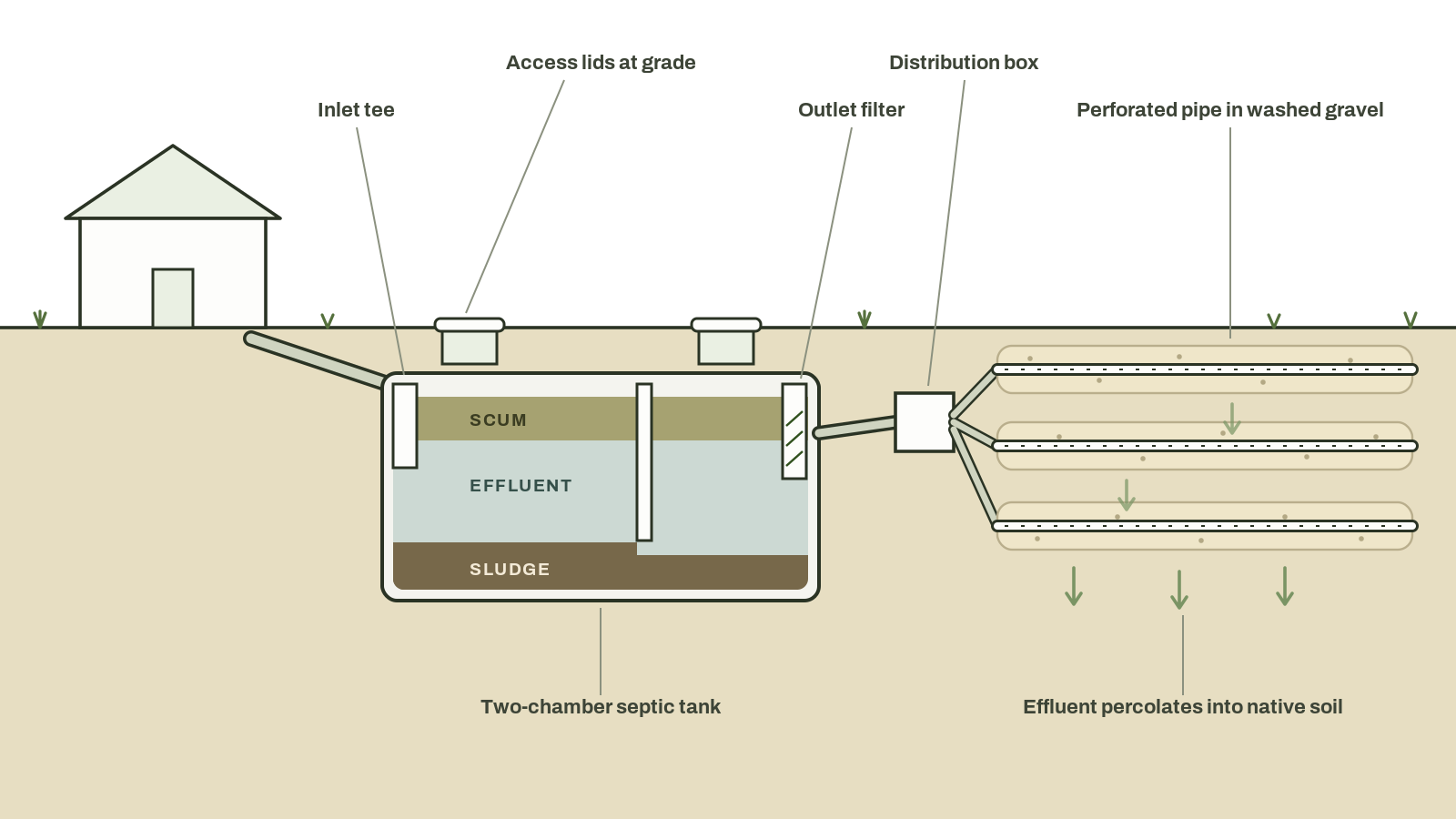
A Pennsylvania report should describe each component’s condition and conclude whether the system can handle the household’s wastewater, not simply record “no visible issues.” Penn State Extension describes it as covering “the condition of the septic system components, including the tank, the distribution system, and the drainfield/absorption area.”
Inspectors’ own component lists fill in the detail: structural integrity, baffle condition, solids accumulation, the drain field checked for surface breakout, odors, or saturated soil, and the distribution box where reachable (First Class Home Inspections, May 26, 2026). John Kline Septic in Lancaster County adds pump and float operation, liquid levels, verified flow to the absorption area, and measured separation distances between tanks, well, and drainfield (September 2020).
Pennsylvania sets no statewide pass-or-fail standard. “Passed” means whatever the party who ordered the report decides, so ask whose criteria yours is written to satisfy.
Does PA require a septic inspection when you sell?
No. Pennsylvania has no statewide point-of-sale septic inspection mandate, and the requirement, where one exists, comes from your municipality or your lender. Act 537, the Sewage Facilities Act (35 P.S. §§ 750.1–750.20), is administered locally under 25 Pa. Code Chapters 71 through 73, with DEP overseeing.
Who can demand an inspection is therefore set street by street. Our validated extract of DEP’s service-area tabulations counts 1,806 local agencies and joint local agencies holding permitting power, 1,782 of them individual municipalities; Philadelphia answers to the City of Philadelphia. That extract rests on a 2015 DEP table, corrected for Delaware County on August 21, 2026 and nowhere else: Delaware County’s health department has issued on-lot permits for 36 of its 49 municipalities since June 1, 2023, the other thirteen staying outside its environmental health services after litigation the county did not appeal. Any of them may adopt a sewage management program, which 25 Pa. Code § 71.73(b)(1) requires to identify the legal authority for municipal officials “to enter lands and make inspections of onlot sewage facilities.”
Verify your own municipality, not a state-level summary. Two cautions. DEP publishes no annual on-lot permit counts or malfunction totals, so any statewide failure rate quoted at you was built, not measured. And the “dye test” demanded at closing across western Pennsylvania is a sewer test: Kennedy Township in Allegheny County charges $250 for one at sale or refinance and says it “is not required on vacant land or properties with septic systems” (effective May 1, 2026).
What to ask before you book a PA inspection
Each of these five questions changes what you are actually buying.
- Is this written to the PSMA/NOF procedure, and do I get the completed report form?
- Is the tank opened and emptied within this price, or billed separately at pumping rates?
- What would trigger a hydraulic load test here, and what does it add?
- Does my municipality keep an approved inspector or hauler list, and are you on it?
- Who hauls the septage, and what is the DEP registration number on the truck?
The last is checkable on sight: DEP requires registered haulers to display a five-digit number at least three inches tall on the truck, and publishes an active hauler workbook dated April 2024. Roughly 605 million gallons of residential septage move under that registration each year. Our septic inspection service page covers what to watch between visits; the Chester County page shows one of six county health departments at work.
FAQs
How much is a septic inspection in PA?
Plan on $350 to $700 without pumping and $625 to $1,200 with it, per Penn State Extension (March 2026). Published PA prices sit inside that: $375 at Integra, from $450 at Chester County Septic. A $225 dye test is cheaper but no substitute.
Do PA inspectors pump the tank as part of the job?
Only if the quote says so. Penn State Extension lists pumping as a separate $275 to $500 item, NEPA inspectors as a $250 to $500 add-on. The tank does need emptying at some stage so the walls and baffles can be seen.
Who pays for the septic inspection in Pennsylvania, buyer or seller?
It is negotiable in the agreement of sale. No Pennsylvania rule assigns it. The common central-PA split, per John Kline Septic, is the buyer paying the inspection and the owner the pumping.
Can my home inspector do the septic inspection?
Some can, because no Pennsylvania license restricts who may inspect a septic system. Several PA firms hold PSMA certification and bundle the visits, which is cheaper: Integra charges $350 bundled versus $375 alone. Ask whether whoever opens your tank is PSMA certified.
Sources & Methodology
Prices come from published Pennsylvania sources, each shown separately with its own date: Penn State Extension (March 11, 2026), rate cards from Integra Home Inspections, Chester County Septic and Hill Property Inspections (accessed August 21, 2026), and dated breakdowns from Mountain to Valley (May 19, 2026) and First Class Home Inspections (May 26, 2026). Angi’s Philadelphia page (August 4, 2026) is a model built from federal price parities, labeled as such. We do not average across sources.
Regulatory statements come from primary material: 25 Pa. Code §§ 71.1 and 71.73, DEP’s Sewage Enforcement Officer and septage hauler pages, the Attorney General’s contractor registration page, and the township ordinances above. The 1,806 figure is Nearby Septic’s extract of DEP service-area tabulations, validated August 2, 2026 and corrected for Delaware County on August 21, 2026. Where Pennsylvania publishes nothing, we say so. Every provider listed on our Pennsylvania county pages passes the credential checks set out in how we verify.
Do this work for a living?
- Credential-matched claim
- You control your profile
- Quote-request alerts
Get free quotes from verified septic pros.
Pumping, an inspection, or help fixing a septic system: tell us once and we send it to up to 3 verified pros. Free, no spam, delete your request anytime.
Secure form. Sent over an encrypted connection to up to 3 verified pros. Never sold to data brokers, and you can have your request deleted anytime.