Septic Tank Pumping Cost in Pennsylvania (2026)
A routine septic pump-out in Pennsylvania costs about $360 to $475 in Lancaster County and $470 to $615 in Chester County, according to Sonlight Services’ dated 2026 price posts (March and April 2026), a DEP-registered hauler that publishes its numbers. In Bucks County, Camerlengo Septic quotes $300 to $500 for a 1,000-gallon tank (July 2025). Statewide estimates cluster lower, $305 to $505 (SepticTankHub, June 2026), but carry no sources.
Key figures up front: Lancaster County routine pump-out: $360–$475; Chester County: $470–$615 (Sonlight Services, posts dated Mar 17 and Apr 21, 2026). Bucks County, 1,000-gallon: $300–$500, roughly $400 typical (Camerlengo, Jul 2025). Hauled septage disposal at Pennsylvania-American Water plants: $45–$100 per 1,000 gallons by solids content (PUC tariff, effective Aug 2024). Penn State Extension pumping cycle: every 2–3 years (fact sheet, 2023).
What will pumping cost by tank size in Pennsylvania?
The most credible Pennsylvania numbers come from pumpers who publish prices, and the spread between sources is itself the finding. Each column below is one source, reported separately; we never merge them into a fake average.
| Tank size | Camerlengo, Bucks Co. (Jul 2025) | Septic & Well Pro PA estimate (Apr 2026, unsourced) | HomeAdvisor national (Jun 2026) |
|---|---|---|---|
| 750 gal | $250–$350 | $275–$375 | $250–$550 |
| 1,000 gal | $300–$500 | $375–$450 | $325–$700 |
| 1,250 gal | – | $400–$500 | $375–$900 |
| 1,500 gal | $500–$700 | $450–$575 | $450–$1,100 |
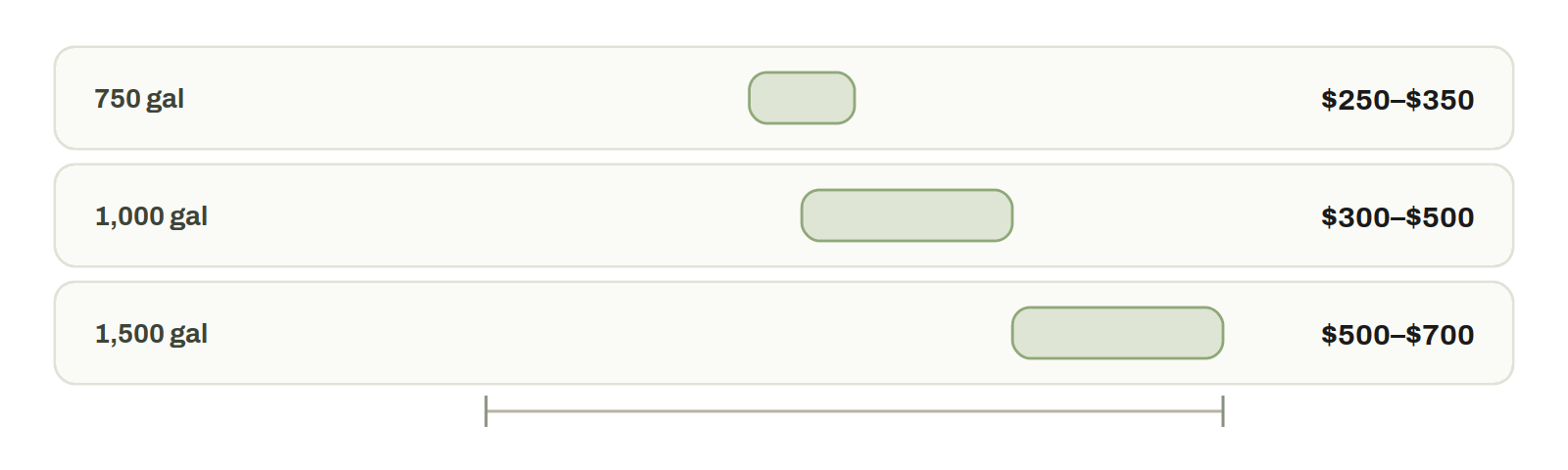
Sonlight’s county figures ($360–$475 Lancaster, $470–$615 Chester) are complete-job prices rather than size-split rates, and they include the pump-out, disposal, a basic visual inspection, a filter check, and a written report (posts dated Mar–Apr 2026). Their pricing page adds something rarer than a number: a list of fees they don’t charge, including fuel surcharges and standard-access hose fees (accessed Aug 10, 2026).
The southeast premium is real and citable: the same company charges roughly $100 more per job in Chester County than in Lancaster County. Disposal distance, wage costs, and township paperwork all live inside that gap.
Your township may require pumping by law
In much of Pennsylvania, the pumping schedule is not advice, it is an ordinance, and skipping it carries fines. Under Act 537, townships adopt sewage management programs that mandate pump-outs on a fixed cycle. Three examples from the townships’ own pages:
- Westtown Township (Chester County): pump at least once every three years and have a PSMA-certified inspection on the same cycle, with receipts due to the township by October 31. The program fee is $24 per year, billed with trash service (Ordinance 2013-3; township page updated June 2026). About 43% of the township’s properties are on septic.
- Plumstead Township (Bucks County): pump every three years using a hauler licensed by the Bucks County Health Department and DEP, with the report filed within 30 days. Noncompliance carries a fine of up to $500 plus court costs (Ordinance 2021-05; program began January 2023).
- Strasburg Township (Lancaster County): pump every three years, with a five-year extension available to households of one or two permanent occupants who apply for it (Ordinance #92 of 2015). The township publishes its own list of registered pumpers.
Dozens of other townships in Chester, Bucks, and Lancaster counties run the same model. Practical upshot: before you price a pump-out, check whether your township mandates one, on what cycle, and whether your hauler must be registered with it. Your municipality’s rules and permitting contacts are on your county page; start at Lancaster or Chester, or find yours from the Pennsylvania hub.
How often should you pump, according to Penn State?
Penn State Extension recommends pumping every two to three years, which is more aggressive than the national three-to-five-year interval and is grounded in published math. The Extension’s fact sheet (updated July 2023) calculates that each adult adds roughly 60 gallons of solids per year after digestion. Hence, a family of four fills the working storage of a 1,000-gallon tank in about a year and a half. The same sheet carries the state’s tank-sizing floor: a three-bedroom home requires at least a 900-gallon tank, four bedrooms 1,250 gallons. Two of its field rules are worth repeating verbatim in spirit: pump through the maintenance hole access port rather than the small baffle-inspection ports, and skip additives, which the Extension calls unnecessary. DEP’s own guidance says three to five years depending on tank and household size (pa.gov, accessed Aug 10, 2026); where your township has an ordinance, the ordinance wins.
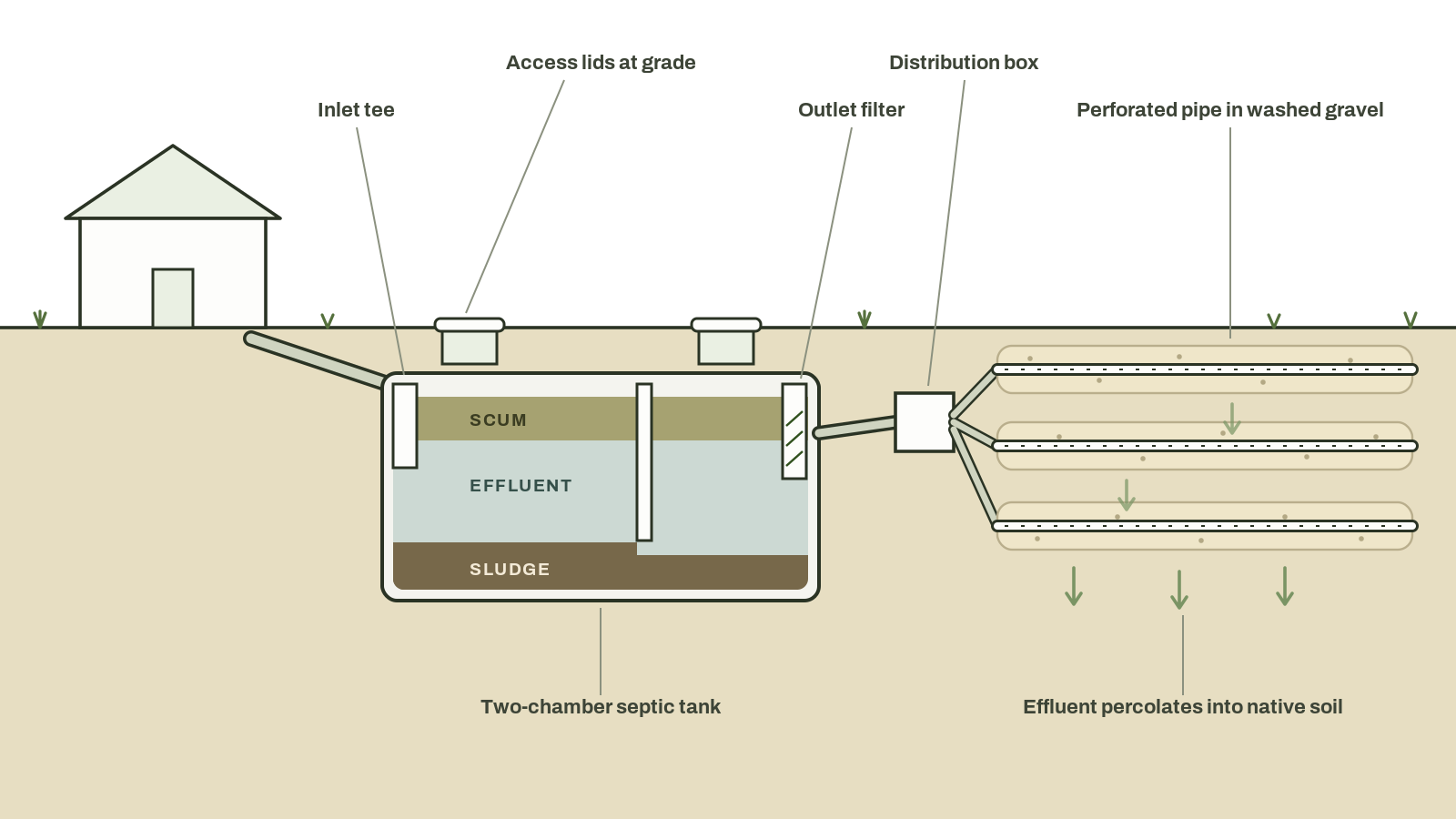
On a three-year cycle at Lancaster County’s published price, budget roughly $120 to $160 a year for the habit that protects a drainfield worth ten to a hundred times that.
Where the disposal dollars go
Pennsylvania is one of the few states where you can read the actual disposal tariff behind your bill. Haulers pay treatment plants to accept septage, and Pennsylvania-American Water’s PUC-filed wastewater tariff (effective August 2024) prices residential septage by solids content: from $0.045 per gallon at 3% solids up to $0.10 per gallon at 8%, which is $45 to $100 for a typical 1,000-gallon load. Its Exeter Township zone runs cheaper at $0.032 per gallon. Plants can also cap the number of loads a hauler brings per day, which pushes trucks farther and adds miles to rural jobs. Statewide, Pennsylvania households generate roughly 605 million gallons of septage a year (DEP hauler-registration figures), all of which has to be hauled somewhere legal. When a quote in the Poconos or the Laurel Highlands runs higher than a Lancaster one, disposal distance is usually the quiet reason.
One credential note while you’re comparing: DEP septage haulers are registered, not licensed. Registration is a filing, not an endorsement, which is why we verify listings against the DEP registry and say exactly what that does and doesn’t prove (how we verify).
What the SEO does, and doesn’t do
Your Sewage Enforcement Officer will not show up for a routine pump-out, and any guide that implies otherwise is guessing. SEOs administer Act 537 for municipalities: site testing, permits for new and repaired systems, construction inspections, and enforcement of malfunctions (25 Pa. Code § 72.41). Routine pumping compliance runs on the pumper’s receipt and is filed with the township where an ordinance requires it. The SEO enters the picture when something is failing. If your system is at that stage, pumping is a stopgap, and the township and SEO conversation comes next; our pumping service page covers the failure signs that separate the two situations.
Add-on fees to ask about before the truck rolls
Most surprise charges on a Pennsylvania pumping bill are predictable, and several have published figures. Digging out a buried lid runs $50 to $150 (Septic & Well Pro PA, Apr 2026; septictankhub, Jun 2026). A riser that eliminates digging permanently runs $200 to $400 installed (same sources). Long hose runs beyond 100 feet add $25 to $50 per extra 50 feet (Septic & Well Pro PA, Apr 2026). Emergency and after-hours work carries the widest spread: 50 to 100% premiums with Pennsylvania emergency jobs at $500 to $900 (Septic & Well Pro PA, Apr 2026), and Camerlengo in Bucks County says weekend emergency work “can be double” a scheduled visit (Jul 2025). Winter frozen-ground surcharges of $100 to $300 appear in the northern tier (Septic Tank Hub, Jun 2026). The cheapest version of every one of these fees is the scheduled, daytime, marked-lid version.
You can double-check any quote against tank size with our septic cost calculator.
How to vet a Pennsylvania pumping quote
A good Pennsylvania quote answers five questions; a lead-generation quote answers none of them.
- Is the price all-in: pump-out, disposal, filter check, and a written report?
- Are you DEP-registered, and registered with my township’s program if it has one?
- Will you file the township receipt, or do I?
- What do you charge to locate or dig, and is a riser worth it for my lid depth?
- What would this same job cost scheduled versus as an emergency?
Two of the companies whose published prices anchor this guide are verified listings in our directory: Sonlight Services and John Kline Septic Services, both of which were checked against DEP’s hauler registry. Every county’s verified providers are on its county page.
FAQs
How much is it to pump a 1000 gallon septic tank?
In Pennsylvania, $300 to $500 by the one published local price, with all-in county jobs from $360 to $615. Camerlengo in Bucks County publishes $300–$500 for a 1,000-gallon tank, with $400 typical (Jul 2025); Sonlight’s complete-job prices run $360–$475 in Lancaster County and $470–$615 in Chester County (Mar–Apr 2026). National estimates stretch to $700 (HomeAdvisor, Jun 2026), which mostly reflects averaging across states that aren’t yours.
How often does a 1000 gallon septic tank need to be pumped out?
Every two to three years by Penn State Extension’s math, and every three years by ordinance in many townships. The Extension calculates a family of four fills a 1,000-gallon tank’s working storage in about 18 months (fact sheet, 2023). Townships like Westtown, Plumstead, and Strasburg mandate a three-year cycle regardless of your math.
Can a septic tank go 20 years without being pumped?
Not safely, and in a sewage-management township, not legally. Unpumped solids migrate to the drainfield and destroy it, which turns a few-hundred-dollar habit into a five-figure replacement. In townships with Act 537 pumping ordinances, two decades of skipped pump-outs also amount to a stack of violations with fines attached.
How long do septic tanks last in Pennsylvania?
Decades for the tank; the drainfield is what your pumping schedule actually protects. Concrete tanks routinely serve 40 years or more. Drainfields fail early for one dominant reason: solids carryover from tanks that were pumped rarely or never. The pumping cycle is drainfield insurance, priced at a few hundred dollars every few years.
Is there a septic pumping cost calculator for Pennsylvania?
Yes, ours. The septic cost calculator turns tank size into a budget range you can hold against any quote, and this page’s tables show you the published Pennsylvania prices behind it.
Sources & Methodology
This guide’s figures come from published Pennsylvania pumper prices (Sonlight Services’ dated 2026 county posts and pricing page; Camerlengo Septic’s 2025 Bucks County post), township ordinances read on the townships’ own sites (Westtown, Plumstead, Strasburg), Penn State Extension’s pumping fact sheet (2023), PA DEP guidance, the PUC-filed Pennsylvania-American Water wastewater tariff (2024), and dated aggregator estimates labeled as such. Sources are reported separately, never blended into a single average. No independent 2026 price series exists for Pittsburgh, the Poconos, or any western Pennsylvania metro; rather than estimate one, we say so, and western PA prices here are limited to what’s honestly available. Provider links go to listings verified against DEP’s septage hauler registry; the method and its limits are documented at how we verify.
Do this work for a living?
- Credential-matched claim
- You control your profile
- Quote-request alerts
Get free quotes from verified septic pros.
Pumping, an inspection, or help fixing a septic system: tell us once and we send it to up to 3 verified pros. Free, no spam, delete your request anytime.
Secure form. Sent over an encrypted connection to up to 3 verified pros. Never sold to data brokers, and you can have your request deleted anytime.