How to Clean a Septic Effluent Filter (Texas, 2026)
Cleaning your own effluent filter is legal in Texas without a permit, a license, or a phone call to the county. Texas rule 30 TAC §285.2(35) defines maintenance to include “cleaning” and the “replacement of pumps, filters, aerator lines, valves, or electrical components,” and it says plainly that maintenance “does not include alterations.” That single sentence is what separates a Saturday chore from a permitted repair. The job needs a garden hose, gloves, and no special tools.
Heads up: this guide contains one Amazon affiliate link. As an Amazon Associate we earn from qualifying purchases. It never changes what we recommend. Details in our affiliate disclosure.
Is cleaning a filter really unregulated in Texas?
Yes, and the rule chain is short enough to check yourself. 30 TAC §285.3(a) lists five things you need a permit for, and building, altering, and repairing are three of them. Cleaning a filter is none of the five, because the definitions rule it out one by one.
§285.2(35) puts cleaning and filter replacement inside maintenance. §285.2(61) then defines repair as replacing components “excluding maintenance.” So a task that is maintenance cannot also be a repair, and the permit trigger never fires.
Two boundaries are worth knowing, because they are where homeowners actually get into trouble.
The first is the housing, not the cartridge. Pulling the cartridge out and rinsing it is maintenance. Cutting out the filter housing, changing the outlet tee, or moving the tank’s plumbing is a different animal: §285.35(b) lists “replacing inlet and outlet devices” under Emergency Repairs, and §285.35(c) requires written notice to the permitting authority within 72 hours of starting one. If you are replacing hardware rather than washing it, you have left the maintenance lane.
The second is the aerobic question. If your system is an aerobic treatment unit, §285.7 requires a maintenance contract, and §285.7(a) exempts only “homeowners who maintain their own systems,” under the conditions in §285.7(d)(4). That exemption applies to single-family residences, not commercial, speculative residential, or multifamily property. Many counties also want a maintenance contract on file. Our Texas aerobic maintenance contract guide covers who can sign one and what it must contain, and the statewide rules overview covers the rest of the permit picture.
Do you even have a filter?
Texas does not require an effluent filter, so many older tanks have none. What the state regulates is the filter you choose, not whether you have one: §285.34(a) sets an NSF Standard 46 listing requirement for any filter installed in a septic tank. TCEQ keeps a published list of approved products, and the replacement you buy should be on it. That single check is the difference between a Texas-legal cartridge and a plausible-looking one from a national listicle.
The filter, if you have one, sits in the outlet tee on the far end of the septic tank, the end nearest the drain field. It is a plastic cartridge that slides down inside the tee, usually with a handle at the top. Do not confuse it with the inlet baffle at the opposite end, which is a fixed pipe and is not removable.
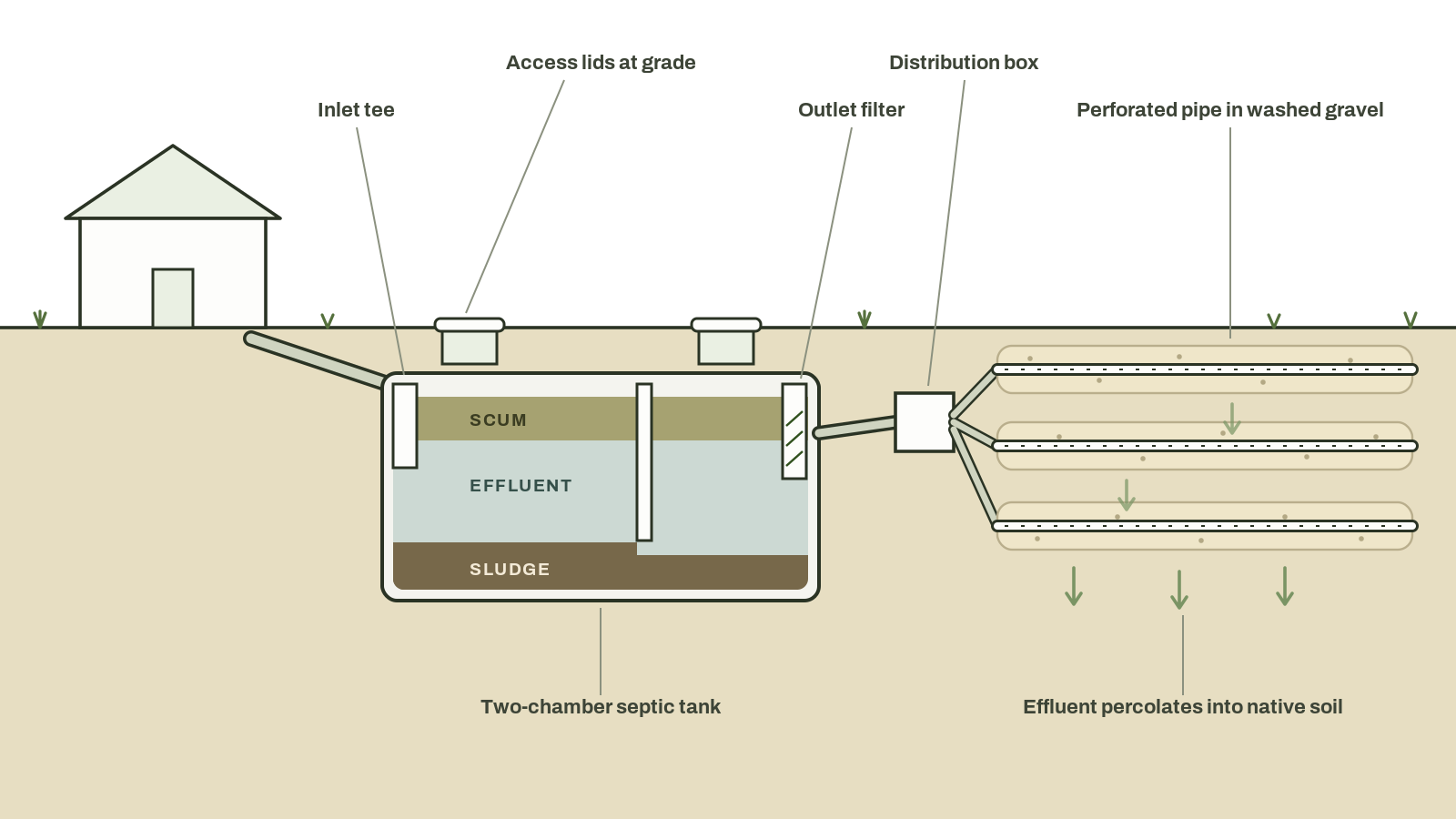
What a clogging filter feels like
Slow drains everywhere in the house at once, arriving gradually over weeks, is the signature. A clog under one fixture is a plumbing problem. A filter doing its job poorly slows the whole house because it throttles the tank’s only exit.
Sewage backing up into the lowest drain, gurgling toilets, and a high-water alarm are later stages of the same thing. If an alarm has sounded, treat it as the system telling you the outlet is restricted; our septic alarm guide explains what the different alarm conditions mean.
The procedure
A garden hose, gloves, and one rule that overrides all the others: you never put any part of yourself inside the tank.
- Find the outlet lid. It is the tank lid closest to the drain field. On a riser, it unscrews or unclips. For a buried tank, you’ll need to dig.
- Open it and step back for a minute. Let the gas clear before you put your face anywhere near the opening.
- Look at the liquid level before you touch the filter. If it is abnormally high, sitting at or above the inlet or outlet baffle, stop. Public-health guidance is explicit that you should not pull the cartridge in that condition, because doing so “will flush extra sewage, solids, floating scum, grease, into the drainfield, potentially clogging it or shortening its life.” Get the tank pumped first.
- Position a bucket. You want everything that comes off the filter to land in the bucket or back in the tank, never on the ground and never on the drain field side.
- Pull the cartridge straight up by its handle. It should lift out of the tee without force. If it fights you, stop and look for a locking tab rather than pulling harder.
- Hose it off over the open tank or the bucket. A garden hose and moderate pressure is all it takes. The solids you are rinsing belong back in the tank, where they will settle.
- Inspect it. Cracked plastic, a broken handle, or a cartridge that no longer seats squarely means replacement rather than another year of service. If yours is a Tuf-Tite tee, the EF-4 replacement cartridge drops into the same housing; our effluent filter guide covers the other brands.
- Seat it back in the tee and close the lid properly. An unsecured lid is the single most dangerous thing you can leave behind.
The safety rules that are not negotiable
Never enter a septic tank, and never lean into an open one. Septic tanks generate hydrogen sulfide and methane and displace oxygen. The atmosphere inside is a confined space in the technical sense, and it can be fatal within a breath or two. People die in septic tanks every year in the United States, and a common pattern is a second person dying while trying to help the first.
Work from outside the tank, standing up, with the lid open no wider than the job requires. Keep children and pets away from the opening for the whole job. Do not smoke near it. Wear waterproof gloves and eye protection, and wash thoroughly afterward.
One more: an unsecured tank lid is a drowning and fall hazard. If a lid is cracked or does not seat, replace it before you walk away, not next weekend.
How often, and what cleaning will not fix
There is no single correct interval, and the authorities that address it publish a range rather than a number. Bemidji Area Indian Health Service guidance states that cleaning frequency “may range from every few months to every few years, depending on system usage, wastewater flow, septic system design, and the type of filtration used,” and that manufacturers “recommend that the filters be cleaned every time the tank is pumped or at least every three years.”
The same guidance offers the more useful rule: “Most effluent filters will need to be inspected and cleaned more often than the septic tank is pumped out.” So inspect on a schedule you will actually keep, and let what comes out of the tee set the interval. A cartridge that lifts out heavily loaded tells you to shorten the interval; one that comes out nearly clean tells you the opposite. The best moment to clean it is right after a pump-out, when the tank is empty, and nothing can bypass the filter into the drain field.
Cleaning the filter is not a substitute for pumping. The filter keeps solids out of your drain field; it does nothing about the sludge and scum accumulating in the tank, which is what pumping removes. If you have skipped pumping, see Texas septic pumping costs and get on a schedule.
If you clean the filter and the drains are still slow, the problem is downstream and cleaning it again will not help. That points to the drain field, the pump, or a line, and it is a service call.
When the cartridge needs replacing, match the size and tank outlet rather than buying by price, and check the model against TCEQ’s approved list. We compare common residential cartridges in best septic tank effluent filters for Texas homes, and the rest of our maintenance parts coverage is in the supplies hub.
Frequently asked questions
Can I clean my own septic filter in Texas, or do I need a licensed provider?
You can clean it yourself. 30 TAC §285.2(35) classes cleaning and filter replacement as maintenance and states that maintenance “does not include alterations,” and §285.2(61) excludes maintenance from the definition of repair, so §285.3(a)’s permit requirement does not reach it. The exception is an aerobic treatment unit under a maintenance contract, where §285.7 governs who services the system.
How often should a septic effluent filter be cleaned?
No single interval is published, and the guidance that exists gives a range. Bemidji Area IHS puts it at “every few months to every few years” depending on usage, flow, system design, and filter type, with the manufacturer convention being every pump-out or at least every three years. Since most filters need attention more often than the tank needs pumping, inspect more often than you clean and let the cartridge set the schedule.
What happens if I never clean it?
The filter blocks, the tank’s outlet throttles, and sewage backs up toward the house. That is the filter working as designed, since the alternative is those solids leaving the tank and blinding your drain field, which is a repair measured in thousands rather than minutes.
Can I just remove the filter instead of cleaning it?
No. Removing it sends suspended solids straight to the drain field and shortens its life. It also puts the system out of step with the planning materials it was permitted under.
Where does the rinsed material go?
Back into the septic tank, or into a bucket you empty into the tank. Never onto the ground, never into a storm drain, and never onto the drain field side of the system.
Is a filter required on a Texas septic system?
No. 30 TAC §285.34(a) sets a standard for filters that are installed rather than requiring one, so plenty of older Texas tanks have no filter. Adding one to an existing tank is worth discussing with a licensed installer, because it changes hardware rather than washing it.
Sources and methodology
One definition carries this whole page, so it got the most scrutiny: 30 TAC §285.2(35) was checked against current Texas Administrative Code text on August 24, 2026, and the wording quoted above is what the rule says today.
The supporting provisions were re-read against current Texas Administrative Code text on September 5, 2026, at the publish gate: §285.2(61), §285.7(a) and (d)(4), §285.34(a) and §285.35 all say what this page quotes. §285.2, §285.7 and §285.34 were last amended effective July 6, 2023; §285.35 in 2012. One wording difference surfaced and is not a change in the rule: current §285.34(a) names “NSF International Standard 46 (2000)” where an older state-hosted compilation reads “National Sanitation Foundation (NSF) Standard 46 (2000)”.
Safety guidance here is deliberately conservative and stops well short of anything requiring equipment or training. Where the honest answer was “do not do this yourself,” that is the answer given.
TCEQ has an open rulemaking revising Chapter 285. When a citation here moves, this page moves with it.
This page explains what the Texas rules say and is not legal advice. Counties may go further than the state does: Comal County, for instance, permits every system regardless of acreage.
Get free quotes from verified septic pros.
Pumping, an inspection, or help fixing a septic system: tell us once and we send it to up to 3 verified pros. Free, no spam, delete your request anytime.
Secure form. Sent over an encrypted connection to up to 3 verified pros. Never sold to data brokers, and you can have your request deleted anytime.