Septic Tank Pumping Cost in Texas (2026)
Pumping a standard 1,000-gallon septic tank in Texas costs $225 to $650 in 2026, the full span of the four published price series cited here: Angi’s Dallas data ($225–$400 for that tank size), Angi Austin ($250–$600), Angi Houston ($275–$600), and Hill Country provider pricing from Dillon Septic ($350–$650). City averages differ more than most homeowners expect: Angi puts Dallas at $314, Houston at $375, and Austin at $435. Nationally the average pump-out is $428, with most homeowners paying $291–$564; your price moves with tank size, how easy the lids are to reach, and how long since the last pump-out.
…, and its own docstring records the old drop as the bug it fixed. The div path shipped 2026-08-16, which is what the DRIFT WARNING flag’s parenthetical and the republished_prod line already said; this comment and the PUBLISH BLOCKER flag were the two places that never got updated. Original text, now false, follows: md2blocks.py currently DROPS raw
Sources: Angi Dallas, Austin and Houston cost data (all May 2026) and Dillon Septic, Central Texas (Aug 2026); Angi national (Jul 2026); US EPA; time on site per Dillon Septic.
How Much Does Septic Pumping Cost by Tank Size?
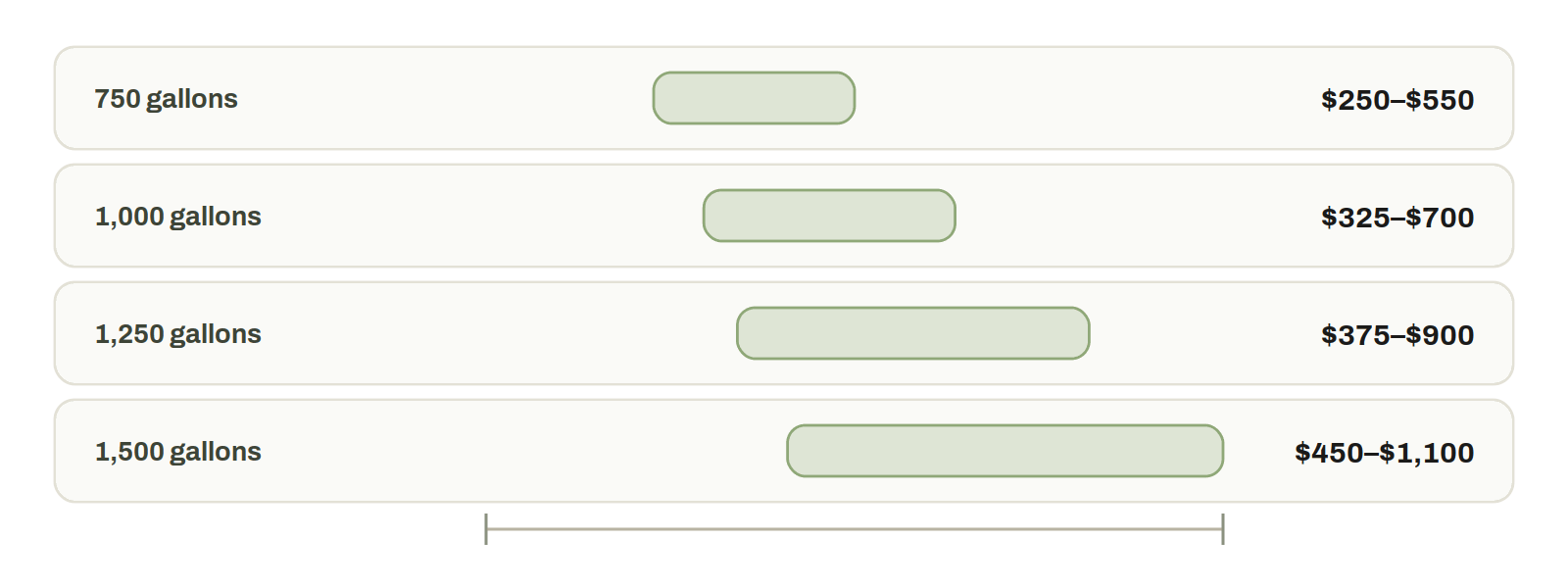
A 1,000-gallon tank (the most common size in Texas homes) runs $325–$700 nationally and $350–$650 from Central Texas providers, and every step up in tank size adds roughly $100–$200. Bigger tanks mean more gallons hauled and higher disposal fees at the treatment plant, which is why pumpers price by capacity first.
Two current datasets side by side, a national cost survey and published 2026 pricing from a Hill Country pumper:
| Tank size | National range (Angi, Jul 2026) | Central Texas provider (Dillon Septic, Aug 2026) |
|---|---|---|
| 750 gallons | $250–$550 | $275–$450 (quoted for 500–750 gal) |
| 1,000 gallonsMost common | $325–$700 | $350–$650 |
| 1,250 gallons | $375–$900 | $450–$850 |
| 1,500 gallons | $450–$1,100 | $450–$850 |
| 2,000+ gallons | — | $700–$1,200 |
Not sure what size you have? Most Texas homes built since the 1990s carry 1,000–1,250 gallons for three to four bedrooms, and your county’s permit file lists the exact specs. In Kerr County, for example, the environmental health office can pull the original schematic on request.
What Do Texans Pay by Region?
Dallas is the cheapest major Texas metro to pump a septic tank and Austin is the most expensive, a gap of $121 on the average job. Angi puts the Dallas average at $314, Houston at $375, and Austin at $435. Provider density drives the spread: DFW and metro Houston have dozens of competing pumpers, while a ranch outside Junction might be an hour from the nearest vacuum truck.
| Market | Average pump-out | 1,000-gal range | Basis |
|---|---|---|---|
| Dallas | $314 | $225–$400 | Angi Dallas cost data, May 2026 |
| Houston area | $375 | $275–$600 | Angi Houston cost data, May 2026 |
| Austin | $435 | $250–$600 | Angi Austin cost data, May 2026 |
| Hill Country / Spring Branch | not published | $350–$650 | Dillon Septic published pricing, Aug 2026 |
| San Antonio area | not published | $375–$750 | Van Delden Wastewater Systems, Apr 2025 |
| National baseline | $428 | $325–$700 | Angi, Jul 2026 |
Two cautions on that table. The San Antonio figure comes from a 2025 page, the newest published San Antonio number we could find, so treat it as older than the rest. And Angi publishes no Fort Worth or San Antonio pumping-cost page at all, which is why neither appears with an Angi average; we checked rather than assumed.
Published price lists from actual Texas operators are rare, and that itself is worth knowing. We fetched the sites of six Austin-area septic companies while refreshing this page, and not one of them publishes a price. The clearest exception is HomeField Onsite in Travis County, whose rate card (updated August 2, 2026) reads: $395 to pump a small 500-gallon conventional tank, $495 for a standard conventional pump-out, $650 for an aerobic pump-out, a $95 service call, and $75 per foot of digging. That $650-versus-$495 gap is the most useful Texas-specific number on this page: it prices the aerobic premium at about 31%, and aerobic systems dominate new Texas permits.
Rural Texas adds one more line item: distance. Pumpers charge travel or trip fees when your property sits well outside their route territory. Published bands for that surcharge run $25 to $75 (Texas Septic Guide, verified March 2026), and the operator-published trip fees we have located run $35 (ACE Enterprise, Georgetown, maintenance-contract PDF) to $95 (HomeField, Travis County, August 2026) and $99 (Cosmic Septic, Houston, September 2026). No Texas septic pumper publishes a per-mile pump-out rate, so ask.
In thin-provider counties there may be only one or two companies to call, which is why our directory is organized county by county, right down to Kerr County. Before you book a rural job, confirm the trip charge to your address and how the company bills disposal. Both get baked into rural quotes.
What Makes a Pump-Out Cost More Than the Quote?
Buried lids, years of neglect, and grease are the three most common reasons a $400 job becomes a $700 one. The quote assumes the truck can park near an exposed lid on a tank pumped within the past five years. Break any of those assumptions and the meter runs.
The big adders, from 2026 cost data:
Locating and digging. If your lids are under 18 inches of St. Augustine and nobody remembers where, the crew digs by the hour. In one Central Texas example this year, a tank buried under a stone patio pushed a routine pump-out to $850 (Dillon Septic, 2026). A one-time riser installation brings the lid to grade and ends the digging fee permanently, typically paying for itself within two or three pumpings.
Neglect surcharges. A tank that’s gone seven-plus years builds compacted sludge that takes extra time and water to break up. A rental property in that condition ran $720 against a $480 norm in the same 2026 provider data.
Grease. Heavy fat, oil, and grease loads clog hoses and take longer to evacuate. Houston-area data shows severe cases adding up to $400 (Angi, May 2026).
Add-on services. Filter cleaning, effluent-filter replacement, or baffle repairs add roughly $200–$600 when needed (Angi Houston data, May 2026). Ask the crew to show you the worn part before approving it.
Timing. Same-day and after-hours calls carry real premiums, and Texas figures are now published often enough to quote. Two Texas providers put the emergency surcharge at $150 to $300 (Texas Septic Solutions, July 2026) and $100 to $300 (Texas Septic Guide, verified March 2026), with the latter also publishing an absolute emergency band of $350 to $700 against $250 to $400 scheduled. Read those as a surcharge envelope of roughly $100 to $300, not a single rate. Ask the dispatcher for the trip fee and the after-hours rate before the truck rolls, and if sewage is already backing up, read our first-hour emergency guide while you wait.
Digging, priced by the foot. Most sources give a range for buried-lid work; one Texas operator gives a rate. HomeField Onsite charges $75 per foot to dig to a buried lid in Travis County (August 2026). At two feet down, that’s a $150 adder on a $495 job, every time, forever, until somebody installs a riser.
Do Aerobic Systems Cost More to Pump?
Aerobic pump-outs price in the same band as conventional tanks, but the schedule works differently: your licensed maintenance provider tracks sludge at each required inspection and tells you when it’s time. Aerobic Treatment Units, or ATUs, are a popular choice for Texas homes because so much of the state’s ground (Hill Country limestone, Blackland clay, wet East Texas timberland) can’t pass the soil evaluation a conventional buried drain field needs. The permit ledger shows how popular: systems with surface spray irrigation, which require aerobic pretreatment, made up 58% of the 41,990 on-site sewage facility (OSSF) authorizations Texas counties issued in 2025, per annual reporting from the Texas Commission on Environmental Quality (TCEQ). State rules require most ATUs to be inspected every four months by a TCEQ-licensed maintenance provider.
Three things aerobic owners should know before paying for pumping:
First, your maintenance contract covers inspections, not pump-outs. That contract runs $200–$600 a year, the full span across Dillon Septic’s published 2026 pages (its general and aerobic-specific guides quote different bands; we print the envelope). Pumping is billed separately when sludge levels call for it, usually on a schedule similar to conventional tanks. Details on what contracts must include are in our aerobic maintenance contract guide.
Second, an aerobic system has multiple compartments (trash tank, aeration chamber, pump tank), and a proper pump-out addresses the right ones. Confirm the company holds the TCEQ Maintenance Provider license. That’s the credential for servicing aerobic units, and not every pumper has it.
Third, don’t let anyone talk you into pumping the aeration chamber “on schedule” without a sludge measurement. Measured need, not the calendar, is the trigger. That’s also the EPA’s guidance for any tank: pump when sludge and scum exceed about a quarter of the liquid depth.
How Often Should You Pump, and What Does Waiting Cost?
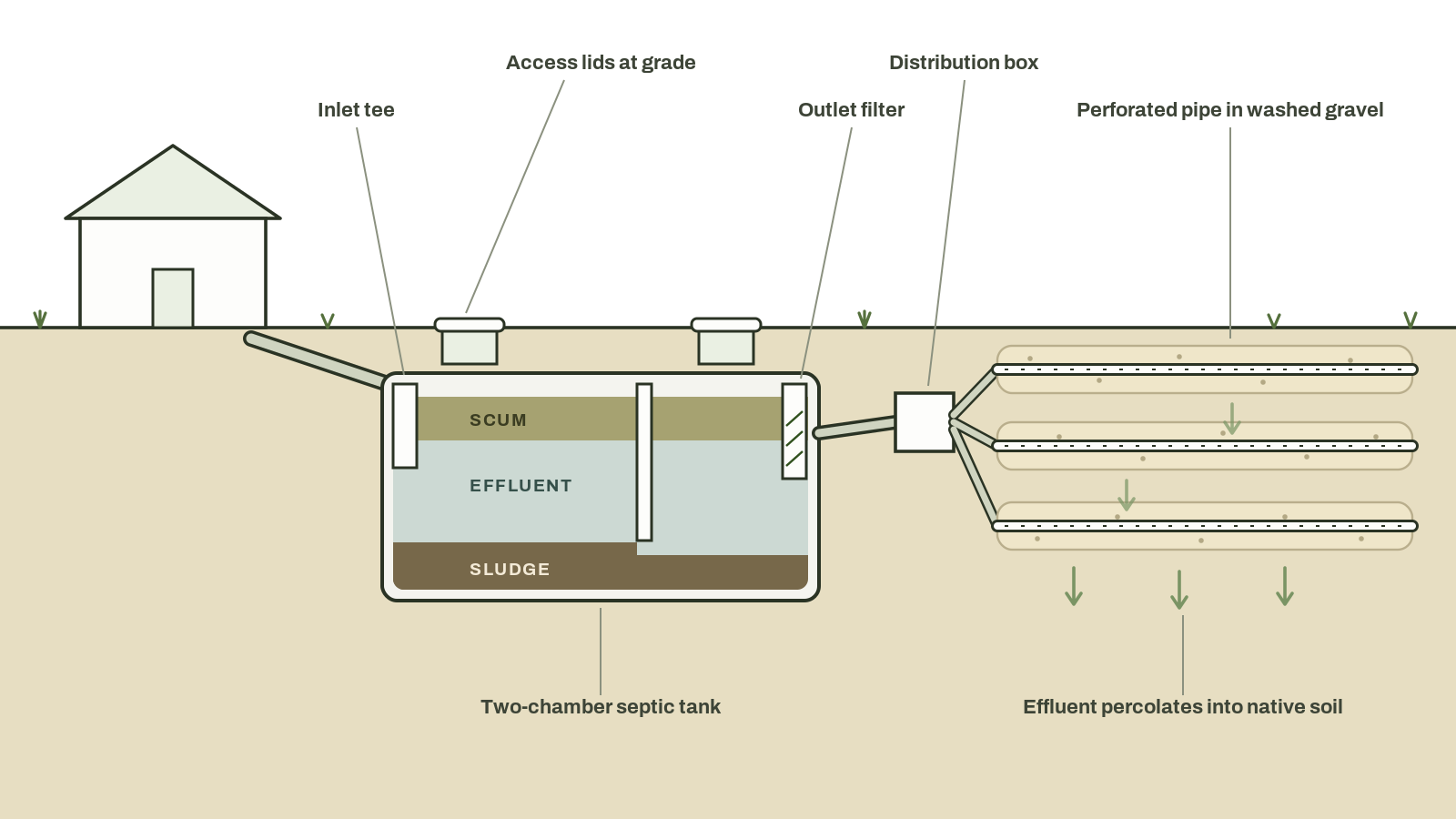
Most households should pump every three to five years, per the EPA. Skipping a $400 pump-out is how homeowners end up with four-figure repair bills. Solids that overfill the tank migrate to the drain field, and once the field clogs you stop buying maintenance and start buying repairs: Angi puts average septic repairs at $1,830. The EPA frames the same math, putting routine maintenance at $250 to $500 every three to five years against $5,000 to $15,000 to replace a conventional system.
Frequency by household, from Angi’s 2026 data:
| Tank size | Home size | Pump about every |
|---|---|---|
| 750 gal | 2 bedrooms | 5 years |
| 1,000 gal | 3 bedrooms | 3 years |
| 1,250 gal | 4 bedrooms | 3 years |
| 1,500 gal | 5 bedrooms | 2–3 years |
Those tank-size-to-bedroom pairings are Angi’s typical installations, not Texas minimums. Texas does not size a tank from a bedroom table at all; it takes two steps. 30 TAC §285.91(3) Table III sets a design flow of 450 gallons per day for a five-bedroom house under 4,500 square feet, and §285.91(2) Table II turns any flow from 351 to 500 gallons per day into a minimum liquid capacity of 1,250 gallons — not 1,500. Installers routinely fit above that floor, and a bigger house carries a bigger design flow, so the floor rises with square footage. The legal minimums by bedroom count, state by state, are in our septic tank size chart.
Garbage disposals, big households, and short-term rentals all push you toward the early end. Texas adds its own wrinkles: heavy clay soils and drought-stressed drain fields don’t forgive an overloaded tank. Full workup in our pumping frequency guide, and if you’re seeing slow drains or odors now, start with the signs your tank is full.
How to Vet the Quote: Check the License Before the Price
Every legitimate septic professional in Texas holds a TCEQ license or registration you can verify online in under two minutes, and checking it is the single best filter against fly-by-night pumpers. This is the step the lead-gen sites tell you to do without ever showing you how.
- Go to TCEQ’s licensing records search: www2.tceq.texas.gov/lic_dpa/index.cfm and choose the individual search.
- Search the name on the truck or the quote. Matching records show the license type, number, and expiration. TCEQ licenses run on three-year cycles, so a current expiration date means active continuing education.
- Read the license class. Installer I covers standard systems; Installer II covers everything including aerobic; Maintenance Provider is the aerobic-service credential. For a routine conventional pump-out, you’re mainly confirming the company is registered with TCEQ and in good standing; for aerobic work, insist on the Maintenance Provider license.
- Cross-check the company name against your county’s posted list of OSSF professionals. Many permitting offices publish one (Kerr County’s environmental health department does, for example).
A standard pump-out should include full evacuation of liquid and sludge, a look at baffles and inlets, disposal fees, and a written receipt noting tank condition. Get that receipt: it’s your maintenance record when you sell the house, and Texas buyers’ inspectors ask for it.
Red flags worth walking away from: door-to-door “your neighbor said you need pumping” pitches, quotes wildly under the ranges on this page (partial pump-outs that leave sludge behind are the classic bait), and any crew that can’t tell you where they legally dispose of septage.
What Should the Written Quote Include?
A trustworthy Texas pumping quote itemizes five things: the base pump-out for your tank size, disposal, any digging or access work, add-on services, and trip or after-hours fees. Anything quoted as one round number deserves a follow-up question. Itemization protects you on both ends: it stops surprise charges when the truck arrives, and it lets you compare quotes that would otherwise look identical.
Ask two questions before you book. First: “Does that price include pumping both compartments and the disposal fee?” Some low quotes cover evacuating liquid only: the sludge that stays behind is the part you’re paying to remove.
Second: “Where do you dispose?” A legitimate answer names a permitted treatment facility; hesitation is your cue to call the next company on the list. In rural counties, confirm the trip charge up front too. It’s a real cost of doing business out there, but it belongs on the quote, not on the invoice.
FAQs: Texas Septic Pumping Costs
How much does it cost to pump a 1,000-gallon septic tank in Texas?
Plan on $225–$650, and where you live moves it more than anything else you control. Angi’s 1,000-gallon rows read $225–$400 in Dallas, $250–$600 in Austin, and $275–$600 in Houston (all May 2026), while Hill Country provider pricing runs $350–$650 (Dillon Septic, August 2026). For a feel of “normal”: Dillon’s published example for a family-of-four tank pumped on schedule was $480. The high end of every range reflects difficult access or long-neglected tanks, not a better pump-out.
Is $500 too much for septic tank pumping?
For a 1,000-gallon tank with exposed lids and a 3–5 year service history, $500 sits at the high edge of normal (get a second quote); for a larger tank, buried lids, or years of buildup, it can be fair. Ask for the line items: base pump-out, digging, disposal, add-ons. A good pumper itemizes without being pushed.
How long does septic pumping take?
Most residential pump-outs take 45–90 minutes on site (Dillon Septic, 2026). Add time if the crew has to locate and dig lids, or if compacted sludge needs to be broken up and rinsed.
How can I pay less for pumping?
Install risers, keep a steady 3–5 year schedule, and get two or three quotes from TCEQ-verified providers every time. Risers kill the recurring digging fee, staying on schedule avoids neglect surcharges, and in metro counties quotes for the identical job can differ by $100 or more. Never stretch the interval to “save”: the repair math never works in your favor.
What does emergency septic pumping cost?
Expect a surcharge of roughly $100 to $300 on top of the scheduled rate. Texas Septic Solutions publishes $150 to $300 (July 2026) and Texas Septic Guide publishes $100 to $300, with an absolute emergency band of $350 to $700 against $250 to $400 scheduled (verified March 2026). Get the after-hours rate and trip fee quoted before dispatch, and use our emergency backup guide to limit damage in the meantime. If the “emergency” is recurring, the tank isn’t your problem. The system is.
How much does it cost to pump a septic tank, nationally?
Angi puts the national average at $428, with most homeowners paying $291 to $564 and a 1,000-gallon tank running $325 to $700 (updated July 9, 2026). Texas sits below that national average in Dallas and Houston and above it in Austin, which is why a single national number is a poor planning figure anywhere in this state.
Which Texas city is cheapest for septic pumping?
Of the three Texas metros with published cost data, Dallas is cheapest at a $314 average, ahead of Houston at $375 and Austin at $435 (Angi, May 2026). Angi publishes no Fort Worth or San Antonio pumping-cost page, so those markets have no comparable figure; the newest published San Antonio range we found is $375 to $750 from Van Delden Wastewater Systems, dated April 2025.
Ready to book? Find licensed septic pumpers by county. Every provider we list is checked against TCEQ’s license registry, and each county page names the companies that actually serve that county, including the rural counties the metro companies skip.
Sources & Methodology
Cost figures on this page come from published, dateable sources (not proprietary surveys), and each is named where it’s used. Where no trustworthy figure exists, we say so rather than print a guess. Page refreshed August 13, 2026, when every figure below was re-read on the live source. Three gaps closed in that refresh: Austin and Dallas now have published city-level series, and emergency surcharges have three independent Texas figures. Two gaps remain open and are marked as such on the page: no Texas septic pumper publishes a per-mile pump-out rate, and no municipal septage fee schedule confirming a 2026 disposal-fee increase could be found, so we do not repeat the industry claim that disposal fees drove this year’s prices.
- Angi, “How Much Does It Cost to Pump a Septic Tank? [2026 Data],” updated July 9, 2026 (national averages, size and frequency tables, repair costs)
- Angi, Houston, Austin, and Dallas septic pumping cost pages, all updated May 5, 2026 (metro averages, 1,000-gallon ranges, surcharge data)
- Dillon Septic (Spring Branch, TX), “How Much Does It Cost to Pump a Septic Tank?”, published November 23, 2025, modified August 7, 2026 (Central Texas provider pricing, job durations, case examples)
- HomeField Onsite, Travis County service rate card, updated August 2, 2026 (published Austin-area rates, aerobic premium, dig and service-call fees)
- Van Delden Wastewater Systems (San Antonio / Boerne, TX), “Septic Tank Cleaning Cost,” April 15, 2025 (San Antonio range)
- Texas Septic Solutions, “Septic Tank Pumping Cost in Texas: 2026 Homeowner Price Guide,” July 15, 2026, and Texas Septic Guide, “Septic Pumping Cost in Texas,” verified March 9, 2026 (emergency and rural surcharge bands only)
- US EPA, “How to Care for Your Septic System” (pumping frequency, inspection cadence, sludge-depth triggers) and “Why Maintain Your Septic System,” modified March 11, 2026 (maintenance and replacement cost anchors)
- TCEQ, OSSF annual permitting reports: 2024 authorizations-to-construct by system type (57% surface-irrigation figure), parsed July 30, 2026
- TCEQ, “Occupational Licenses: On-Site Sewage Facilities” and TCEQ licensing records search (license classes, verification steps): tceq.texas.gov/licensing/licenses/ossflic; www2.tceq.texas.gov/lic_dpa/index.cfm
Do this work for a living?
- Credential-matched claim
- You control your profile
- Quote-request alerts
Get free quotes from verified septic pros.
Pumping, an inspection, or help fixing a septic system: tell us once and we send it to up to 3 verified pros. Free, no spam, delete your request anytime.
Secure form. Sent over an encrypted connection to up to 3 verified pros. Never sold to data brokers, and you can have your request deleted anytime.