Septic Tank Size Chart by Bedrooms, Occupants and Flow
There is no national septic tank size chart. The same three-bedroom house is required to have a 900-gallon tank in Pennsylvania, 1,000 gallons in Texas and Washington, and 1,500 gallons in Ohio. Every figure in the chart below is a legal minimum from a named state rule, read from the rule itself, not an average of what installers happen to sell.
Before using any chart, find out which of two methods your state uses. Some publish a table you read straight off bedroom count. Others publish a design flow in gallons per day, then a formula that turns that flow into tank gallons. Texas is the second kind, which is why Texas answers differ from the numbers most size charts print.
Septic tank size chart: four states, four sets of rules
Minimum tank capacity for a single-family house, by bedroom count, from each state’s own rule.
| Bedrooms | Texas | Ohio | Pennsylvania | Washington |
|---|---|---|---|---|
| 1 | 750 gal | 1,000 gal | 900 gal | 1,000 gal |
| 2 | 750 gal | 1,000 gal | 900 gal | 1,000 gal |
| 3 | 1,000 gal | 1,500 gal | 900 gal | 1,000 gal |
| 4 | 1,250 gal | 2,000 gal | 1,250 gal | 1,000 gal |
| 5 | 1,250 gal | 2,000 gal | 1,400 gal | 1,250 gal |
| 6 | 1,312.5 gal | see note | 1,550 gal | 1,500 gal |
Minimum liquid capacity, single-family residence. Texas: 30 TAC 285.91(3) Table III and 285.91(2) Table II, rule effective July 6, 2023, without water-saving devices; each Texas row also carries a square-footage ceiling (see below). Ohio: OAC 3701-29-12(C)(1), effective January 1, 2015. Pennsylvania: 25 Pa. Code 73.31(a), worked from the rule’s own flow figures and capacity formula. Washington: WAC 246-272A-0232 Table VII.
Two cells need explaining. Ohio’s six-bedroom rule reads “two thousand five hundred gallons plus an additional two hundred fifty gallons of tank capacity for each bedroom.” Read literally that adds 250 gallons per bedroom in the house rather than per bedroom above six, and the rule does not say which, so the cell stays blank.
Pennsylvania’s figures above three bedrooms are arithmetic, not a printed table. The only figure the rule prints is the 900-gallon floor in 73.31(a)(1). Everything else comes from a flow (400 gpd for three bedrooms or fewer, plus 100 gpd per bedroom over three) run through a formula converting flow to capacity. Four bedrooms is 500 gpd, so (3.5 x 100) + 900 = 1,250 gallons. Five bedrooms is 600 gpd, in the 500 to 5,000 band, so (1.50 x 100) + 1,250 = 1,400 gallons.
Why one house needs four different tanks
States write tank sizing two different ways, and which way yours uses matters more than any single number.
Ohio and Washington publish the answer directly. Bedrooms in, gallons out. Washington’s Table VII is two rows long: four bedrooms or fewer is 1,000 gallons, each bedroom after that adds 250. Ohio’s is a four-item list in rule 3701-29-12(C)(1), and its figures are the highest of the four states in the chart at every bedroom count from three up.
Texas and Pennsylvania publish a design flow first, then convert it. That extra step is where the differences live, because a design flow can be adjusted by things a bedroom count cannot see: square footage, water-saving fixtures, metered use. So a chart copied from a national blog is right in some states and wrong in others. Washington and Ohio disagree by 500 gallons on a three-bedroom house, and both are correct in their own state.
How Texas actually sizes a septic tank
Texas sizes the tank in two steps, and neither step is a bedroom-to-gallons table.
Step one is Table III in 30 TAC 285.91(3), the Wastewater Usage Rate table. It gives a design flow, written Q, by bedroom count with a square-footage ceiling on every row: one or two bedrooms under 1,500 square feet is 225 gallons per day, three bedrooms under 2,500 square feet is 300, four bedrooms under 3,500 is 375, five bedrooms under 4,500 is 450, six bedrooms under 5,500 is 525. Above 5,500 square feet, each additional 1,500 square feet adds 75 gpd.
Step two is Table II in 285.91(2), headed “Septic Tank Minimum Liquid Capacity.” It is a five-line formula, not a chart:
| Design flow Q (gallons/day) | Minimum liquid capacity V |
|---|---|
| Q equal to or less than 250 | 750 gallons |
| Q from 251 to 350 | 1,000 gallons |
| Q from 351 to 500 | 1,250 gallons |
| Q from 501 to 1,000 | V = 2.5 x Q |
| Q of 1,001 or more | V = 1,750 + (0.75 x Q) |
Run a four-bedroom, 3,000-square-foot Texas house through both steps. Table III gives Q = 375 gpd, which lands in the 351 to 500 band, so the minimum liquid capacity is 1,250 gallons. A three-bedroom house of 2,000 square feet gives Q = 300, so 1,000 gallons.
Texas A&M AgriLife Extension published the finished ladder in L-5227 in September 2008: 750, 1,000, 1,250, 1,250 and 1,315 gallons for one-or-two through six bedrooms. Those figures match the current rule when you work it, which is a useful check on both. AgriLife’s 1,315 is a rounding of the formula’s own answer for six bedrooms, 2.5 x 525 = 1,312.5 gallons.
Square footage is the part homeowners miss. A three-bedroom house of 2,900 square feet does not fit Table III’s three-bedroom row, because that row is capped at 2,500 square feet. The rule’s companion aerobic table in the same figure makes the logic explicit, sizing “Less than four bedrooms and 2,500 < sq. ft. < 3,501” the same as a four-bedroom house. Bedrooms and floor area both push you up the table, whichever gets there first.
The water-saving column is the largest single swing in the Texas rule
Table III publishes two design flows for every house, one with water-saving devices and one without, and the gap is big enough to move a house down a whole tank size.
The second column runs 180, 240, 300, 360 and 420 gallons per day for one-or-two through six bedrooms. Feed those into the Table II formula and the minimums come out as 750, 750, 1,000, 1,250 and 1,250 gallons. A four-bedroom house drops from 1,250 gallons to 1,000, a three-bedroom house from 1,000 to 750.
Be careful with that, because three things are true at once. The rule publishes both columns. Table II says to use “the applicable wastewater usage rate (Q) in TABLE III,” which means the applicable column. And AgriLife’s homeowner table prints only the without-devices figures, the conservative reading and the one most Texas designers work from.
Chapter 285 also never defines “water saving devices.” The phrase appears in Table III and again in 285.33 for evapotranspirative systems, and nowhere in the 285.2 definitions. Which fixtures qualify is a question for your permitting authority, not one this page can answer. Design on the without-devices column unless the authority reviewing your plan says otherwise in writing.
Bedrooms, not occupants, and what that is really measuring
Every state rule in the chart sizes for bedrooms because occupants change and bedrooms do not.
The EPA’s Onsite Wastewater Treatment Systems Manual says it plainly: “Bedrooms, rather than current occupancy, are used for the basis of SWIS design because the number of occupants in the house can change.” The convention is two people per bedroom at 75 gallons per day each, which is where the widely used 150 gallons per bedroom comes from.
It is deliberately generous. EPA’s worked example puts a three-bedroom design flow at 450 gallons per day against an actual average of 125 to 195, “an implicit factor of safety of 2.3 to 3.6.” State design flows, the manual says, “typically are 2 to 5 times greater than the average daily flow actually generated in the home.”
A family of two in a four-bedroom house still gets a four-bedroom tank, and that is correct rather than wasteful. The tank is sized for the house you might sell to. Occupancy shows up instead in how often the tank needs emptying, a separate calculation from a separate table; our pumping schedule guide carries TCEQ’s interval table by tank size and household size.
Texas keeps one door open. The note above Table III states that if “actual water use records are greater than the usage rates in this table, the system shall be designed for the higher flow.” Metered use can raise a design flow. Nothing in the rule lets it lower one.
What “capacity” means on a size chart
Every figure in the chart above is liquid capacity, which is less than the tank you buy.
Texas defines the measurement in 30 TAC 285.32(b)(1)(A): “The liquid volume of a septic tank, measured from the bottom of the outlet, shall not be less than established in 285.91(2) of this title.” Everything above the outlet is freeboard and does not count. The same subsection requires a liquid depth of at least 30 inches. EPA’s manual notes 36 inches as the more commonly specified minimum, and that shallower depths disturb the sludge blanket and force more frequent pumping.
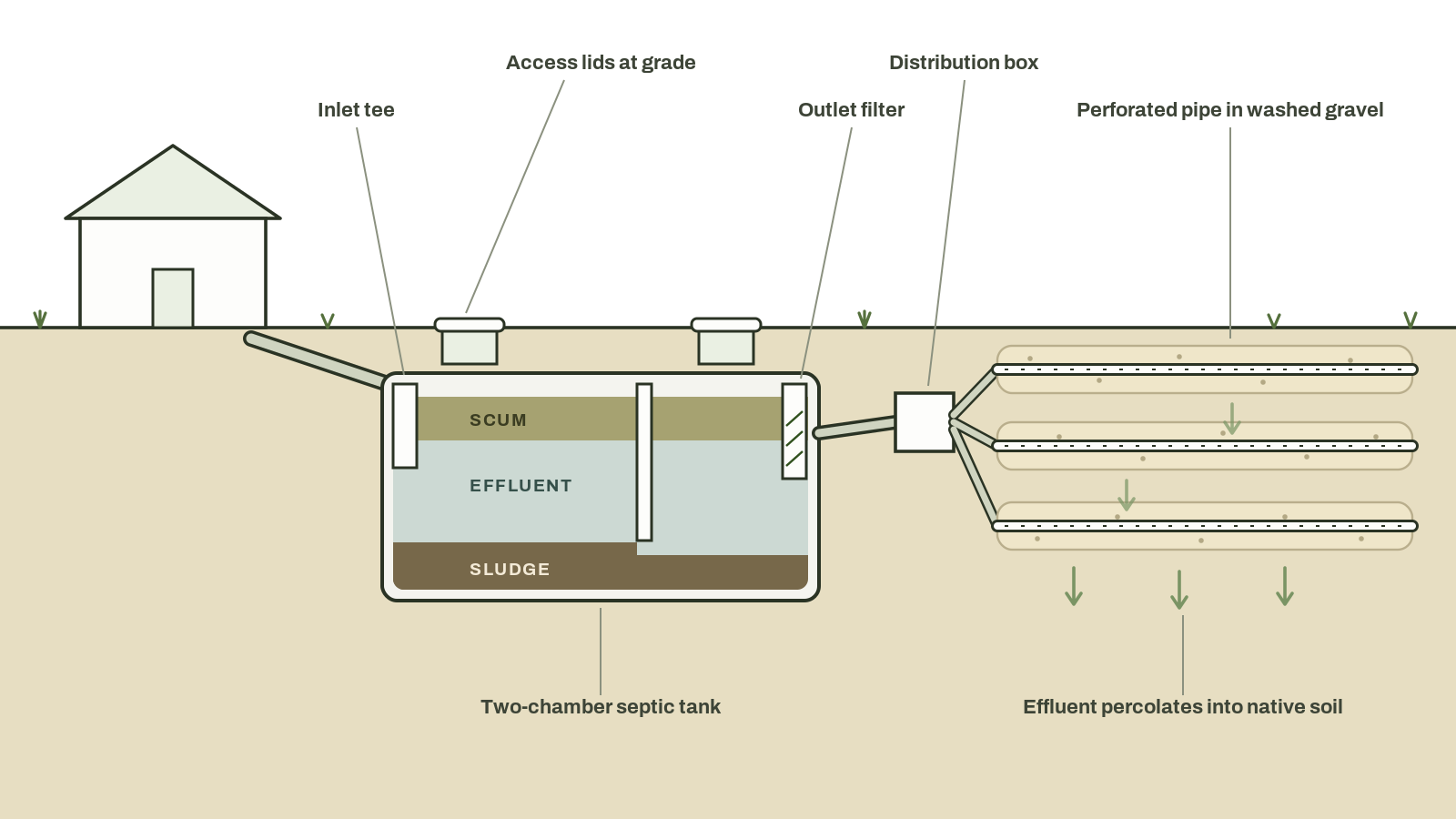
Compartments are the other thing one gallon figure hides. Ohio requires two tanks or compartments at three bedrooms and above. Washington requires two compartments with the first holding one-half to two-thirds of total liquid volume, which is also EPA’s finding on where the split performs best. A 1,500-gallon single-chamber tank and a 1,500-gallon two-chamber tank do not treat the same.
Where a size chart stops being the right tool
Two situations put you outside every chart on this page.
Aerobic systems are sized in a different unit. The second half of Texas Table II rates an aerobic treatment unit in gallons per day of treatment capacity, not gallons of tank: 360 gpd for three bedrooms under 2,501 square feet, 480 for four bedrooms under 3,501, 600 for five, 720 for six.
And soil sets the drain field, not the tank. The two are separate calculations sharing one input, the design flow. AgriLife’s instruction for the field is to “divide the wastewater flow by the hydraulic loading for the soil type in which the field will be built.” A house on Class IV clay and the identical house on sand get the same tank and very different fields.
Finding the size of the tank you already have
The permit file names the design size, and it is the only source that is specific to your property.
Guessing from the lid, the risers or the age of the house does not work. In most of Texas the permit is held by your county’s Authorized Agent; our Texas permitting authority directory lists who that is, and county pages like Kerr County carry the local office. Ask for the OSSF permit and the approved planning materials.
Sizing a system you have not built yet is what the sizing calculator is for. Working out whether an existing tank is undersized or simply overdue is a different job, and signs your septic tank is full starts it, because the two problems look identical from inside the house.
Frequently asked questions
What size septic tank do I need for a 4-bedroom house?
It depends on the state, and the spread is 1,000 to 2,000 gallons across the four rules here. Washington requires 1,000. Texas and Pennsylvania both land on 1,250 by different routes. Ohio requires 2,000. Texas drops to 1,000 if the design is worked off the water-saving column of Table III, which is a question for the permitting authority reviewing the plan.
Is a 1,000-gallon septic tank big enough for a family of five?
Occupant count does not enter the sizing rule, so the question is how many bedrooms the house has. A 1,000-gallon tank meets the Texas minimum for a three-bedroom house under 2,500 square feet no matter how many people sleep in it. Five occupants change the pumping interval, not the required tank.
How many gallons is a standard septic tank?
There is no standard, only a state minimum and whatever the installer put in. Ohio and Washington both floor at 1,000 gallons. Texas allows 750. Pennsylvania sets an absolute floor of 900 gallons for any installation.
Does square footage change the septic tank size?
In Texas, yes, and it can override bedroom count. Every row of Table III carries a floor-area ceiling, so a three-bedroom house of 2,900 square feet does not qualify for the three-bedroom flow. Ohio, Washington and Pennsylvania all size single-family dwellings on bedrooms alone.
Can a septic tank be too big?
None of the rules cited here caps residential tank size or states a penalty for oversizing. The constraints on going larger are cost, excavation depth and access.
Sources and methodology
Every capacity figure here was read from the rule that sets it. Texas comes from TCEQ’s own adopted text of Chapter 285 (Rule Project 2021-030-285-CE, effective July 6, 2023), cross-read against TCEQ publication RG-472 to confirm the column alignment of Table III and checked against AgriLife’s published Table 1 in L-5227. Ohio comes from OAC 3701-29-12(C)(1) on Ohio’s own code site, Washington from WAC 246-272A-0232 Table VII, Pennsylvania from 25 Pa. Code 73.31(a) and 73.17(a).
Two Pennsylvania cells and the whole Texas water-saving column are arithmetic we performed on the rules’ own formulas rather than figures any of these documents prints; the working is shown so it can be checked. Where a rule’s wording is genuinely ambiguous the page says so and leaves the cell empty, which happens once, at Ohio’s six-bedroom provision. No figure here is averaged from installer pricing or aggregated from other websites.
Cost is a separate question from size. For what a system costs to build once it is sized, see our state cost guides for Texas, Ohio and Pennsylvania. For the wider Texas rulebook, see Texas septic regulations.
Get free quotes from verified septic pros.
Pumping, an inspection, or help fixing a septic system: tell us once and we send it to up to 3 verified pros. Free, no spam, delete your request anytime.
Secure form. Sent over an encrypted connection to up to 3 verified pros. Never sold to data brokers, and you can have your request deleted anytime.