Types of Septic Systems: What Texas Actually Builds
The standard list of septic system types has a structural problem, and the EPA’s own version of it shows the problem clearly. That list gives “aerobic treatment unit” and “mound system” their own headings, side by side, as though they were alternatives to each other. They are not. One is a decision about how the wastewater gets treated. The other is a decision about where the treated water goes. A single property makes both decisions, and the answers are independent.
Texas rule is clear about this, because it puts the two decisions in two different sections of the code. 30 TAC §285.32 is “Criteria for Sewage Treatment Systems”. 30 TAC §285.33 is “Criteria for Effluent Disposal Systems”. Read them side by side and the subject reorganizes itself.
Then there is a second problem with the standard list, which is that it tells you nothing about which types get built. Texas publishes that. Its 2025 permit record is at the top of this page for that reason.
What Texas actually installed in 2025
Of 41,990 authorizations to construct issued by Texas’s authorized agents in 2025, surface irrigation accounted for 24,392 of them. One dispersal method took more than half the state.
This is TCEQ’s own table, from the report “Types of Systems Installed by Time Period”, dated 27 April 2026 and covering 1 January to 31 December 2025. The counts are TCEQ’s, printed on its grand total line. The share column is our arithmetic on those counts, not a TCEQ figure.
| System type, as TCEQ names the column | 2025 authorizations | Share (our arithmetic) |
|---|---|---|
| Surface irrigation | 24,392 | 58.1% |
| Leaching chamber | 5,894 | 14.0% |
| Drip irrigation | 3,767 | 9.0% |
| Standard trench/bed | 3,105 | 7.4% |
| Gravel-less | 2,352 | 5.6% |
| Low pressure dosing | 809 | 1.9% |
| EZFlow | 739 | 1.8% |
| Other | 470 | 1.1% |
| Pumped effluent | 178 | 0.4% |
| Evaporation beds | 148 | 0.4% |
| Absorptive mounds | 136 | 0.3% |
| PTI | 0 | 0% |
| Grant Total (TCEQ’s own spelling) | 41,990 | 100% |
Three things in that table are worth sitting with.
The mound system is a rounding error here. It appears on every national list of septic types, usually with a diagram. Texas authorized 136 of them in a year, against 41,990 systems. That is not an argument that mounds are bad. It is an argument that a list which gives mounds equal billing with surface irrigation is describing a different state than this one.
The gravel trench is no longer the default trench. Standard trench and bed came to 3,105. Leaching chambers came to 5,894 and gravel-less piping to 2,352, both of which Texas lists as proprietary disposal systems under §285.33(c). Add EZFlow’s 739 and those three columns total 8,985 against 3,105, which is our arithmetic on TCEQ’s own counts.
Evapotranspiration is nearly extinct in the permit record, at 148, and pumped effluent drainfields at 178. Both are standard, permitted, legitimate designs under Texas rule. Almost nobody builds them.
One caution about that table, recorded so nobody repeats the mistake: the report’s county rows wrap across lines in the PDF, so a row-by-row parse undercounts. Read the printed grand total. Our Texas septic data study works the same dataset at county level.
The two questions every septic system answers
How is the wastewater treated, and where does the treated water go? Those are separate choices, and Texas rule keeps them in separate sections.
Treatment (§285.32) happens in a tank or a tank-like unit before anything reaches the ground. The rule sorts it into three tiers.
- Standard treatment is §285.32(b): the septic tank, and the intermittent sand filter. The tank separates rather than treats, and the EPA is careful with the verb when it defines one: “A buried, watertight tank designated and constructed to receive and partially treat raw domestic sanitary wastewater.” Partially is the operative word, and it is why a disposal method has to follow.
- Proprietary treatment is §285.32(c): aerobic treatment units and similar products, approved as products rather than as designs. The rule’s route to approval runs through third-party testing: treatment systems “tested by and are currently listed by NSF International as Class I systems under NSF Standard 40 (2005) … shall be considered for approval by the executive director.” An aerobic unit adds oxygen so that aerobic bacteria break the waste down faster and further than a septic tank can.
- Non-standard treatment is §285.32(d): everything else, including activated sludge processes, rotating biological contactors and recirculating sand filters, each designed by a professional engineer or professional sanitarian. Table IX of §285.91 reserves one case for an engineer only: non-standard treatment where secondary treatment is required.
Disposal (§285.33) is what happens to the effluent afterwards, and the rule sorts it into the same three tiers.
- Standard disposal is §285.33(b): the absorptive drainfield, the evapotranspirative system, and the pumped effluent drainfield.
- Proprietary disposal is §285.33(c): gravel-less drainfield piping, leaching chambers and drip irrigation, plus a route for the executive director to approve others.
- Non-standard disposal is §285.33(d), all requiring planning materials from a professional engineer or professional sanitarian: low-pressure dosed drainfields, surface application systems, mound drainfields, soil substitution drainfields, and secondary treatment and disinfection drainfields.
Section 285.33(a) is the sentence that ties the two halves together: “All disposal systems in this section shall have an approved treatment system as specified in § 285.32(b) – (d).”
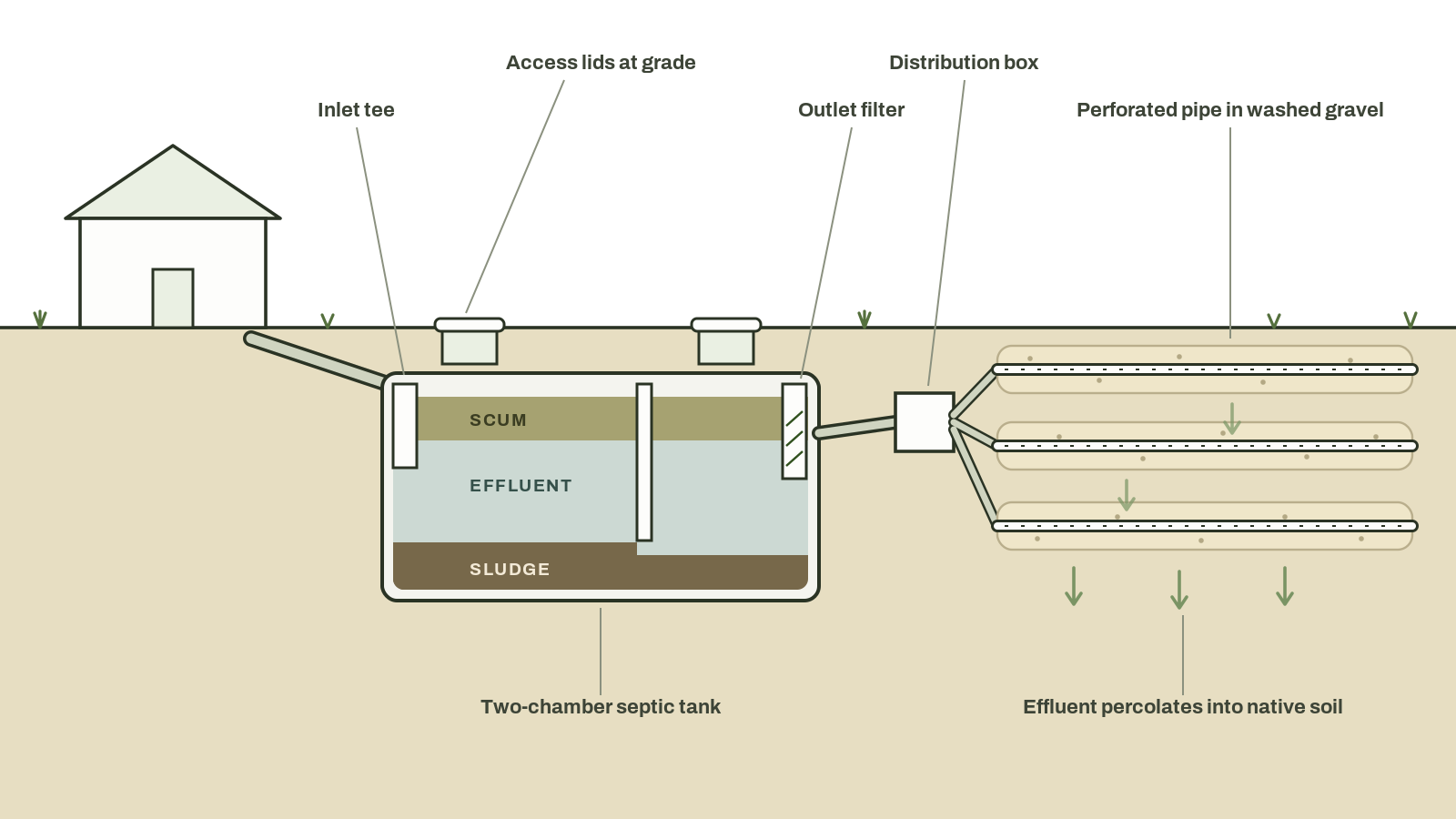
Now put the Texas permit record back on top of that structure. “Surface irrigation”, the column that took 58.1% of 2025, is a disposal method sitting in §285.33(d). It is what most people mean when they say “aerobic system”, but the aerobic unit is the treatment half and the spray heads are the disposal half. They are bought together and they are two decisions.
What decides which system you get
The soil does, and the rule says so in one sentence.
30 TAC §285.31(a): “The type and size of an OSSF shall be determined on the basis of the soil and site information developed according to § 285.30.” Not your preference. Not your budget. The site evaluation.
§285.31(b) then sets the sequence. Where all the soil and site criteria come back suitable, a standard subsurface absorption system may be used. Where any single criterion comes back unsuitable, that option closes and the site moves to a proprietary or a non-standard system, provided the criteria for that system can be met.
Three findings from the site evaluation close the standard option, and any one of them is enough on its own.
Soil texture that is too coarse or too fine. §285.30(b)(1)(A) sorts Texas soils into five classes, and the two extremes both fail: the gravelly sands move water through faster than the soil can treat it, and the heavy clays barely move it at all.
Rock or dense clay too close to the surface. §285.30(b)(1)(C) calls these restrictive horizons. Limestone close to grade is the Hill Country version of this finding.
Groundwater too high. §285.30(b)(2) puts the evaluator’s test at 24 inches below the excavation.
That is the mechanism behind the 2025 numbers. It is not that Texans prefer spray systems. It is that clay and shallow rock disqualify trenches across large parts of the state, and surface application with an aerobic unit is the engineered answer that remains. Why those soil findings matter, and what the two feet of clearance under a trench is actually for, is the subject of our guide to what a drain field is.
Sizing is a separate question again, and Texas answers it in the tables at §285.91: loading rates by soil class, criteria for standard absorption systems, system designations, and a selection matrix. All four are published as graphics rather than as rule text, and no figure from any of them appears on this page.
The systems on every national list, and where they actually stand in Texas
The EPA publishes a list of ten types, and it is honest that the list is a starting point rather than a taxonomy: “The list is not all-inclusive; there are many other types of septic systems.” Here is each of them against the Texas record.
Conventional system. EPA defines it as a septic tank plus a subsurface infiltration trench or bed. In Texas that is standard treatment under §285.32(b) plus an absorptive drainfield under §285.33(b)(1). 3,105 authorizations in 2025.
Chamber system. EPA: “Consists of a series of connected chambers. The area around and above the chambers is filled with soil.” Texas treats leaching chambers as proprietary disposal under §285.33(c). 5,894 authorizations, making it the most-installed subsurface method in the state and nearly double conventional trench and bed.
Aerobic treatment unit. EPA: “Use many of the same processes as a municipal sewage plant, but on a smaller scale.” In Texas this is proprietary treatment under §285.32(c). It does not appear as a column in TCEQ’s table at all, because the table counts disposal methods. That absence is the clearest evidence for the two-axis point: the most consequential treatment decision in Texas is invisible in the state’s own type counts. What you see instead is its usual disposal partner, surface irrigation. Aerobic units also carry an ongoing maintenance duty that a plain septic tank does not, set out in our aerobic maintenance contract guide.
Drip distribution. EPA calls it “a type of effluent dispersal that can be used in many types of drainfields” and notes it needs a large dose tank. Texas lists drip irrigation as proprietary disposal under §285.33(c). 3,767 authorizations, third place.
Mound system. EPA: “An option in areas of shallow soil depth, high groundwater, or shallow bedrock.” Texas puts mound drainfields in the non-standard tier at §285.33(d), designed by a professional engineer or professional sanitarian. 136 authorizations in 2025, 0.3% of the state’s work. Texas has plenty of shallow soil and shallow bedrock; it answers that problem with aerobic treatment and surface application instead.
Recirculating sand filter. EPA describes effluent pumped from the septic tank to a sand filter. Texas puts recirculating sand filters in non-standard treatment, §285.32(d), which again is not a column in the disposal table. The intermittent sand filter, its simpler relative, is standard treatment under §285.32(b).
Evapotranspiration system. EPA: these “have unique drainfields” in which “the effluent never filters to the soil and never reaches groundwater.” Texas has this as standard disposal, §285.33(b)(2). 148 authorizations. Legal, standard, and rarely built.
Constructed wetland. EPA: “Mimics the treatment processes that occur in natural wetlands.” No column in TCEQ’s table. In Texas this would be a non-standard design.
Cluster or community system. EPA: “Under some form of common ownership and collects wastewater from two or more dwellings or buildings.” Above 5,000 gallons a day, Texas moves systems out of Chapter 285 altogether; our Texas septic regulations guide sets out where that line sits.
Cesspools and straight pipes. EPA calls a cesspool an “outdated and ineffective method of wastewater disposal with no treatment” and says straight pipes are “prohibited due to the severe health and environmental risks.” Texas prohibits cesspools by rule, and the provision is set out on our regulations guide.
Two Texas columns have no EPA heading at all. EZFlow, at 739, is a product name that TCEQ tracks as its own column. Gravel-less piping, at 2,352, is a separate column again. Between them they are almost as much of the state’s work as conventional trenches, and neither appears on the national list most people read.
Which one is right for a given property
Nobody can answer that from a web page, including this one, because the answer is produced by a site evaluation and not by a preference.
What you can do before the evaluator arrives is understand what the result will mean. If the soil comes back in the workable middle of the class range, with the required two feet of suitable soil under the trench bottom and no groundwater in the way, a conventional trench is on the table. If it comes back heavy clay, or rock inside that two feet, the standard option is gone and the conversation moves to aerobic treatment with spray or drip, which brings an ongoing maintenance obligation the conventional system does not have.
Costs sit on their own pages, with their own dated sources: new septic system costs in Texas and aerobic system costs. County-level permit practice sits on the Texas county pages.
Frequently asked questions
What is the most common type of septic system in Texas?
By dispersal method, surface irrigation, at 24,392 of the 41,990 authorizations to construct that Texas’s authorized agents issued in 2025 (TCEQ, report dated 27 April 2026). That peer set matters: it is Texas, it is one year, and it counts authorizations rather than systems in the ground.
Is an aerobic system a type of septic system, or something else?
It is a type of treatment. An aerobic treatment unit replaces or follows the septic tank and is approved as a proprietary treatment system under 30 TAC §285.32(c). It still needs a disposal method, which is usually surface application or drip.
Why do so many Texas homes have spray heads in the yard?
Because the soil closed the other options. Under §285.31(b), a standard subsurface absorption system may be used only where every soil and site criterion is suitable; heavy clay and shallow rock both fail those criteria, and surface application with aerobic treatment is the engineered answer that remains.
Are mound systems used in Texas?
Rarely. TCEQ counted 136 absorptive mound authorizations in 2025 out of 41,990. Texas classifies mound drainfields as non-standard disposal under §285.33(d), which means a professional engineer or professional sanitarian designs each one.
How many US households are on a septic system?
The EPA states that “More than one in five households in the U.S. depend on individual septic (decentralized) systems or small community cluster systems.” EPA attaches no year or dataset to that figure on the page where it appears, so we quote it as EPA states it and do not convert it into a household count.
Can I choose the type of system I want?
Not really. 30 TAC §285.31(a) is explicit: “The type and size of an OSSF shall be determined on the basis of the soil and site information developed according to § 285.30.” Where the site allows more than one option, you choose between those. Where it allows one, that is the one.
Sources and methodology
The install counts are TCEQ’s own, taken from the report “Types of Systems Installed by Time Period” dated 27 April 2026, covering calendar 2025 and counting systems authorized by authorized agents. We downloaded the PDF and read the printed grand total line rather than parsing county rows, because the county rows wrap and a parse undercounts. Every share in the table is our arithmetic on TCEQ’s counts and is labeled as such; TCEQ publishes counts, not shares.
The rule structure comes from the current text of 30 TAC §§285.30, 285.31, 285.32 and 285.33, each read with its Source Note. Who may design a non-standard system was re-read on 7 October 2026 in §285.32(d), §285.33(d) and Table IX of §285.91, in TCEQ’s adopted rule text. The national list and the descriptions attributed to the EPA come from EPA’s Types of Septic Systems page, last updated 4 May 2026, and its About Septic Systems page, last updated 7 July 2026.
We publish no cost figure, no sizing figure and no loading rate on this page. The Texas tables holding the loading rates and selection criteria are published as graphics in the codified rule; we read them as text in TCEQ’s adopted rule document and print no figure from them here. Texas pricing lives on our cost pages, which carry their own dated sources.
Get free quotes from verified septic companies.
Pumping, an inspection, or help fixing a septic system: tell us once and we send it to up to 3 verified septic companies. Free, no spam, delete your request anytime.
Secure form. Sent over an encrypted connection to up to 3 verified septic companies. Never sold to data brokers, and you can have your request deleted anytime.